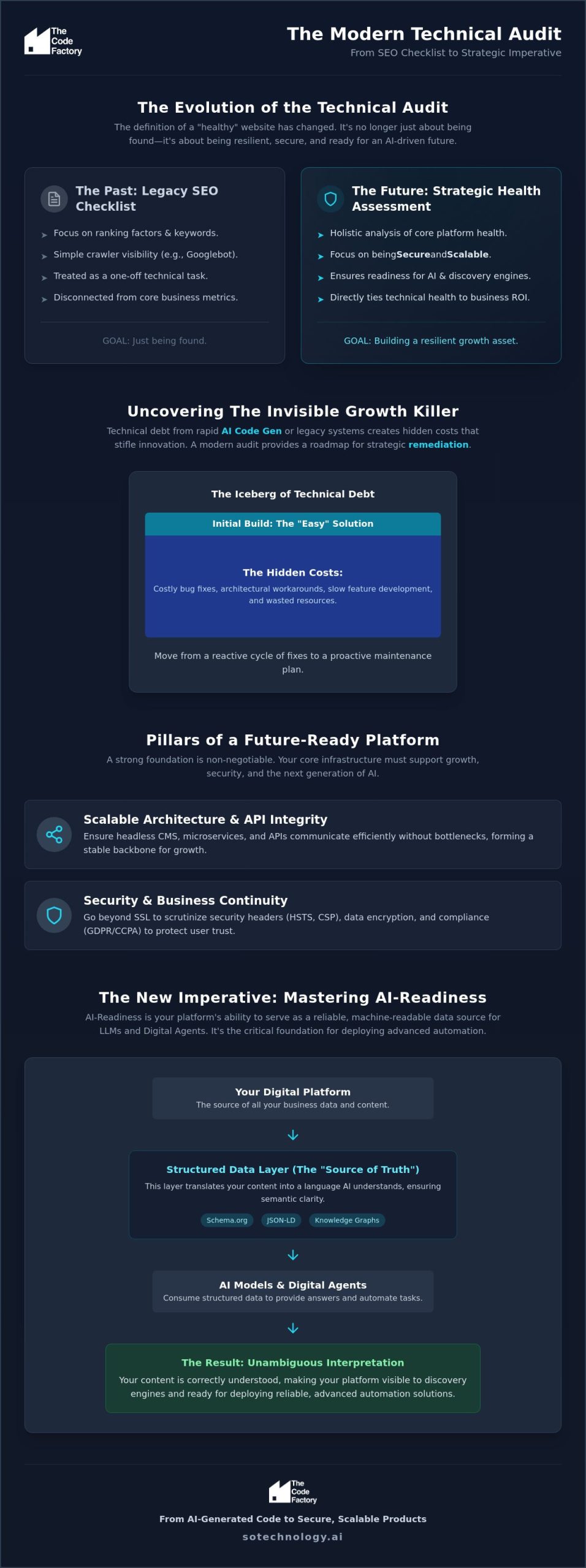
A technical website audit was once a straightforward SEO exercise—a checklist to ensure search engine crawlers could find and index your pages. Today, that approach is dangerously outdated. In an era of complex digital ecosystems, AI-driven discovery, and sophisticated security threats, a technical audit must evolve from a simple ranking tool into a strategic assessment of your platform’s core health. It’s no longer just about being found; it’s about being resilient, secure, and ready for the future.
For organizations leveraging modern tech stacks or even AI-generated code to accelerate development, this shift is critical. An initial build can deliver speed, but long-term success depends on a foundation that is both secure and scalable. This checklist moves beyond legacy SEO to provide a framework for ensuring your digital infrastructure is not just functional, but a high-performance asset ready to support your growth, adapt to new technologies, and deliver measurable business impact.
The Modern Technical Audit: From SEO Compliance to Strategic Advantage
The 2026 technical audit is a holistic health check for your entire digital presence. It recognizes that your website is no longer a standalone brochure but a complex, integrated system of services, APIs, and user experiences. While traditional SEO checklists focus narrowly on ranking factors, a strategic audit answers a more important question: “Is our digital platform a growth enabler or a source of hidden risk?” By bridging the gap between code health and business ROI, this approach transforms the audit from a technical chore into a vital strategic planning tool, ensuring the stability required to deploy next-generation tools like Digital Agents.
The Shift from Search Engines to Discovery Engines
The way information is found online is fundamentally changing. LLMs and AI agents “consume” your website differently than traditional crawlers like Googlebot, seeking structured, semantically clear data to provide instant answers. Any technical friction—slow APIs, confusing content hierarchies, or ambiguous data—creates a barrier that can render your content invisible to these new discovery engines. In this new landscape, technical resilience is no longer a luxury; it’s a primary competitive advantage, ensuring your platform can communicate clearly with both human users and their AI-powered assistants.
Technical Debt: The Invisible Growth Killer
Technical debt is the implied cost of rework caused by choosing an easy, limited solution now instead of using a better approach that would take longer. In the context of legacy systems or rapidly-built prototypes, it manifests as “interest payments”—the extra time and resources your team spends patching old code, fixing unexpected bugs, and working around architectural limitations. A strategic audit identifies these hotspots, allowing you to move from a reactive cycle of costly fixes to a proactive maintenance plan that protects your capacity for innovation and supports future development.
Core Infrastructure: Architecture, Security, and Performance
Your website’s core infrastructure is its foundation. If the server-side health, security protocols, or cloud architecture are unstable, any investment in content or features will be undermined. This part of the audit evaluates the non-negotiable pillars of a modern digital platform, ensuring it is prepared for global traffic, secure from emerging threats, and performant enough to meet user expectations. A strong “Support & Maintenance” strategy is essential here, preventing the natural decay of architectural integrity over time.
Scalable Architecture and API Integrity
Modern digital experiences are often built on decoupled architectures, like a headless CMS, where microservices and APIs handle specific functions. An audit must verify that these components communicate efficiently without creating performance bottlenecks. This includes checking endpoint security, data transfer protocols, and the overall health of your API ecosystem. In short, API integrity is the backbone of modern enterprise web stability, ensuring all parts of your digital platform work together reliably as you scale.
Security Protocols and Business Continuity
A secure website is a prerequisite for user trust and business continuity. The audit should go beyond a basic SSL check to scrutinize security headers (like HSTS and CSP), data encryption standards, and user access controls. With regulations like GDPR and CCPA becoming stricter, technical health is now inextricably linked to legal compliance. Integrating professional code reviews into your security audit cycle provides a deeper level of assurance, identifying vulnerabilities that automated scanners might miss and safeguarding your platform against data breaches.
Assessing AI-Readiness: Is Your Site Optimized for Digital Agents?
“AI-Readiness” is the most critical new category in a modern technical audit. It measures how effectively your website can serve as a reliable, machine-readable data source for AI models, whether they are third-party discovery engines or your own proprietary Digital Agents. This involves a deep look at your structured data, content architecture, and the permissions you grant to AI crawlers. A platform that is truly AI-ready is structured not just for human eyes, but for machine interpretation, creating a direct pathway to deploying advanced automation. This is a foundational step in enabling solutions like a Digital Agent as a Service (DAaaS), which can transform how you handle everything from customer service to internal workflows. To learn more, explore these practical use cases for business process automation with AI.
Structured Data and Semantic Clarity
Structured data, primarily through Schema.org and JSON-LD, acts as a “source of truth” for AI models. A comprehensive audit must validate that your structured data goes beyond basic rich snippets to accurately describe your core business entities—products, services, locations, and articles. This ensures your content hierarchy is unambiguously interpretable by non-human agents. For enterprise-level organizations, a well-maintained Knowledge Graph can further enhance this clarity, creating a powerful, interconnected data asset that AI can leverage for complex queries.
AI Crawler Management and Ethics
As AI companies scrape the web for training data, it’s crucial to audit which models are accessing your site and how. Your robots.txt file and server-side controls are no longer just for SEO bots; they are strategic tools for managing AI access. The goal is to strike a balance between being “open” enough for discovery in legitimate AI-powered search and protecting your proprietary intellectual property from unauthorized data harvesting. A strategic AI-permissions audit is essential for controlling how your digital assets are used in the emerging AI ecosystem.
The Master Technical Website Audit Checklist (Execution Framework)
A successful audit delivers a clear, actionable framework, not just a list of problems. We categorize findings into two groups: Critical (Fix Now) issues that pose an immediate risk to performance or security, and Strategic (Roadmap Items) that represent opportunities for long-term improvement. This prioritized approach ensures development resources are focused on what matters most.
- Step 1: Deep Crawl & Indexation Logic (The Baseline)
- Step 2: Performance & Asset Optimization (The Speed Layer)
- Step 3: Security & Compliance Verification (The Trust Layer)
- Step 4: AI & Machine-Readiness Audit (The Future Layer)
The Baseline: Crawling and Indexing Logic
This initial step ensures your site can be efficiently and accurately understood by all crawlers, both traditional and AI-driven. Key checklist items include:
- Verifying XML sitemap accuracy and health, especially for complex, multi-language URL structures.
- Identifying and eliminating “crawl budget” waste caused by faceted navigation, infinite scroll, or incorrect parameter handling.
- Auditing redirect chains and 404 errors to ensure link equity is preserved and user experience is seamless.
- Checking for orphaned pages that receive no internal links and are therefore invisible to crawlers.
- Confirming canonical tags are implemented correctly to prevent duplicate content issues.
The Future Layer: AI and Data Accessibility
This final layer prepares your platform for the next generation of the web, focusing on how machines will interpret and interact with your digital assets. Key checklist items include:
- Validating JSON-LD implementation across all core business entities (e.g., Organization, Product, Service, Article).
- Ensuring API documentation is clear, accessible, and provides reliable endpoints for external integrations.
- Verifying that media assets like images and videos contain accurate metadata and alt-text that are useful for AI vision models.
- Reviewing your robots.txt and other crawler directives to ensure you are explicitly allowing or disallowing access for specific AI agents.
From Audit to Action: Implementing a Strategic Remediation Roadmap
An audit’s value is realized only through implementation. The final and most important phase is translating technical findings into a strategic roadmap with a clear business case for stakeholders. This process moves beyond a simple bug-fix list to become a core part of your digital strategy. A one-off audit will inevitably fail if it isn’t supported by an ongoing “Support & Maintenance” plan that protects your investment and maintains platform health over time.
Prioritizing for Impact and ROI
Not all technical issues are created equal. Using a “Complexity vs. Impact” matrix helps prioritize remediation efforts effectively. This framework allows you to map each finding based on the development effort required versus the potential business value (e.g., improved conversion, reduced security risk, faster page speed). This data-driven approach helps secure buy-in from leadership by clearly distinguishing between quick wins (“low-hanging fruit”) and more substantial, long-term architectural improvements that require strategic investment.
Continuous Optimization and Managed Services
The goal is to shift from a reactive “audit and fix” cycle to a state of “continuous technical health.” This is achieved through a partnership that provides ongoing monitoring and strategic guidance. At SoTechnology, we often manage this through a flexible, credit-based system, allowing you to scale support up or down based on your needs—from addressing minor issues to planning major platform enhancements. By leveraging AI-enabled monitoring tools and expert oversight, we help ensure the standards established in the audit are maintained, keeping your platform secure, performant, and ready for what’s next.
Ready to align your technical health with your strategic growth? An AI Discovery Workshop can provide the clarity needed to transform your digital platform from a technical liability into a future-ready asset.