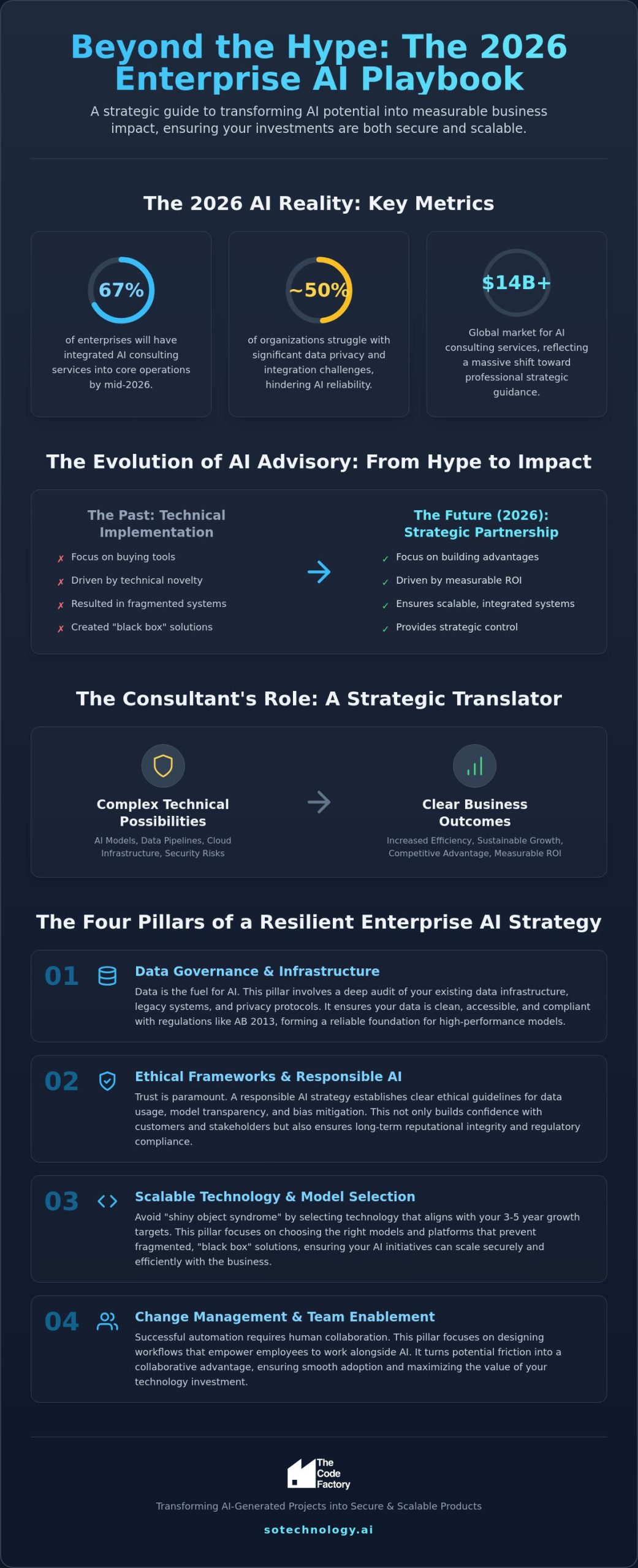
By mid-2026, 67% of enterprises have integrated ai consulting services into their core operations, yet nearly half of these organizations still struggle with data privacy and integration. It’s common to feel a sense of hesitation when the promise of automation is clouded by technical jargon and uncertain costs. You want to lead with innovation, but the fear of accumulating technical debt or investing in “black box” solutions is a valid concern for any pragmatic leader.
This guide is designed to strip away that uncertainty and provide a clear path forward. We’ll show you how to move beyond the surface-level hype to deliver measurable business impact through a structured approach to enterprise automation. You’ll gain a solid framework for identifying high-impact use cases and the confidence to choose a partner who translates complex technology into strategic growth. From defining your initial strategy to understanding the latest regulatory shifts, we’re covering the essentials for a successful, sustainable transformation.
Key Takeaways
- Understand why modern ai consulting services focus on strategic partnership rather than just implementation to align technology with your specific business goals.
- Identify the four essential pillars required to build a resilient AI strategy that avoids the common pitfalls of fragmented, “black box” solutions.
- Gain a methodology for prioritizing high-impact use cases, ensuring your automation efforts deliver measurable ROI instead of just technical novelty.
- Learn how to navigate the 2026 landscape of providers by applying a rigorous framework to select a partner with deep strategic and technical expertise.
- See how a “Strategic Translator” approach simplifies technical complexity into actionable steps that drive efficiency and sustainable growth.
What are AI Consulting Services in 2026? Beyond the Hype
In 2026, Artificial intelligence has moved past the era of experimental pilots and entered a phase of industrial-scale application. While many associate the field with writing code or building models, true ai consulting services represent a strategic partnership designed to align technical capabilities with specific business goals. It’s the difference between buying a tool and building a competitive advantage. The global market for these services is estimated at $14.08 billion this year, reflecting a massive shift toward professional guidance as organizations realize that technology alone isn’t a silver bullet.
Consulting is fundamentally distinct from implementation. While implementation focuses on the “how” of coding and deployment, AI strategy addresses the “why” of investment. It’s about ensuring that every dollar spent on automation contributes directly to the bottom line. In this environment, the consultant acts as a “Strategic Translator” for the C-suite. They convert complex technical possibilities into clear, actionable business outcomes, stripping away the stress of technical uncertainty so leaders can maintain strategic control.
The Evolution of AI Advisory: From Hype to Impact
We’ve reached the year of “Pragmatic AI.” In 2026, ROI has become the primary metric for success, replacing the novelty of basic generative tools. Organizations have transitioned from simple chatbots to complex, multi-modal digital agents that handle intricate workflows across departments. This shift requires a steady hand. Professional advisory prevents “shiny object syndrome,” ensuring that technology procurement is driven by necessity rather than trends. By focusing on long-term value, consultants help leaders avoid the trap of fragmented solutions that don’t scale or communicate with one another.
Core Deliverables of a Modern AI Consultancy
An effective engagement produces more than just advice; it yields a blueprint for transformation. Modern ai consulting services provide a suite of deliverables that ground technical ambition in operational reality. These outputs move the needle by focusing on growth and long-term impact rather than short-term fixes.
- Strategic Roadmaps: These plans align AI initiatives with 3-5 year growth targets. They ensure technology evolves alongside the business rather than becoming an isolated silo.
- Technical Audits: A deep dive into existing data infrastructure and legacy systems identifies bottlenecks before they become expensive failures. This step is crucial for avoiding technical debt.
- Change Management: Successful automation requires team enablement. Consultants design workflows that empower employees to work alongside AI, turning potential friction into a collaborative advantage.
This structured approach turns technical uncertainty into a controlled, strategic asset. It allows businesses to move at a deliberate pace, ensuring no strategic detail is overlooked while maintaining a focus on tangible results.
The Four Pillars of an Effective Enterprise AI Strategy
Success in automation doesn’t start with choosing a Large Language Model; it begins with a robust structural foundation. While it’s tempting to jump straight into tool selection, doing so often results in fragmented systems that fail to scale. Strategic ai consulting services prioritize a blueprint that precedes any code, ensuring that technical investments translate into tangible business value. This approach mirrors frameworks like a strategic guide to enterprise AI, which emphasizes that organizational readiness is the true engine of transformation.
Data Governance and Infrastructure Health
Data is the fuel for any intelligent system, yet around 48% of organizations face significant challenges with data privacy and integration. You can’t build a reliable output on a foundation of silos and inconsistent quality. Modern strategy involves assessing how your data is stored and accessed, particularly when implementing Retrieval-Augmented Generation (RAG) to manage corporate knowledge. By 2026, compliance isn’t optional; laws like California’s AI Training Data Transparency Act (AB 2013) mandate clear summaries of training datasets. A thorough audit ensures your infrastructure is both compliant and capable of supporting high-performance models.
Ethical Frameworks and Responsible AI
Trust is the currency of the digital age. Establishing “guardrails” for AI decision-making isn’t just about ethics; it’s about risk management. Your strategy must include clear protocols for transparency to maintain stakeholder confidence. With the introduction of the Great American AI Act in June 2026, the national framework for governance is becoming more defined. When you prioritize responsible AI, you protect your brand from the reputational damage of “black box” errors. If you’re unsure where your current systems stand, a professional Discovery & Strategy session can help identify potential vulnerabilities before they impact your customers.
Scalability and Long-Term Maintenance
Many projects fail because they’re built as isolated experiments rather than integrated assets. As your organization grows, your AI must grow with it without incurring exponential costs. We’ve seen a shift from one-off project builds to recurring management models that prioritize continuous improvement. The most effective ai consulting services look beyond the initial launch to ensure long-term viability. Scalability in AI is the ability of a system to handle increasing workloads and complexity through a modular architecture that allows for independent updates to data, models, and interfaces. A well-structured AI strategy for growth ensures that what begins as a prototype evolves into a secure, production-ready enterprise solution rather than accumulating technical debt.
Identifying High-ROI Use Cases: A Pragmatic Framework
Identifying where to start with automation is often the most significant hurdle for enterprise leaders. While the market is flooded with “cool” applications, the most successful ai consulting services focus exclusively on what’s “profitable.” This is particularly true for mid-market and scaling firms that can’t afford the multi-year, multi-billion dollar “transformations” favored by global giants. We utilize an “Impact vs. Feasibility” matrix to cut through the noise. This framework acknowledges the complex reality of your current operations while providing a streamlined resolution for prioritization. By plotting potential use cases based on their expected business value against the technical effort required, we ensure your resources are directed toward projects that deliver a clear return on investment. This methodical approach strips away the stress of technical uncertainty, replacing it with a sense of calm, strategic control.
Customer Support and Experience Transformation
Customer experience has evolved significantly. We’re no longer talking about basic chat interfaces. In 2026, the focus is on autonomous digital agents that don’t just answer questions; they execute complex tasks like processing returns or handling procurement requests. This level of personalization at scale is powered by predictive sentiment analysis, allowing your team to proactively address customer needs and reduce churn before it happens. It’s about moving from reactive support to proactive partnership.
Operational Efficiency and Internal Productivity
The Discovery Workshop: Uncovering Your AI Roadmap
The most effective way to build this roadmap is through an AI Discovery Workshop. These aren’t just brainstorming meetings; they’re structured sessions where stakeholders collaborate to define success metrics and KPIs. We examine your existing workflows to uncover hidden inefficiencies ripe for automation. The result is a prioritized implementation backlog, providing you with a clear, staged path forward. This transition ensures that your AI journey is methodical and purposeful, respecting both your time and your budget while ensuring no strategic detail is overlooked.
How to Choose the Right AI Partner: A 2026 Selection Framework
Selecting the right ai consulting services is a high-stakes decision that dictates your technical health for years to come. In a market flooded with “AI-washing”-where traditional agencies have rebranded overnight without building deep technical expertise-you need a rigorous framework to separate the visionaries from the wrappers. A true partner doesn’t just hand over a tool; they act as a “Strategic Translator” who understands your business model as deeply as they understand the code. This ensures that your automation efforts are grounded in practical application rather than technical novelty.
Step 1: Evaluate Technical Depth vs. Strategic Breadth
You must determine if a consultancy understands the underlying architecture of a system or if they’re simply connecting to an existing API. While APIs are useful, enterprise-grade solutions often require custom integrations and a deep knowledge of how data flows through your infrastructure. Ask for evidence of projects they’ve successfully moved from a Proof of Concept (PoC) into a full-scale production environment. A reliable firm should be capable of performing rigorous Code Reviews and technical audits to ensure your systems are resilient, secure, and ready for the demands of 2026.
Step 2: Assess Cultural Alignment and Communication
Communication is the ultimate test of a strategic partner. Do they speak in terms of business outcomes, or do they hide behind dense jargon? You’re looking for a collaborative relationship where the consultant builds *with* you, empowering your internal team rather than creating a permanent dependency. If your organization operates across multiple regions, verify their ability to navigate the patchwork of state-level regulations, such as California’s SB 53 or the Texas Responsible AI Governance Act. A partner with a global perspective ensures your systems remain compliant regardless of where you deploy them.
Step 3: Review the Post-Deployment Support Model
AI is never a “set and forget” investment. Models can drift, and data environments are constantly shifting. You need to know how a partner handles ongoing maintenance and updates after the initial launch. This is where the value of Digital Agent as a Service (DAaaS) becomes clear. By opting for a subscription-based management model, you ensure your AI agents receive continuous optimization. This proactive approach secures your long-term ROI and prevents the accumulation of technical debt. If you’re ready to move beyond the hype and find a partner committed to your long-term success, explore our Discovery & Strategy services to start your journey with clarity.
Scaling with Precision: The SoTechnology Approach to AI
Scaling automation isn’t about adding more code; it’s about increasing the precision of your digital ecosystem. At SoTechnology, we act as a global partner for AI-enabled digital transformation, helping organizations move beyond the initial excitement of new tools into the reality of sustainable growth. Our philosophy centers on being a “Strategic Translator.” We understand that while the technical complexities of ai consulting services are deep, your focus must remain on actionable results. We bridge that gap by converting high-level technical possibilities into streamlined solutions that respect your time and your bottom line.
From Discovery to Impact: Our Proven Methodology
Our process begins with AI Discovery Workshops, a structured engagement designed to identify high-ROI use cases in days rather than months. We’ve found that many businesses lose momentum during the transition from a good idea to a functional tool. We solve this by combining strategic foresight with technical execution. Our team doesn’t just hand over a report; we handle the Web Development and custom architecture required to turn workshop findings into production-ready solutions. This ensures that your roadmap is grounded in what’s technically feasible and commercially profitable, moving you quickly from a concept to a measurable impact on your productivity.
- Rapid identification of automation opportunities through stakeholder alignment.
- Custom architecture designed to integrate with your existing legacy systems.
- Focus on “Strategic Translation” to ensure every feature serves a business goal.
Digital Agent as a Service (DAaaS): Your Competitive Edge
The most significant risk in enterprise AI is the “set and forget” mentality. Models drift, data environments shift, and regulations evolve, which is why recurring management is essential for any high-performing tool. We’ve introduced Digital Agent as a Service (DAaaS) to provide the ongoing Support & Maintenance and performance monitoring required to keep your systems at peak efficiency. This subscription-based model ensures your digital agents are constantly optimized, secure, and compliant with the latest standards without requiring you to hire a massive internal technical team.
By leveraging DAaaS, your internal talent is empowered to focus on high-impact growth and creative strategy while we manage the operational health of your automated workforce. It’s a collaborative approach that provides strategic control and peace of mind. We’re invested in the long-term success of our partners, providing a steady hand in a rapidly changing field. If you’re ready to strip away the uncertainty and build a roadmap for 2026, you can Book an AI Discovery Workshop with SoTechnology to start your journey with a clear, result-oriented framework.
Driving Sustainable Growth through Strategic Automation
The transition from experimentation to enterprise-wide impact requires a steady hand and a clear roadmap. We’ve explored how prioritizing strategy over tool selection prevents technical debt and ensures your infrastructure is ready for the demands of 2026. By focusing on high-ROI use cases and maintaining ethical guardrails, you turn technical uncertainty into a controlled business asset. The future of your organization depends on making these strategic choices today.
As a global partner for digital transformation, SoTechnology specializes in moving projects from initial concept to full production with precision. Our ai consulting services act as your strategic translator, simplifying complexity into tangible results. Whether you need specialized Code Reviews or long-term management through Digital Agent as a Service (DAaaS), our proven methodology ensures your automation efforts remain a competitive advantage. Ready to move beyond the hype? Book your AI Discovery Workshop today.
The path to automation doesn’t have to be a source of stress. With a pragmatic partner, a clear framework, and the right leadership development from ClickAcademy Asia, it becomes a predictable journey toward efficiency and long-term success.
Frequently Asked Questions
What is the typical ROI of AI consulting services for a mid-sized business?
ROI typically manifests through significant gains in operational efficiency and the reduction of manual labor costs. While exact figures depend on the specific use case, mid-sized firms often see the fastest returns by automating repetitive administrative tasks or customer support workflows. By focusing on high-impact projects, businesses can move from initial investment to measurable impact within months rather than years. It’s about choosing the right starting point to ensure the technology pays for itself through improved productivity.
How long does an AI discovery workshop usually take to complete?
An AI Discovery Workshop generally spans from a few days to two weeks depending on the complexity of your organization. This condensed timeframe is designed to respect your leadership team’s schedule while delivering a high-level briefing on your best opportunities. We move quickly from identifying pain points to creating a prioritized implementation backlog. This ensures you have a clear, actionable roadmap without the months of delay often associated with traditional corporate planning.
What is the difference between an AI consultant and an AI software vendor?
An AI consultant acts as a strategic partner who aligns technology with your unique business goals, while a software vendor sells a standardized product. Vendors provide a tool that you must figure out how to use, but ai consulting services provide the “Strategic Translation” needed to integrate that tool into your specific workflows. This collaborative approach ensures the solution is built around your needs rather than forcing your business to adapt to a “black box” product.
Can AI consulting help if our data is currently messy or siloed?
Yes, addressing data readiness is one of the foundational pillars of any effective strategy. Most organizations face challenges with data silos, and a consultant’s role is to perform a technical audit to identify and resolve these bottlenecks. We help you clean and structure your data so it can serve as reliable fuel for your automation systems. This preparation is essential for avoiding technical debt and ensuring your AI outputs are accurate and useful.
Is it better to build an in-house AI team or hire a consulting firm?
Hiring a consulting firm is often the most pragmatic choice for the initial “Discovery & Strategy” and implementation phases. It allows you to access specialized expertise without the high overhead and recruitment time of a full-time internal team. Many successful enterprises use consultants to build and launch their systems, then transition to a hybrid model where a smaller internal team manages the tools with ongoing Support & Maintenance from their strategic partner.
What are Digital Agents, and how do they differ from traditional chatbots?
Digital Agents are autonomous systems that can execute complex tasks, whereas traditional chatbots are generally limited to answering simple questions. While a chatbot might point a customer to an FAQ page, a Digital Agent can process a refund, update a database, or manage a procurement request. This shift toward Digital Agent as a Service (DAaaS) allows your business to automate entire workflows rather than just basic communication, leading to much higher levels of efficiency.
How do AI consultants ensure the security of our sensitive company data?
Security is maintained through rigorous Code Reviews, technical audits, and the implementation of strict ethical guardrails. We design architectures that prioritize data privacy and ensure compliance with evolving regulations like California’s Transparency in Frontier AI Act. By using modular systems and secure integration protocols, we strip away the stress of technical uncertainty. This ensures your sensitive company information remains protected while still being accessible to the intelligent systems that need it.
What should we prepare before engaging with an AI consulting service?
You should start by identifying your most significant operational bottlenecks and the business goals you want to achieve over the next 3-5 years. It’s also helpful to have a general overview of your current data infrastructure and any legacy systems that will need to be integrated. This preparation allows your consultant to act as an effective “Strategic Translator” from day one. When you come to the table with clear pain points, we can move much faster toward a streamlined resolution.