By the end of 2026, experts predict that 40% of enterprise applications will be integrated with task-specific AI agents. While the speed of initial creation is breathtaking, many leaders are now discovering that a prototype that works on a laptop is often a liability in a production environment. You’ve likely experienced the rush of seeing AI generate code in seconds, followed quickly by the stress of managing fragile builds. To move forward, your AI strategy for growth must evolve from simple experimentation to professional-grade engineering.
Transitioning from a fragile prototype to a secure, scalable enterprise solution is the defining challenge of the current year. We’ll show you exactly how to professionalise your AI-assisted builds while maintaining the agility that made you adopt AI in the first place. This guide outlines a clear roadmap for securing your infrastructure and meeting the strict requirements of the EU AI Act. We also examine how a flexible, credit-based engineering model allows you to access expert remediation for both modern AI code and legacy systems, ensuring your technical foundations are as ambitious as your business goals.
Key Takeaways
- Traditional scaling often relies on headcount, but a modern AI strategy for growth focuses on the systematic integration of machine intelligence into your core business processes.
- While AI tools accelerate initial builds, professionalising those assets through remediation is the only way to eliminate the hidden technical debt in automated code.
- A prototype may prove a concept, but turning it into a secure and scalable enterprise solution requires alignment with 2026 infrastructure and regulatory requirements.
- Accessing specialized engineering talent shouldn’t require high overhead; a credit-based model provides flexible, outcome-focused support for your evolving AI projects.
- Gain a clear roadmap for bridging the gap between innovative AI tools and established legacy systems to maintain long-term operational stability.
Beyond the Hype: Defining an AI Strategy for Growth in 2026
2026 marks a definitive boundary in the technology landscape. The era of exploratory AI experimentation has ended, giving way to a period of rigorous AI professionalisation. An AI strategy for growth is no longer about testing what a chatbot can do; it’s the systematic integration of Artificial intelligence (AI) into core business processes to create compounding value. This approach treats machine intelligence as a foundational asset rather than a temporary novelty.
Your strategic focus generally falls into two categories. Offensive strategies focus on market expansion and capturing new revenue streams, while defensive strategies prioritize operational efficiency and the protection of existing margins. Ultimately, a robust AI strategy for growth serves as a bridge between your technical capacity and your specific business outcomes.
The Shift from Tool Adoption to Strategic Capacity
Simply providing your team with access to large language models isn’t a strategy. Sustainable growth requires consistent engineering capacity to build, secure, and maintain the underlying systems. We act as your Strategic Translator, converting raw technical potential into results-driven growth. This ensures your projects aren’t just innovative; they’re resilient and ready for the demands of a high-scale production environment.
Identifying High-ROI Use Cases
Success begins with a clear, actionable roadmap. We utilize an AI Discovery Workshop to map high-impact opportunities that align with your long-term goals. For many organizations in 2026, Digital Agents represent the primary vehicle for scaling productivity. By leveraging Digital Agent as a Service (DAaaS), you can automate complex workflows and drive measurable impact without the risk of a permanent headcount increase. To understand which business use cases for digital agents deliver the strongest ROI for your sector, a structured evaluation of your workflows is the essential first step.
The Three Pillars of Scalable AI: Security, Remediation, and Infrastructure
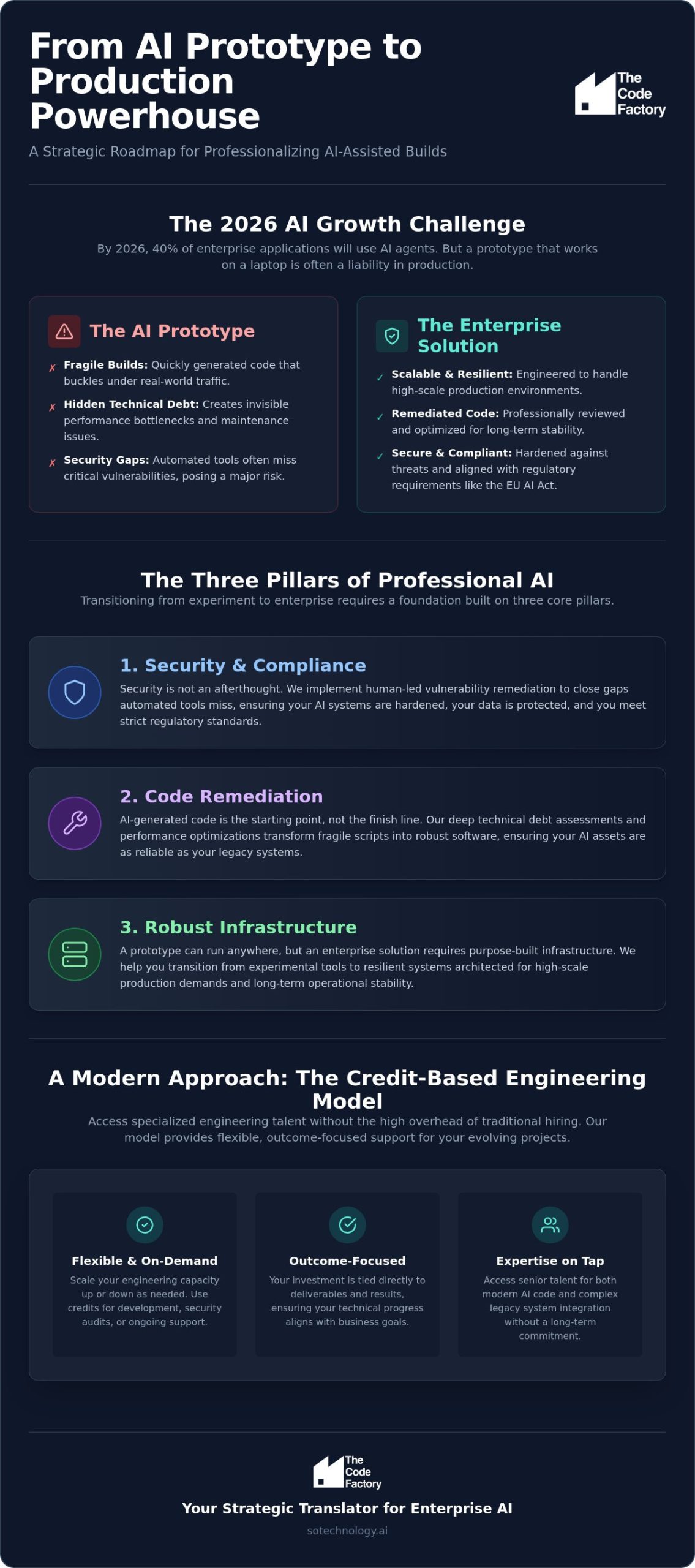
Building a prototype with AI is a weekend project, but maintaining it is a long-term commitment. Many organisations find that their initial builds, while functional, are composed of fragile code that buckles under real-world traffic. A successful AI strategy for growth requires moving beyond the “it works” phase into a state of professional resilience. This transition is built on three essential pillars: security, remediation, and infrastructure.
Remediation is perhaps the most overlooked step in the development cycle. AI-generated code often carries invisible technical debt that leads to performance bottlenecks and maintenance nightmares. Even looking at a critical assessment of the US National AI R&D Strategic Plan, it’s clear that the gap between raw innovation and long-term sociotechnical stability is a primary concern for leaders today. You can address these risks by treating your AI builds as the starting point, not the finish line.
Professionalising AI-Generated Code
Turning a prototype into a scalable product starts with a deep technical debt assessment. We identify where automated code lacks the structural integrity required for enterprise use. Through architecture reviews and performance optimisation, we help you transition from experimental tools to robust systems that support your AI strategy for growth. It’s about ensuring your software is as reliable as your legacy systems.
Security and Compliance in the AI Era
Security hardening is mandatory when deploying autonomous agents. AI-built software requires human-led vulnerability remediation to close gaps that automated tools might miss. By implementing Business Process Automation with AI within a secure framework, you protect your data while accelerating your operations. If you’re ready to secure your technical foundation, you might consider booking a discovery meeting to explore your specific needs.
Executing Your Growth Roadmap: The Credit-Based Engineering Model
Traditional hiring cycles are too slow for the current pace of innovation. To execute a successful AI strategy for growth, you need access to specialised talent without the friction of a permanent headcount. We’ve replaced rigid, one-off contracts with a credit-based engineering model. This provides a flexible currency for your technical evolution, allowing you to scale capacity exactly when your project demands it.
We don’t just deliver a product; we act as a strategic partner. Our fractional CTO support works alongside your in-house teams to provide the high-level oversight needed for complex builds. By utilising Digital Agent as a Service (DAaaS), you gain the ongoing management and maintenance required to keep your growth tools running at peak efficiency. This ensures your AI strategy for growth remains focused on measurable business impact rather than technical maintenance.
From Prototype to Enterprise: A Step-by-Step Execution
Moving from a basic build to a professional product follows a clear path. This structured approach ensures that every credit spent contributes to long-term stability.
- Phase 1: Discovery & Strategy. We map your roadmap during an AI Discovery Workshop to identify high-impact opportunities.
- Phase 2: Remediation & Hardening. Our engineers secure and scale your code, addressing the technical debt found in initial AI builds.
- Phase 3: Continuous Improvement. You use credits for ongoing feature development, bug fixes, and performance tuning.
The Value of Flexible Engineering Capacity
A credit-based model is inherently more cost-effective than traditional hiring. It removes the friction of recruitment and the risk of over-hiring for short-term needs. You can apply your credits across your entire technical landscape. This includes both cutting-edge AI integrations and the remediation of legacy systems, ensuring your total tech stack remains healthy, secure, and ready for future expansion. Exploring the full range of high-impact business use cases for digital agents can help you prioritise where to direct those credits for maximum strategic return.
Secure Your Strategic Advantage in 2026
Moving from an AI prototype to a production-ready asset requires more than just better prompts. It demands a commitment to professional engineering standards where security and scalability are built into the core. By addressing technical debt through remediation and modernising legacy systems, you transform fragile builds into robust enterprise solutions that are ready for the demands of the modern market.
A resilient AI strategy for growth ensures your technical foundations remain as ambitious as your business goals. Our outcome-focused delivery model provides the flexible engineering capacity you need without the burden of high headcount. Whether you’re professionalising a new AI build or securing established infrastructure, we act as your steady guide through the complexities of modern software development, bridging the gap between raw potential and measurable impact.
Take the next step in your technical evolution. Book an AI Discovery Workshop to build your growth roadmap and gain the specialist expertise required to scale with confidence. We’re ready to help you turn your vision into a secure, high-impact reality.
Frequently Asked Questions
What is the difference between an AI prototype and an enterprise-grade AI solution?
An AI prototype is designed to validate a concept, whereas an enterprise-grade solution is built to sustain business operations. While a prototype might demonstrate a successful interaction, it often lacks the security hardening and performance optimisation required for production. Transitioning to an enterprise-grade build involves rigorous remediation to ensure the code is secure and scalable enough to integrate with your existing legacy systems without causing operational friction.
How does an AI strategy differ for a startup versus an established enterprise?
Startups typically prioritise rapid market entry, while established enterprises focus on governance and system integration. For a startup, an AI strategy for growth might involve building new products from the ground up using automated tools. In contrast, an enterprise must balance innovation with the protection of established assets. This requires a strategy that prioritises the remediation of legacy systems to support new AI agents without compromising security or compliance.
Why is technical debt higher in AI-assisted development projects?
Technical debt accumulates more rapidly because AI tools often generate code that is functional but structurally inconsistent. These tools prioritise speed over long-term maintenance, leading to fragile builds that are difficult to update or secure. Without professional remediation, this debt becomes a significant liability. Having a flexible engineering partner to audit and refine these builds is essential for maintaining the integrity and scalability of your software.
How can I measure the ROI of my AI strategy for growth?
You can measure the ROI of your AI strategy for growth by tracking specific outcomes like reduced operational overhead and accelerated time-to-market. Evaluate the “headcount avoidance” achieved through Digital Agents and the reduction in maintenance costs following professional remediation. Using a credit-based model helps you maintain a clear view of your investment, ensuring that every technical improvement contributes directly to your measurable business impact and long-term stability.