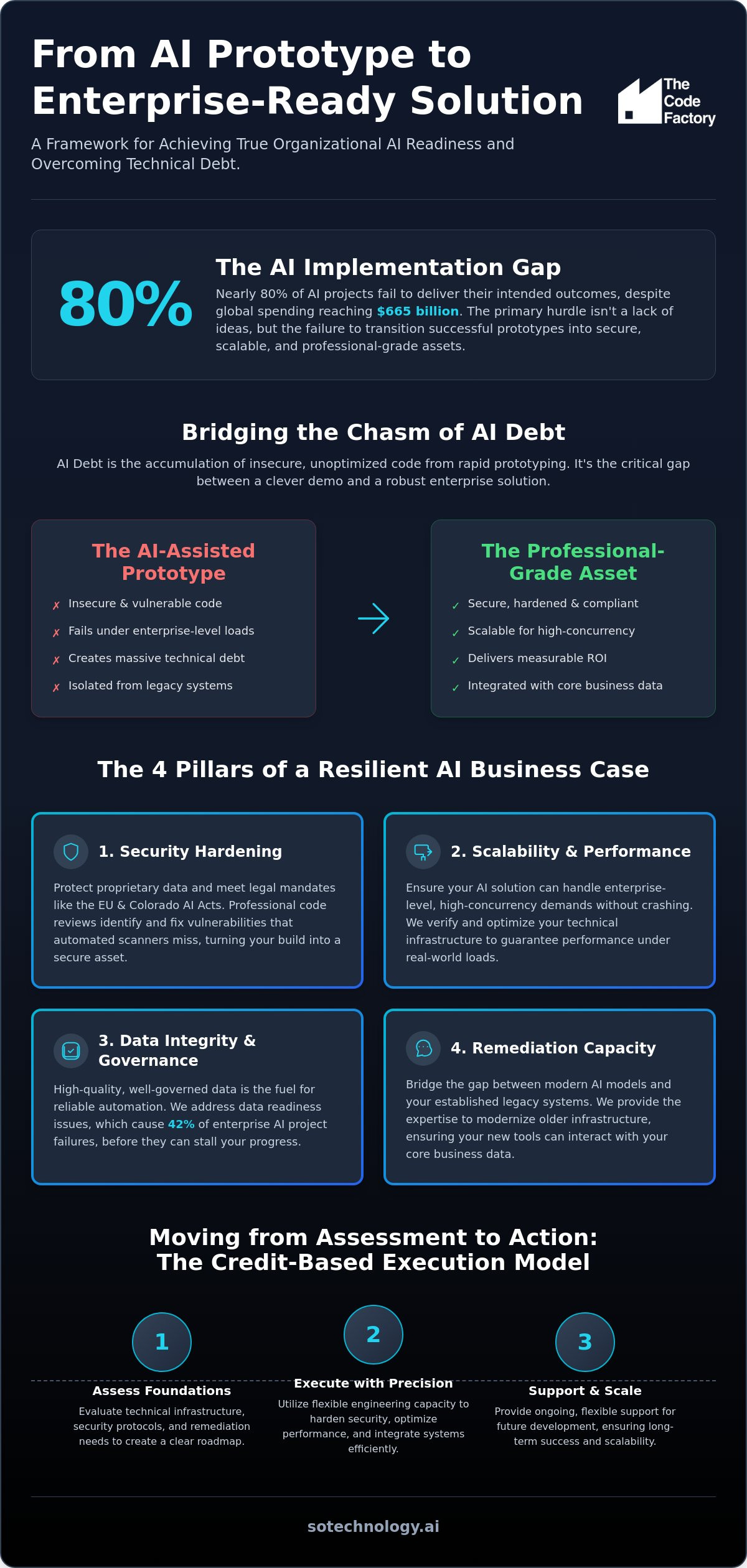
Did you know that as we move through 2026, nearly 80% of AI projects still fail to deliver their intended outcomes despite global spending reaching $665 billion? It’s a staggering figure that highlights a critical gap in organizational AI readiness. Most leaders find themselves caught between the excitement of a successful prototype and the daunting reality of technical debt. You’ve likely felt that same tension, worrying about the security of AI-generated code or whether your internal engineering capacity can actually bridge the gap between legacy systems and modern automation.
We understand that moving from a pilot to a production-grade asset is where most strategies stall. While the promise of rapid AI development is compelling, the challenge lies in ensuring those builds are secure and scalable enough for enterprise use. This article provides a clear framework to help you move beyond the hype by assessing your technical infrastructure, security protocols, and remediation capacity. You’ll discover how to justify the business case for AI automation to stakeholders while establishing a flexible model for ongoing development and support. We’ll walk through a roadmap that transforms experimental code into robust, professional-grade solutions.
Key Takeaways
- Learn how to define organizational AI readiness by prioritizing technical foundations over hype to ensure your builds are enterprise-ready.
- Explore the essential pillars of security hardening that protect your proprietary data while maintaining high-speed automation.
- See how professional remediation services bridge the gap between your established legacy systems and new AI-assisted builds.
- Understand how a credit-based execution model provides the flexible engineering capacity needed to move from assessment to active production.
What is Organizational AI Readiness in 2026?
In 2026, the definition of organizational AI readiness has matured beyond simple experimentation. It’s no longer just about who can prompt a model the fastest; it’s about the technical, strategic, and security foundations required to scale AI without creating massive technical debt. We’ve moved from the era of “hype” into a period of hard-nosed pragmatism. This shift is driven by the urgent need to turn rough AI-assisted prototypes into professional-grade assets that deliver measurable ROI.
Many organizations face a hidden hurdle known as Shadow AI. This represents the unmanaged use of AI tools by employees without proper oversight or security protocols. While this shows initiative, it often results in fragmented data and insecure codebases. This is where the role of a Strategic Translator becomes vital. They act as an expert intermediary, bridging the gap between raw AI potential and tangible business value. They ensure that cutting-edge tools don’t just exist in a vacuum but integrate seamlessly with your established infrastructure.
Assessing these foundations often mirrors the framework of Technology Readiness Levels, where the focus shifts from basic research to proven system performance. For an enterprise, this means moving a build from a clever demo to a robust, scalable product.
The Crisis of AI Debt
AI Debt is the accumulation of insecure, unoptimized code generated by non-professional AI tools that eventually requires costly intervention to fix. Most prototypes fail the “Enterprise Ready” test because they lack the rigorous architecture needed for high-concurrency environments. They might work in a sandbox, but they often crumble when exposed to real-world security threats or complex legacy system integrations.
AI Readiness vs. AI Adoption
There is a vast difference between adoption and readiness. Adoption is simply giving your team access to a tool; readiness is building the infrastructure that makes those tools secure and scalable. Technical health is the deciding factor here. It requires a commitment to remediation and a clear path toward professionalizing every build. You can’t just adopt AI and hope for the best. You need a strategy to transform those initial sparks into resilient enterprise solutions.
The 4 Technical Pillars of a Business Case for AI Automation
Building a business case for AI automation requires moving past the boardroom presentation and into the server room. To achieve true organizational AI readiness, your strategy must rest on four technical pillars that ensure your investment doesn’t become a liability. These pillars provide the structural integrity needed to transition from experimental scripts to resilient enterprise systems.
- Pillar 1: Security Hardening. With the EU AI Act and Colorado AI Act in full effect as of 2026, protecting proprietary data is a legal mandate. You need authentication protocols and encryption standards that meet these modern requirements to keep your builds secure.
- Pillar 2: Scalability and Performance. An AI solution that works for five users often crashes under enterprise-level loads. You must verify that your technical infrastructure can handle high-concurrency demands without compromising response times.
- Pillar 3: Data Integrity and Governance. High-quality, well-governed data is the only fuel that powers reliable automation. Research indicates that 42% of enterprise AI projects are delayed or fail specifically due to data readiness issues. Utilizing a comprehensive AI readiness assessment framework helps identify these gaps before they stall your progress.
- Pillar 4: Remediation Capacity. This is the ability to modernize legacy systems so they can interact with new AI models. Without a path for remediation, your cutting-edge tools remain isolated from your core business data.
Security and Compliance in the AI Era
AI-generated code often contains subtle vulnerabilities that standard automated scanners miss. Professional code reviews are essential for identifying these risks before they reach production environments. Moving from a prototype to enterprise-grade security hardening ensures your automation remains a secure asset rather than a back door for threats. It’s about building trust into the very foundation of your software.
Infrastructure for Digital Agents
Preparing your tech stack for Digital Agent as a Service (DAaaS) integration requires a shift from simple chatbots to autonomous systems. Success depends on building an enterprise AI adoption roadmap that prioritizes long-term scalability over quick wins. If you’re ready to bridge the gap between your current prototypes and a professional-grade solution, you can schedule an AI discovery meeting to map out your specific technical requirements.
Moving from Assessment to Action: The Credit-Based Execution Model
Many leaders excel at assessing organizational AI readiness but struggle when it’s time to pull the trigger. High-level strategy documents often gather dust because the path to execution feels too monolithic and rigid. We solve this “Execution Paralysis” by introducing “Engineering Currency.” This credit-based model provides the flexible capacity your business needs to evolve alongside AI technology without the friction of traditional project scoping.
The journey often begins with an AI Discovery Workshop. This session acts as a catalyst for identifying high-ROI use cases and pinpointing the technical gaps in your current infrastructure. It’s a collaborative process where we work alongside your in-house teams to ensure that organizational AI readiness isn’t just a goal, but a functional reality. We bridge the gap between raw potential and professional execution. For organizations looking to align leadership on strategy and ROI, facilitating an AI workshop for executive teams is a proven way to build consensus and prioritize the right use cases from the start.
The Value of Flexible Engineering Capacity
Traditional hiring is simply too slow for the pace of AI transformation in 2026. By the time you recruit a specialist, the underlying models have already shifted. Using a credit-based system allows you to apply engineering resources exactly where they’re needed. Whether you require a deep code review, security hardening, or new feature development, credits provide a streamlined way to scale your efforts. This approach keeps your momentum high and your overhead low.
Professionalizing the AI Prototype
A “working” AI tool is rarely a secure or scalable one out of the box. Our remediation services focus on turning those initial AI-assisted builds into robust enterprise assets. We specialize in modernizing legacy systems to ensure they communicate effectively with new AI agents. By professionalizing your prototypes, we transform experimental code into a resilient foundation for future growth. Your next step is securing your discovery workshop to map your specific path to production.
Securing Your Path to Enterprise-Grade Automation
The transition from a promising prototype to a professional-grade asset doesn’t have to be a source of technical stress. By focusing on the four technical pillars of security, scalability, data integrity, and remediation, you move beyond the hype into a space of strategic control. True organizational AI readiness isn’t just about having the latest model; it’s about having the technical health required to support it at scale. We’ve seen that the most successful organizations in 2026 are those that bridge the gap between legacy systems and modern automation with a clear, actionable roadmap. A structured approach to identifying business impact of AI ensures that every investment is tied to measurable outcomes rather than speculative potential.
Our collaborative approach provides you with a flexible credit-based engineering capacity, allowing you to scale your development efforts precisely when needed. Whether you’re hardening the security of an AI-generated build or modernizing established infrastructure, our outcome-focused consulting ensures every step adds measurable business value. We act as your strategic partner to turn technical uncertainty into a robust engine for growth. You can take the first step toward professionalizing your builds right now.
Book your AI Discovery Workshop to assess your organizational readiness today and start building for the future with confidence.
Frequently Asked Questions
What are the first signs that our organization is NOT ready for AI?
The clearest signs that you aren’t ready include widespread “Shadow AI” usage and a lack of defined security protocols for AI-generated code. If your team is producing prototypes that can’t safely access your legacy systems, you’re building on a fragile foundation. These technical gaps suggest that your infrastructure isn’t yet mature enough to support professional-grade automation without creating significant debt.
How do we build a business case for AI automation when the technology is changing so fast?
Building a business case involves shifting the focus from specific models to overall technical health and remediation capacity. You don’t need to bet on a single tool; you need to bet on a framework that handles rapid change. By prioritizing organizational AI readiness, you justify the investment as a means to create a secure, scalable environment that can adopt any new model as it emerges.
What is the difference between an AI Readiness Assessment and an AI Discovery Workshop?
An AI Readiness Assessment is a diagnostic look at your current technical gaps, whereas an AI Discovery Workshop is a strategic session to build your execution roadmap. The assessment tells you where you stand today. The workshop is where we identify high-value use cases and determine how to apply our credit-based engineering model to professionalize your builds. If your leadership team needs a structured approach to align on priorities and measure ROI, our guide on facilitating an AI workshop for executive teams outlines a proven framework for turning those sessions into actionable strategy.
Can we professionalize AI-generated code, or should we start from scratch?
It’s often more efficient to professionalize existing AI-generated code through remediation than to start from scratch. Our team specializes in security hardening and architecture optimization to turn initial builds into enterprise-ready products. This process ensures your code is both secure and scalable, allowing you to keep the momentum of your initial build while adding the necessary professional rigor.