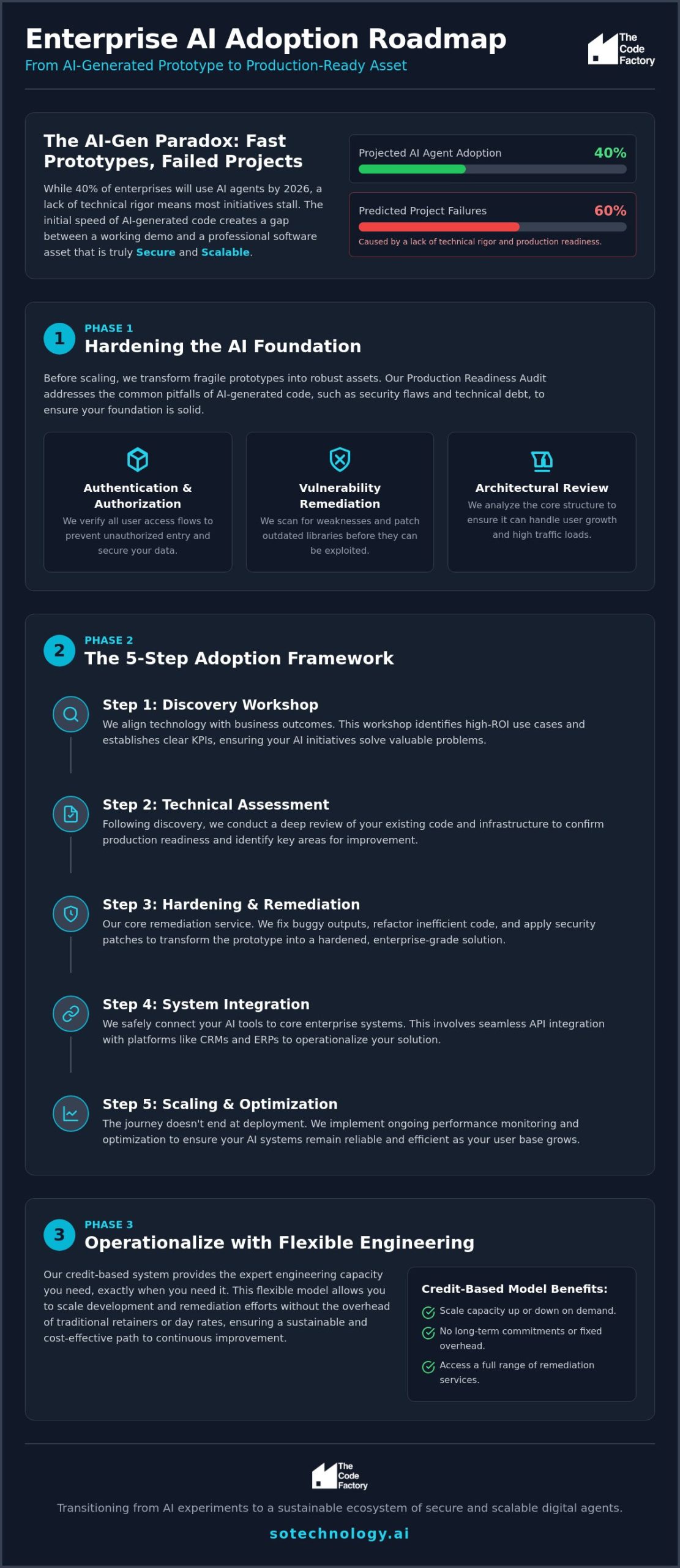
While 40% of enterprise applications are projected to feature task-specific AI agents by late 2026, Gartner predicts that 60% of these initiatives will fail due to a lack of technical rigor. You’ve likely experienced the initial speed of an AI-generated prototype, only to hit a wall when it’s time to address buggy outputs or the strict requirements of the EU AI Act. It’s a common challenge. The gap between a functional experiment and a professional software asset is often wider than it looks. We’re here to help you bridge that gap with a clear enterprise AI adoption roadmap that transforms initial sparks into Secure and Scalable solutions.
This framework provides a methodical path to professionalize your AI builds by applying the engineering standards required to harden code for the real world. We’ll show you how to solve for a lack of internal capacity and how to predict long-term maintenance costs with confidence. While the landscape of 2026 is complex, your strategy doesn’t have to be. By the end of this guide, you’ll have a strategy to move beyond the prototype phase and into a future of continuous, high-impact development. We’ll break down the transition into actionable steps that prioritize security, reliability, and long-term growth.
Key Takeaways
- Identify the technical rigor needed to audit AI-generated code and transform fragile prototypes into production-ready software assets.
- Implement a 5-step enterprise AI adoption roadmap that aligns your initial discovery workshops with long-term strategic business goals.
- Learn the specific hardening techniques required to ensure your automated outputs remain Secure and Scalable as your user base grows.
- Discover how a flexible, credit-based engineering model allows you to scale your development capacity without the overhead of traditional day rates.
- Master the transition from isolated AI experiments to a sustainable ecosystem of digital agents supported by ongoing maintenance and future development.
Phase 1: Hardening the AI Foundation for Security and Scalability
Many leaders find that their initial AI experiments move quickly, but they often stall when trying to transition to a live environment. The early stages of the Technology Adoption Life Cycle focus on speed, yet enterprise success requires a shift toward technical rigor. The first step in a successful enterprise AI adoption roadmap is to audit the foundation. AI-generated code is excellent for rapid prototyping; however, it frequently lacks the architectural depth required for high-traffic or high-security environments. By conducting deep technical reviews, we identify where prototypes are fragile and where they need reinforcement to become Secure and Scalable assets.
The Production Readiness Audit
AI tools often prioritize “completion” over “compliance,” which means generated outputs might ignore your internal security protocols or use outdated libraries. We focus on rigorous authentication reviews and vulnerability remediation to ensure that automated outputs don’t become backdoors for attackers. Our production readiness process includes:
- Authentication and authorization flow verification
- Vulnerability scanning and library patch remediation
- Architectural review for growth and load handling
Production Readiness in AI-built software is the state where code meets all enterprise-grade security, performance, and maintainability standards required for live deployment. This audit moves your project beyond a simple “it works” proof-of-concept to a software asset that’s truly safe to launch.
Addressing Technical Debt Early
Technical debt in AI builds often manifests as “hallucinated” logic or inefficient database queries that look correct but fail under load. Ignoring these issues in early-stage AI agents can lead to maintenance costs that balloon as the system grows. Our enterprise AI adoption roadmap prioritizes early intervention to refactor these weaknesses before they become structural liabilities. Before committing to remediation, it’s worth assessing your organizational AI readiness to ensure your infrastructure, security protocols, and engineering capacity can support the transition from prototype to production. By utilizing a flexible credit-based system, you can access expert engineering capacity to harden these prototypes exactly when you need it. This model ensures your software evolves through future development without the weight of legacy errors, keeping your team agile and your systems reliable.
Phase 2: The 5-Step Enterprise AI Adoption Framework
A successful enterprise AI adoption roadmap isn’t a straight line; it’s a series of intentional upgrades. After you’ve hardened your initial foundation, you need a repeatable framework to move from a single prototype to an ecosystem of reliable tools. We’ve refined a five-step process that ensures every AI initiative becomes a Secure and Scalable business asset. This methodical progression strips away technical uncertainty and replaces it with strategic control.
Discovery: The Strategic Starting Point
Many projects fail because they start with the technology rather than the business outcome. An AI Discovery Workshop clarifies the path forward by identifying high-ROI use cases that align with your specific goals. This stage is about setting KPIs that measure actual business value, such as time saved or error reduction, rather than just technical output. It ensures your resources focus on problems worth solving. Once the strategy is clear, we move into a Technical Assessment to review existing code and infrastructure for production readiness.
Deployment: Operationalizing AI Solutions
There is a significant difference between a basic chatbot and a professional, integrated enterprise AI solution. While a chatbot might answer questions, a robust AI solution acts on and integrates with your data and systems. This requires seamless API integration with your legacy platforms and a commitment to technical rigor. When facilitating an AI workshop with executive stakeholders, aligning these integration decisions with measurable ROI and risk management goals is essential to securing buy-in for each phase. The final stages of the framework focus on operationalizing these AI solutions into permanent, valuable assets:
- Hardening & Remediation: Finalizing security patches and optimizing code performance to handle real-world growth.
- Integration: Safely connecting your AI solutions to core enterprise systems like CRM or ERP tools.
- Scaling & Optimization: Implementing ongoing performance monitoring to ensure the system remains reliable and efficient.
Our credit-based system provides the flexibility to move through these steps at your own pace. You can tap into expert engineering capacity for a Discovery & Strategy session or long-term maintenance without being locked into rigid contracts. This model allows for future development that evolves alongside your business needs, ensuring your software stays ahead of the curve.
Phase 3: Operationalizing the Roadmap with Flexible Engineering Capacity
Executing an enterprise AI adoption roadmap requires more than just a plan; it demands a talent model that moves as fast as the technology itself. While traditional hiring solves for long-term headcount, it rarely solves for the immediate speed required to professionalize a prototype. We’ve moved away from rigid day rates and fixed contracts in favor of an outcome-focused capacity model. This approach ensures that your technical resources are always aligned with your current stage of growth, rather than being tied to a static job description.
The Credit-Based Engineering Currency
Maintaining the Momentum
Software doesn’t stay production-ready on its own. It requires a disciplined approach to Support & Maintenance, especially in AI environments where model behavior can shift over time. Release automation and robust CI/CD pipelines are essential to ensure that model updates don’t break existing workflows. We provide the monitoring and observability tools needed to keep your AI agents performant post-launch, treating future development as a continuous journey rather than a final destination.
This operational model is bolstered by fractional CTO support, giving you high-level strategic guidance alongside hands-on engineering. By integrating this flexible capacity into your enterprise AI adoption roadmap, you ensure that your software evolves through technical rigor. It’s about building a partnership that values simplicity and directness, helping you pivot rapidly as new AI frameworks emerge in the coming years.
Scaling Your AI Vision for Long-Term Impact
Moving from a functional AI experiment to a production-ready software asset requires a shift from rapid generation to technical rigor. You’ve seen how a structured enterprise AI adoption roadmap prioritizes Secure and Scalable outcomes from the very first audit. By focusing on hardening your foundation and following a proven five-step framework, you turn fragile prototypes into reliable enterprise systems that are ready for the demands of 2026 and beyond.
Success in this rapidly evolving field depends on your ability to scale without the friction of traditional recruitment or rigid contracts. Our flexible, credit-based engineering model provides the specialist expertise needed to harden AI-generated code while supporting your ongoing future development. We’re here to ensure your journey from prototype to production is controlled, strategic, and ultimately successful. Let’s build something that doesn’t just work, but thrives as your business grows.
Book your AI Discovery Workshop to start your roadmap today and secure a scalable foundation for your next phase of innovation.
Frequently Asked Questions
How long does a typical enterprise AI adoption roadmap take to implement?
A comprehensive enterprise AI adoption roadmap typically takes three to six months to move from a fragile prototype to a fully hardened production environment. This timeline allows for a methodical progression through discovery, technical auditing, and security remediation. While AI tools generate code in seconds, the engineering rigor required to ensure that code is Secure and Scalable requires a deliberate, multi-phase approach.
What are the biggest security risks when deploying AI-generated code?
The primary risks involve insecure dependencies, insufficient authentication flows, and “hallucinated” logic that can create hidden vulnerabilities. AI generation tools often prioritize completion over compliance, which can lead to code that ignores enterprise safety standards. Professional Code Reviews are necessary to identify these flaws and implement the technical hardening required to protect sensitive data and maintain regulatory compliance.
Can we use existing in-house teams alongside an external AI partner?
Collaborative models are actually the most effective way to professionalize your AI builds. We act as a fractional extension of your current engineering department, providing the specialized capacity to harden outputs while your team focuses on core business logic. Our credit-based system is designed for this exact flexibility, allowing you to scale up technical support for Web Development or maintenance exactly when your internal team needs it.
How do we calculate the ROI of an AI Discovery Workshop?
ROI is measured by the reduction in technical debt and the acceleration of your time-to-market for Secure and Scalable solutions. By identifying high-impact use cases early, an enterprise AI adoption roadmap prevents your team from wasting resources on low-value prototypes that aren’t fit for production. This strategic clarity ensures that every engineering credit you spend contributes directly to long-term business value and sustainable growth.