The most expensive AI project in 2026 isn’t the one that fails to launch; it’s the successful prototype that’s too insecure or fragmented to ever reach production. While global AI spending is forecasted to hit $2.52 trillion this year, many organizations find themselves trapped between impressive demos and the harsh reality of technical debt. Identifying business impact of AI is no longer about finding what’s possible, but determining what’s professional grade. You’ve likely felt the pressure to innovate quickly, only to realize that an AI-generated build requires significant remediation before it meets enterprise standards for security and scalability.
We understand the skepticism that follows a season of unfulfilled hype. This article provides a strategic framework to help you move beyond the “cool demo” phase and identify high-ROI opportunities that are actually ready for deployment. We’ll explore how to audit your current AI builds for security risks, manage the hidden costs of data preparation, and utilize a flexible credit-based engineering model to ensure your systems remain scalable. By the end of this guide, you’ll have a clear roadmap to transition from experimental prototypes to robust, secure products that drive measurable productivity gains.
Key Takeaways
- Shift your perspective from experimental generative hype to operational intelligence by targeting high-impact zones in customer experience and internal productivity.
- Master a strategic framework for identifying business impact of AI that separates fleeting trends from sustainable, high-ROI enterprise opportunities.
- Learn why security and scalability are the non-negotiable foundations for transitioning fragile AI-generated prototypes into professional-grade products.
- Discover how to bridge the gap between cutting-edge AI tools and legacy systems through expert software remediation and architectural alignment.
- Understand how AI Discovery Workshops and flexible credit-based engineering models provide the continuous support needed to scale your AI initiatives safely.
The Framework for Identifying Strategic AI Impact in 2026
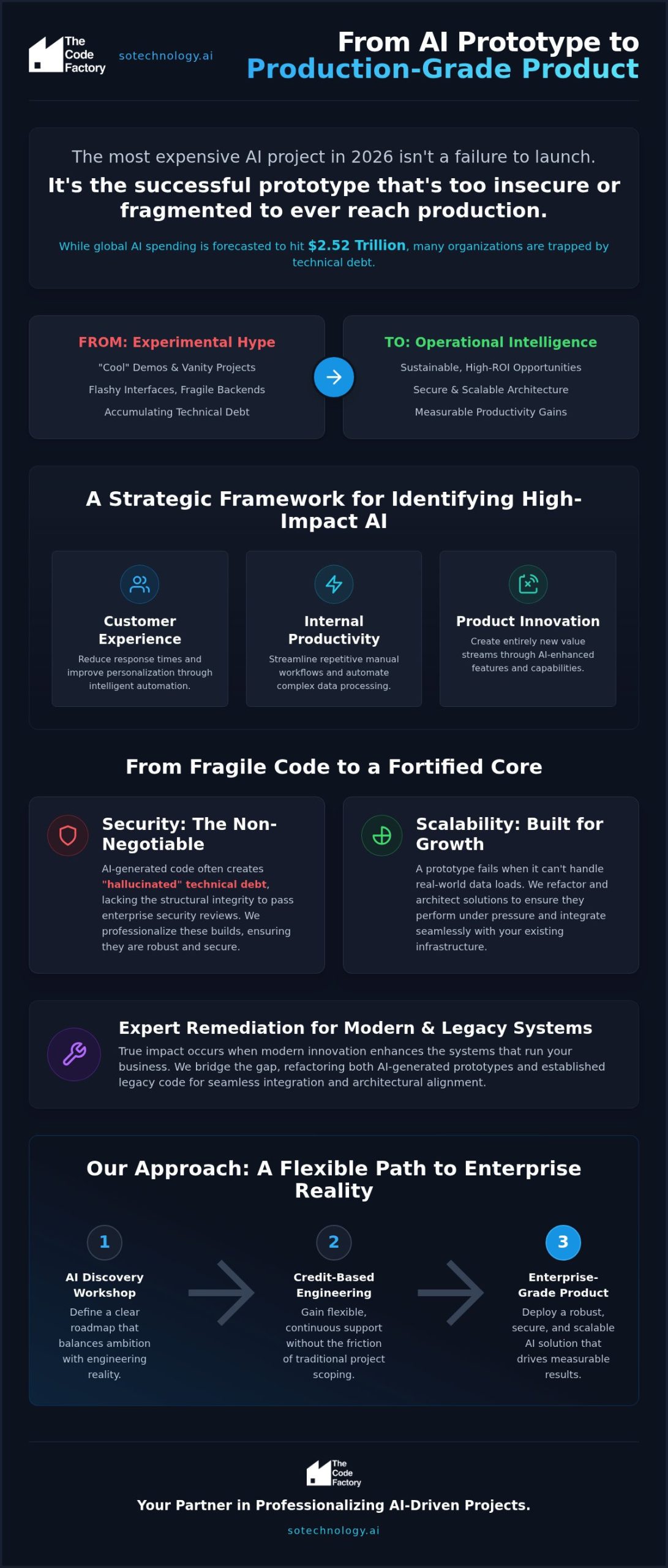
The 2026 shift is clear: the era of generative experimentation has matured into the age of operational intelligence. Success no longer depends on how many AI tools you can deploy, but on how effectively you integrate them into your core architecture. When identifying business impact of AI, leaders must look beyond the initial novelty to find “High-Impact” zones where AI solves persistent friction. These zones typically cluster around three specific areas:
- Customer Experience: Reducing response times and improving personalization through intelligent automation.
- Internal Productivity: Streamlining repetitive manual workflows and complex data processing.
- Product Innovation: Creating entirely new value streams through AI-enhanced features.
While the potential for AI’s impact on the workplace is vast, the true bottleneck is often organizational readiness rather than technical availability. Many businesses struggle to move past the prototype stage because they lack a framework to score potential use cases by ROI against technical feasibility.
High-ROI Use Cases vs. Vanity Projects
Distinguishing between a “cool” feature and a strategic asset is the difference between technical debt and business growth. Vanity projects often focus on flashy interfaces that fail to address backend security or scalability, leading to fragile prototypes that cannot survive production. In contrast, high-ROI initiatives like Digital Agent as a Service (DAaaS) provide measurable gains by automating complex workflows within customer support while remaining integrated with your existing infrastructure. AI Impact is the intersection of cost reduction and revenue acceleration.
Aligning AI with Long-Term Business Strategy
Moving from a visionary concept to a functional product requires a structured approach to discovery. Utilizing AI workshops for executive teams helps define a roadmap that balances ambition with engineering reality. This process ensures that every identified use case is scored through an Impact Matrix, evaluating both the potential ROI and the technical requirements for implementation. Whether you are focused on software remediation for legacy systems or professionalizing an AI-generated prototype, the goal is to create a secure, scalable foundation. Our flexible, credit-based engineering model ensures that identified impacts are not just theoretical goals but are actively built, maintained, and evolved to meet future demands.
Evaluating Technical Readiness: Security, Scalability, and Legacy Systems
The path to identifying business impact of AI frequently begins with a successful prototype, but it often ends abruptly when that prototype hits the enterprise firewall. AI code generation has drastically lowered the barrier to entry for new features. However, it’s also created a new category of “hallucinated” technical debt. While NSF data on AI in the business sector highlights how R&D investment is reshaping the workforce, it doesn’t account for the engineering hours required to fix fragile, AI-generated codebases that lack structural integrity.
Professional code reviews are the first step in determining if your AI initiatives are actually enterprise-ready. We’ve seen many businesses build impressive tools that fail because they can’t communicate with established legacy systems or handle real-world data loads. True impact only happens when your AI agents are integrated safely into your existing infrastructure, ensuring that modern innovation doesn’t break the systems that currently run your business.
Professionalizing AI-Built Software
Transitioning a prototype into a production-grade product requires a deliberate remediation strategy. This isn’t just about fixing bugs; it’s about refactoring code to ensure it’s both secure and scalable. By conducting organizational AI readiness assessments, you can identify where your AI-built software needs professional intervention to meet industry standards. Our credit-based engineering model provides the flexibility to tackle these remediation tasks as they arise, allowing for continuous improvement without the friction of traditional project scoping.
The Importance of Secure and Scalable Architecture
In the context of 2026, “Secure” means more than just password protection. It involves deep LLM data privacy, ensuring your proprietary data doesn’t leak into public models, and maintaining compliance with evolving state regulations. Scalability ensures that as your AI usage grows, your infrastructure costs don’t spiral out of control. If you’re unsure where your current prototype stands, you might benefit from a technical audit of your current AI assets to ensure your foundation is solid before you scale.
Executing the Roadmap: From AI Discovery to Enterprise Reality
Moving from a visionary concept to a functional reality requires more than just enthusiasm; it requires a structured execution plan. Once you’ve finished identifying business impact of AI within your specific workflows, the focus must shift to a three phase delivery model. This journey begins with an AI Discovery Workshop, where we move beyond surface level ideas to uncover the precise impact areas that will drive the most value for your organization. We then transition into the Translation phase, converting high level goals into the rigorous technical requirements needed for enterprise deployment.
The final phase is Implementation. This is where the work of professionalizing your AI builds actually happens. Instead of treating AI as a series of one off projects, we view it as a continuous digital transformation. This approach ensures that as your business evolves, your AI tools remain secure, scalable, and fully integrated with your existing infrastructure. By leveraging professional engineering capacity, you avoid the common trap of building isolated tools that cannot communicate with your legacy systems.
The Credit-Based Model: Engineering Currency for AI Growth
Traditional software development often relies on rigid day rates or fixed price contracts that don’t account for the iterative nature of AI. We use a credit based engineering model to provide a more flexible “currency” for your growth. This system allows you to scale your engineering efforts up or down based on your immediate needs, whether you’re remediating AI generated code or building an enterprise AI adoption roadmap. It provides the ongoing support necessary to transition from a fragile prototype to a robust production grade product without the friction of constant re-scoping.
Partnering for Success: The Strategic Translator Role
Execution fails when there’s a disconnect between executive vision and technical reality. We act as a “Strategic Translator,” bridging the gap between cutting edge AI capabilities and the practical requirements of robust enterprise infrastructure. Our AI consulting services function as the engine for long term impact, ensuring that every line of code we write or remediate contributes to your strategic goals. By partnering with experts who understand both modern AI tools and established legacy systems, you ensure your organization stays ahead of the curve while maintaining total operational control.
Transitioning from AI Prototype to Enterprise Asset
Identifying business impact of AI requires a sophisticated bridge between high-level executive ambition and the grounded reality of technical execution. We’ve established that the path to 2026 success involves more than just development speed; it demands security, scalability, and the expert remediation of fragile codebases. By aligning your AI initiatives with core business friction and existing legacy infrastructure, you move beyond the experimental phase toward genuine, sustainable operational intelligence.
Our credit-based engineering model provides the flexible currency needed to support this ongoing evolution without the constraints of traditional project scoping. As a global partner for digital transformation, we specialize in professionalizing AI-built software and ensuring your products are ready for the rigors of enterprise deployment. This approach strips away the stress of technical uncertainty, providing you with a clear roadmap for long-term growth.
Professionalizing your AI journey starts with a single strategic conversation. We’re here to help you build an enterprise-grade future that’s as secure as it is innovative.
Frequently Asked Questions
How do I measure the actual ROI of an AI implementation?
Actual ROI is measured by comparing the reduction in operational costs and accelerated revenue streams against the total cost of ownership, including hidden expenses like data preparation and monitoring. You should track specific metrics such as hours saved per workflow or the volume of queries resolved by digital agents. High-impact projects deliver the best returns when they solve core business friction rather than just adding experimental features.
What are the biggest risks when identifying business impact of AI?
The primary risks involve overlooking technical debt and security vulnerabilities that often hide within initial AI-generated prototypes. When identifying business impact of AI, organizations frequently underestimate the remediation required to make a system enterprise-ready. Failing to account for evolving 2026 regulatory requirements, such as the EU AI Omnibus Regulation, can also lead to significant compliance risks and potential financial penalties.
Can AI-generated code be used in enterprise-level production?
AI-generated code is suitable for production only after it has undergone professional code reviews and remediation to ensure it meets enterprise standards. Raw AI output often lacks the necessary security protocols and architectural depth required for long-term stability. Transitioning these builds into professional-grade products ensures they’re secure, scalable, and capable of supporting future development without collapsing under technical debt.
How long does it typically take to see the business impact of AI?
Initial impact from lightweight API integrations or Digital Agents can often be measured within weeks of deployment. However, full-scale enterprise transformation usually requires a multi-month roadmap to ensure deep integration with your existing infrastructure. Following a structured discovery phase helps you prioritize quick wins that demonstrate immediate value while you build toward more complex, long-term strategic goals.
What is the difference between an AI prototype and an enterprise-ready product?
A prototype is a proof of concept designed to show what’s possible; an enterprise-ready product is a robust system built to work reliably at scale. Prototypes often ignore edge cases, security vulnerabilities, and integration hurdles with legacy systems. Enterprise-grade solutions prioritize secure architecture and consistent performance, ensuring the tool remains a business asset rather than a technical liability as user demand grows.
How do legacy systems affect the potential impact of AI?
Legacy systems act as the foundational infrastructure that modern AI must interact with to deliver real-world value. If your AI tools can’t communicate with established databases or older software, their impact remains isolated and limited. Professional remediation services bridge this gap, allowing you to layer cutting-edge AI capabilities on top of stable, older systems to unlock data that was previously inaccessible.