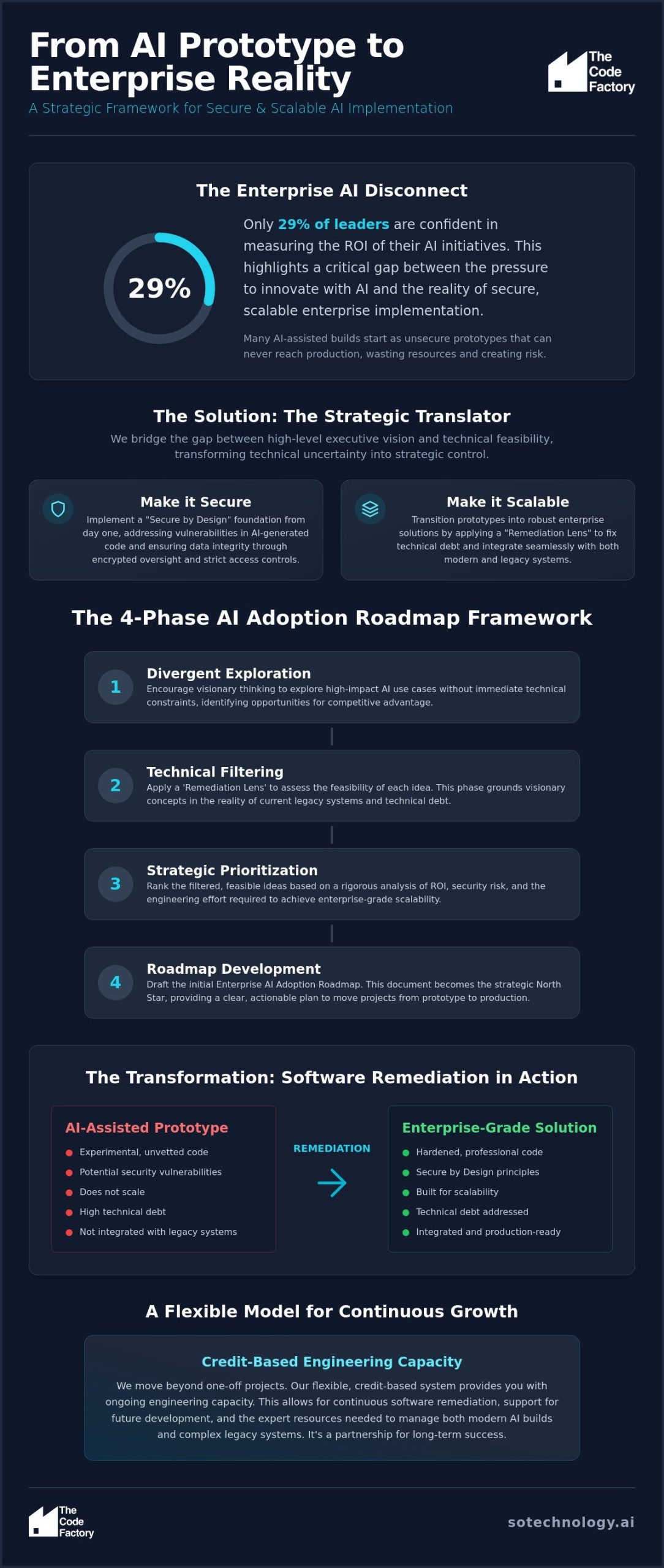
Only 29% of leaders feel confident in their ability to measure the ROI of their AI initiatives, according to 2026 data from The AIE Network. This statistic highlights a growing disconnect between the corporate pressure to innovate and the practical reality of secure enterprise implementation. When you’re facilitating an AI workshop for an executive team, your role is to act as a strategic filter for security, scalability, and long-term value. It’s common to feel overwhelmed by market noise or the risk of building unsecure prototypes, but those challenges are simply signals that your strategy needs a more robust foundation.
This guide provides a structured framework to help you bridge the gap between AI hype and professional-grade reality. You’ll learn how to move beyond basic prototypes toward a prioritized roadmap that aligns stakeholders on both ROI and risk management. We’ll explore how to professionalize AI-assisted builds through a scalable, credit-based model, ensuring your transition from a conceptual tool to a secure enterprise solution is both methodical and measurable. It’s time to turn technical uncertainty into strategic control.
Key Takeaways
- Define the Strategic Translator role to effectively bridge the gap between high-level executive vision and technical feasibility.
- Master a structured two-phase framework for facilitating an AI workshop that balances creative exploration with rigorous technical filtering.
- Learn to apply a remediation lens to identify where legacy systems require modernization to ensure your AI builds are secure and scalable.
- Transition from conceptual prototypes to enterprise-grade reality by utilizing a flexible, credit-based model for ongoing engineering capacity and support.
Preparing for Impact: The Strategic Translation Phase
Successful implementation begins long before the first whiteboard marker is uncapped. When you are facilitating an AI workshop for an executive team, your primary function is that of a Strategic Translator. You aren’t just managing a meeting; you’re bridging the gap between high-level vision and technical feasibility. This phase requires you to apply strategic management principles to ensure that every AI initiative aligns with the organization’s broader goals while remaining grounded in reality. It’s about stripping away the stress of technical uncertainty and replacing it with a sense of strategic control.
To guarantee that workshop outcomes are both desired and deployable, you must identify two critical roles: the Decider and the Technical Guardian. The Decider provides the mandate for change, while the Technical Guardian ensures that proposed solutions don’t collapse under the weight of existing technical debt. Before the session, conduct a rigorous AI readiness assessment. This audit identifies legacy constraints and sets a “Secure and Scalable” baseline, ensuring that every idea meets enterprise standards from the very start. This proactive approach prevents the common pitfall of building unsecure prototypes that can never reach production.
Mapping the Stakeholder Language Gap
Executives and engineers often speak different languages. Your job is to translate data constraints into tangible business outcomes. By using insights from The Code Registry, you can provide a factual baseline of current software health. This moves the conversation away from vague innovation toward the concept of Engineering Currency. Instead of focusing on simple day rates, you’ll help the team understand how flexible engineering capacity allows for the continuous remediation and development required to turn an initial AI build into a robust, professional product.
Designing the Outcome-First Agenda
The most effective sessions shift the focus from “What can AI do?” to “What should AI solve for our growth?” This transition is vital for achieving organizational AI readiness. By making readiness a core session pillar, you ensure the team isn’t just chasing hype. Instead, you’re building a plan for secure and scalable solutions that integrate seamlessly with established infrastructure, whether it’s modern AI code or legacy systems.
Facilitating the Session: From Divergent Ideas to Scalable Roadmaps
Facilitating an AI workshop requires a deliberate shift from creative ‘rabbit’ thinking to rigorous technical scrutiny. During Phase 1, encourage your executive team to explore high-impact use cases without immediate constraint. This divergent exploration allows for visionary ideas that can drive competitive advantage, which is a core component of any modern AI strategy for leaders. Once the board is full of potential, you must pivot to Phase 2: Technical Filtering. This is where you apply a ‘Remediation Lens’ to assess which ideas are actually feasible given your current legacy systems and technical debt.
In Phase 3, you rank these filtered ideas based on ROI, security risk, and the effort required to achieve scalability. A structured approach to identifying business impact of AI is essential at this stage to ensure you’re prioritizing initiatives that are genuinely production-ready rather than impressive demos that can’t meet enterprise standards. This logical progression leads directly into Phase 4, where you draft the initial enterprise AI adoption roadmap. This document serves as your strategic North Star, moving projects from prototype to production. If you’re looking to refine your initial vision into a concrete plan, it’s often helpful to schedule a discovery meeting to validate your technical assumptions before committing resources.
The ‘Secure by Design’ Workshop Framework
Security shouldn’t be an afterthought; it must be the foundation. We facilitate a ‘Red Team’ exercise where stakeholders deliberately identify potential vulnerabilities in proposed AI agents. This process helps determine whether Digital Agent as a Service (DAaaS) or an off-the-shelf SaaS tool is the better choice for long-term scalability. Every AI prototype discussed must adhere to a secure baseline where data integrity is maintained through encrypted oversight and strict access controls.
Turning Prototypes into Professional Grade Products
The gap between an AI-assisted build and a robust enterprise solution is often wider than it appears. We focus heavily on Software Remediation, which involves fixing the experimental code generated during the ideation phase to ensure it’s secure and scalable. By addressing technical debt early, you ensure that your AI initiatives don’t just stay as conceptual prototypes but become reliable, high-performance assets for the business.
Closing the Gap: Professionalising AI Outcomes with Capacity
The true value of a strategic session is measured by what happens after the stakeholders leave the room. While many competitors focus on summarizing discussion points, facilitating an AI workshop with our team serves as the launchpad for actual engineering capacity. We bridge the gap between conceptual vision and enterprise-grade reality by utilizing a flexible, credit-based model. This system allows you to apply monthly engineering currency toward AI consulting services and critical software remediation, ensuring that ideas aren’t just discussed but deployed.
To professionalize these outcomes, we implement a robust CI/CD pipeline and release automation. This infrastructure ensures that your AI roadmap is supported by modern deployment standards, reducing the risk of manual errors. Our fractional CTO approach maintains strategic oversight long after the workshop ends, providing a steady hand to guide your technical team through the complexities of legacy systems and cutting-edge AI tools.
Implementing the Credit-Based Delivery Model
Flexible engineering currency allows for the rapid scaling of AI features without the administrative burden of traditional project scoping. You can pivot resources between feature development and the remediation of legacy infrastructure as your priorities shift. By using a transparent credit consumption list, you gain total visibility into how your investment is maturing your AI-assisted builds into professional products.
The Continuous Improvement Loop
AI-generated code requires ongoing vigilance to remain secure and scalable. We incorporate regular code reviews into your delivery cycle to prevent the accumulation of technical debt. This continuous improvement loop allows you to scale from an initial ‘Start-Up’ credit allocation to ‘Enterprise Plus’ as your AI adoption matures. It’s a methodical way to ensure your prototypes evolve into robust, enterprise-ready solutions that drive long-term business value.
Turning Strategic Vision into Enterprise Reality
Transitioning from a visionary concept to a functional, secure enterprise solution requires more than just a successful meeting. It demands a commitment to professional-grade engineering and proactive technical debt remediation. Facilitating an AI workshop that focuses on these foundational pillars ensures your executive team isn’t just chasing the latest trend but building a robust roadmap for long-term growth.
You’ve seen how acting as a strategic translator bridges the gap between technical feasibility and business goals. Our credit-based model provides the flexible engineering currency needed to turn prototypes into secure, scalable products. This system gives you access to a specialized team capable of managing both cutting-edge AI builds and the complex remediation of legacy systems, ensuring your strategy remains focused on ROI and security.
It’s time to replace technical uncertainty with strategic control. We’re ready to act as your visionary partner and help you navigate this transition with confidence and clarity.
Frequently Asked Questions
What is the primary goal of an AI workshop for executive teams?
The primary goal is to establish a shared understanding of AI’s strategic value while filtering out market noise. By aligning the Decider and the Technical Guardian, you ensure that every proposed initiative is both desired and deployable. The session moves the team from vague ideas to a prioritized roadmap focused on ROI and long-term impact. This alignment strips away technical uncertainty and creates a sense of strategic control over the adoption process.
How do we ensure the AI solutions we brainstorm are actually secure?
Security is ensured by incorporating ‘Red Team’ exercises and a ‘Secure by Design’ framework directly into the ideation process. We evaluate every potential AI agent against strict enterprise standards for data integrity and access control. This proactive approach prevents the common pitfall of building unsecure prototypes. By establishing a secure baseline early, you protect the organization’s infrastructure while ensuring that all AI-driven projects are robust enough for production.
What happens if our current legacy systems aren’t ready for AI integration?
If legacy systems aren’t ready, we apply specialized software remediation services to modernize your existing infrastructure. This bridge allows cutting-edge AI tools to integrate seamlessly with older, established frameworks. We use technical audits to identify specific areas of debt that could hinder scalability. Once these legacy constraints are addressed, your organization can move forward with a secure foundation that supports sophisticated AI implementation without compromising stability.
How much engineering capacity do we need to implement an AI roadmap?
Engineering capacity varies based on the roadmap’s complexity, but a credit-based model provides the necessary flexibility. This system allows you to scale resources up or down without the friction of traditional project scoping. You can allocate credits toward feature development, bug fixes, or remediation as needed. It’s a pragmatic way to ensure you always have the right level of specialist expertise available to maintain a steady, purposeful development pace.
Can we use an AI workshop to professionalise an existing AI-built prototype?
Facilitating an AI workshop is specifically designed to help you transition a conceptual prototype into a professional-grade enterprise solution. We analyze the AI-generated code to identify vulnerabilities and scalability issues that often plague initial builds. The workshop results in a plan for systematic remediation and continuous improvement. This process ensures your prototype evolves into a secure, high-performance asset that is ready for full-scale deployment and long-term support.
What is the difference between an AI Discovery Workshop and general AI consulting?
An AI Discovery Workshop is a structured, results-driven session that produces a clear, actionable roadmap, while general consulting often focuses on broader advisory services. Our workshops are deeply practical, focusing on technical readiness and engineering currency. We move quickly from high-level concepts to tangible outcomes. This methodical approach ensures that you leave the session with a defined plan for implementation rather than just a list of theoretical possibilities.