
With 70% of digital transformation efforts failing to meet their goals, the gap between a functional AI prototype and a market-ready product has never felt wider. You’ve likely seen the speed of AI code generation first-hand, but turning those initial wins into a robust digital transformation implementation roadmap requires more than just a clever prompt. By 2026, global spending on these initiatives is projected to reach $3.4 trillion. Yet, many organizations find themselves stalled by technical debt and unrefined code that isn’t ready for the rigors of the enterprise.
It’s frustrating to watch a promising pilot program struggle to scale because of security vulnerabilities or rigid architecture. We understand that your AI-built foundation is a valuable start, not a finished product. This guide will help you master the transition to secure, enterprise-grade software that’s built for the long term. We’ll preview a framework for 2026 that prioritizes scalable engineering and future development. You’ll discover how a credit-based system provides the flexible capacity needed to refine your code, meet new compliance standards like the EU Cyber Resilience Act, and finally turn your digital vision into a lasting reality.
Key Takeaways
- Learn to translate AI technical complexity into measurable business outcomes using a framework built for the 2026 digital landscape.
- Follow a structured digital transformation implementation roadmap that moves your project from an AI-generated prototype to production-ready software.
- Identify how to secure and scale your existing AI-built foundations by addressing technical debt and aligning with modern security standards.
- Explore how a credit-based system offers the flexible engineering capacity required for future development and long-term maintenance.
- Understand the role of Digital Agent as a Service (DAaaS) in creating a responsive, automated organization that adapts to changing market priorities.
Defining the 2026 Digital Transformation Strategy Framework
A robust digital transformation strategy framework isn’t just a list of software upgrades. It’s a structured approach that integrates AI, cloud infrastructure, and data governance to drive measurable results. While Digital Transformation has historically focused on basic digitization, the 2026 landscape demands a deeper focus on ‘Strategic Translation.’ This means moving past the novelty of AI-generated code to create enterprise-grade systems that solve real business problems. We help you bridge the gap between initial AI creation and professional engineering standards.
The Core Pillars: Secure, Scalable, and Future-Ready
In 2026, security can’t be an afterthought or a final checklist item. It must be baked into every line of code from the start to protect against evolving vulnerabilities. As organizations scale, they need architecture that supports global, distributed teams and heavy AI-enabled workloads without performance degradation. Scalability now means having the infrastructure to handle the 80% of enterprises expected to deploy GenAI applications by next year. It’s about building for future development so your technical foundation grows as fast as your market share.
The Role of AI Discovery in Strategy
Many organizations rush into development and end up with expensive technical debt. AI Discovery Workshops act as a bridge between executive vision and technical execution. AI Discovery is the process of mapping technical capabilities to specific business growth levers. These workshops help identify high-ROI use cases before you commit to a full-scale digital transformation implementation roadmap. This shift from one-off projects to continuous improvement is powered by flexible engineering capacity. Instead of rigid, fixed-fee contracts, a credit-based system allows you to pivot resources as priorities change, ensuring your digital transformation implementation roadmap remains as agile as the market.
A 5-Stage Digital Transformation Implementation Roadmap
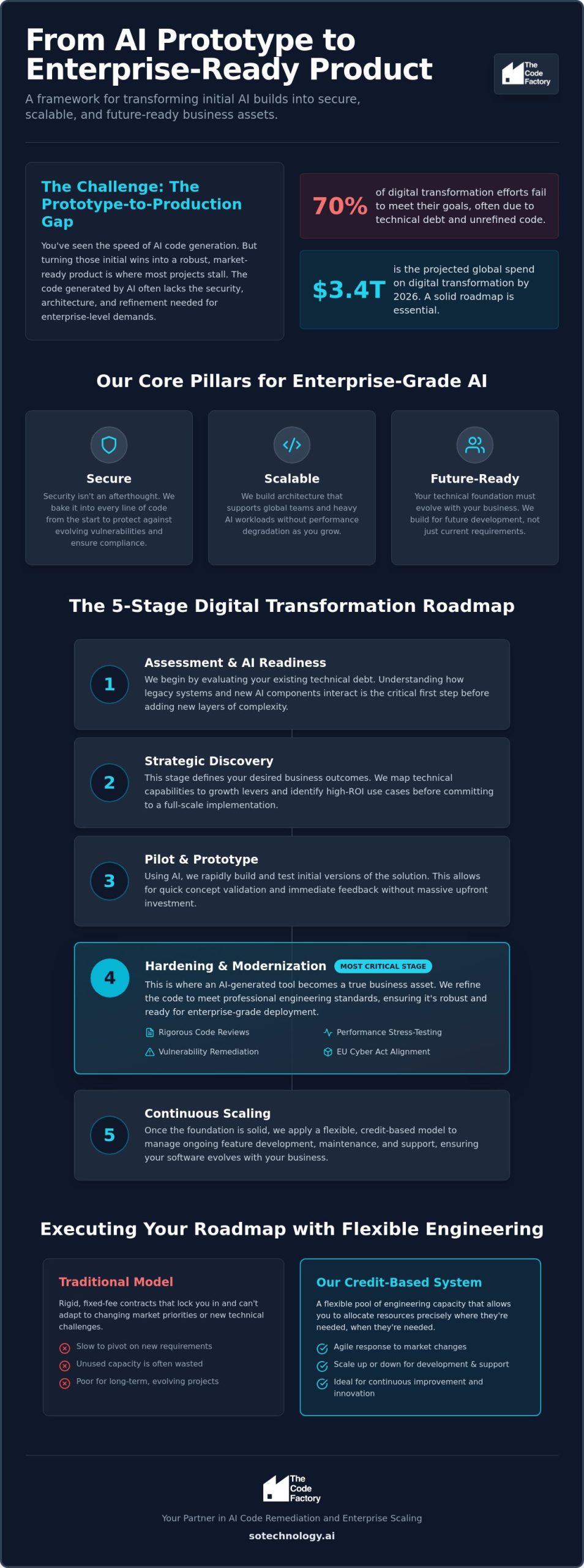
Moving from a functional AI-generated prototype to a resilient, enterprise-grade solution requires a methodical approach. This digital transformation implementation roadmap provides the structure needed to move from experimentation to execution without losing momentum. It’s a common trap to assume a working prototype is a finished product. In reality, the code generated by AI often lacks the security protocols and architectural depth required for long-term growth. We act as your expert guide, helping you navigate these five critical stages.
- Stage 1: Assessment & AI Readiness. We begin by evaluating existing technical debt. It’s vital to understand how your legacy systems and AI-built components interact before adding new layers of complexity.
- Stage 2: Strategic Discovery. This stage defines your desired outcomes. We identify the right tools, such as Digital Agent as a Service (DAaaS), to automate core functions and drive efficiency.
- Stage 3: Pilot & Prototype. We use AI to rapidly build and test initial versions. This proves the concept quickly, allowing for immediate feedback without massive upfront investment.
- Stage 4: Hardening & Modernization. This is the most critical step. We refine AI-generated code, ensuring it’s secure, scalable, and meets professional engineering standards.
- Stage 5: Continuous Scaling. Once the foundation is solid, we apply a credit-based model to manage ongoing feature development and support. This ensures your software evolves alongside your business.
If you’re unsure where your current prototype sits on this scale, scheduling an AI initiative discovery meeting can provide immediate clarity on your next steps.
The Hardening Phase: Moving Beyond the Prototype
The hardening phase is where your digital transformation implementation roadmap turns a technical vision into a business asset. We perform rigorous code reviews and technical debt assessments to identify vulnerabilities that AI might have overlooked. An AI-built tool is only ready for “enterprise-grade” deployment when it’s been stress-tested for security and optimized for performance. We focus on baking in security from the start, ensuring compliance with upcoming 2026 regulations like the EU Cyber Resilience Act.
Measuring ROI at Every Stage
With the global digital transformation market projected to reach $3.4 trillion by 2026, measuring impact is non-negotiable. Key performance indicators should move beyond simple uptime to include metrics like deployment speed and the reduction of manual task hours via Digital Agents. Our credit-based system allows you to pivot your strategy based on these KPIs without the friction of new contract negotiations. You gain the flexibility to allocate resources where they’ll drive the most growth, ensuring your technical investment delivers a clear return.
Executing Your Roadmap with Credit-Based Engineering
Traditional development models struggle to match the velocity of AI-driven growth. Hiring a full-time team is a slow, expensive process; fixed-fee contracts often lack the flexibility needed for a shifting digital transformation implementation roadmap. We solve this through a credit-based system. This “Engineering Currency” provides you with on-demand access to professional developers who specialize in refining AI-generated foundations. It allows your organization to scale capacity up or down as project priorities evolve, ensuring you always have the right expertise without the overhead of permanent hires.
The transition from a prototype to a production-ready application is just the beginning. Most AI-built tools carry hidden technical debt that can stall your progress once you reach a certain user threshold. SoTechnology acts as your strategic partner, filling the technical gaps that in-house teams might face during rapid expansion. We focus on the entire lifecycle of your software, ensuring that the speed of initial generation is matched by the stability of professional engineering standards.
Support and Maintenance as a Strategic Asset
Your digital transformation implementation roadmap shouldn’t end the day you deploy. Effective transformation requires ongoing attention to remain secure and scalable. We treat Support & Maintenance as a proactive strategy rather than a reactive necessity. Through recurring service subscriptions, we ensure your code remains optimized for performance and compliant with the latest security regulations. This steady oversight prevents small technical glitches from snowballing into enterprise-wide failures.
Future-Proofing Through Continuous Development
Scaling organizations must integrate release automation and CI/CD pipelines to stay competitive. Our credit model allows for proactive problem solving before technical debt impacts growth, giving you the freedom to innovate without fear of breaking existing systems. By prioritizing future development through continuous refinement, you ensure your digital assets remain high-quality, long-term solutions that can adapt to any market change. This methodical approach transforms your initial AI wins into a robust foundation for the years ahead.
Building a Resilient Digital Future
The journey from a functional prototype to a market leader requires a steady hand and a clear strategy. By focusing on the hardening phase and integrating security from the start, you ensure your initial digital wins become permanent business assets. Your digital transformation implementation roadmap shouldn’t be restricted by rigid contracts or mounting technical debt. Instead, a flexible credit-based system allows your team to pivot resources toward high-impact results while maintaining a baseline of engineering excellence.
As a global partner for enterprise-ready AI solutions, we provide the expertise needed to turn unrefined code into a secure, scalable foundation. We bridge the gap between technical complexity and business value, helping you manage the entire lifecycle of your project from initial generation to future development. You don’t have to navigate these complexities alone. We’re here to help you refine your AI-built foundations into high-quality, long-term solutions.
Start your transformation with an AI Discovery Workshop today. Let’s work together to build a robust digital infrastructure that supports your organization’s growth for years to come.
Frequently Asked Questions
What is the first step in a digital transformation implementation roadmap?
The first step in a digital transformation implementation roadmap is a comprehensive assessment of your existing technical debt and AI readiness. This initial phase involves evaluating your current AI-built foundations to identify security gaps and architectural weaknesses. By performing a rigorous audit before moving to full-scale development, you can ensure that your roadmap is built on a stable, secure foundation. This proactive approach prevents costly reworks and sets a clear trajectory for future growth.
How does a credit-based system help with digital transformation?
A credit-based system provides the flexible engineering capacity required to adapt to changing project priorities without the friction of new contract negotiations. Instead of being locked into rigid, fixed-fee projects, you can allocate engineering currency to specific needs as they arise. This model is particularly effective for scaling organizations that require on-demand expertise for tasks ranging from code reviews to advanced feature development. It ensures your transformation remains agile and results-oriented throughout the entire development lifecycle.
Why is security a primary concern for AI-built software?
Security is a primary concern because AI-generated code often lacks the deep architectural safeguards required for enterprise-grade deployment. While AI can produce functional prototypes quickly, it may overlook complex vulnerabilities or fail to meet modern compliance standards like the EU Cyber Resilience Act. Professional intervention ensures that security is baked into the software rather than treated as an afterthought. This transition to a secure codebase is essential for protecting your data and maintaining user trust as you scale.
Can I use a digital transformation strategy to modernize legacy systems?
Yes, a modern digital transformation implementation roadmap is designed to bridge the gap between legacy systems and future-ready technology. By utilizing AI Discovery Workshops, organizations can identify high-ROI opportunities to modernize outdated infrastructure through targeted automation and cloud integration. This process transforms rigid legacy code into a scalable asset that supports current business objectives. It allows you to preserve your historical data while leveraging the speed and efficiency of contemporary engineering standards for future development.