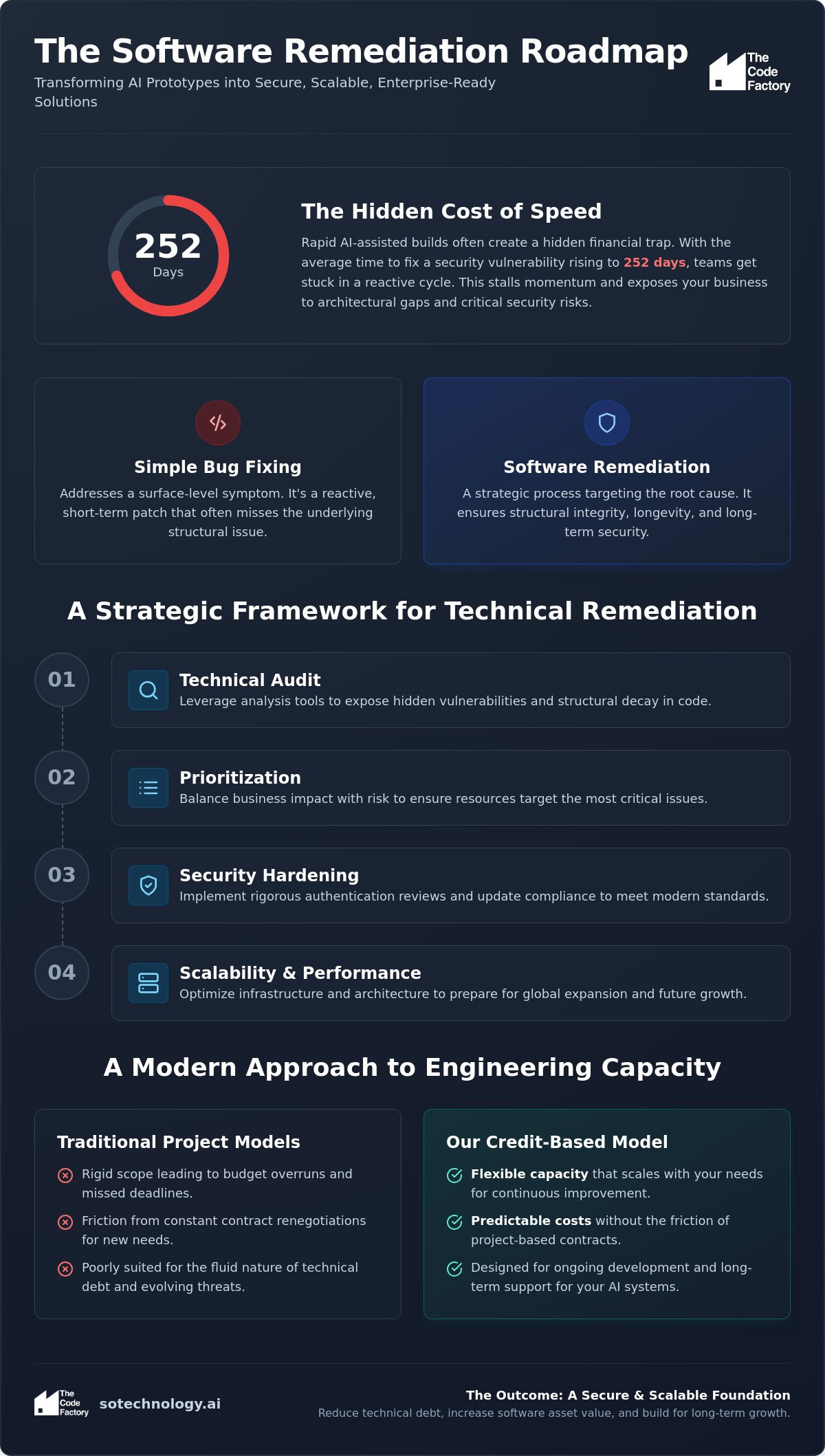
What if the rapid speed of your AI-assisted build is actually creating a hidden financial trap? With the average time to fix a security vulnerability rising to 252 days, many teams find themselves stuck in a cycle of reactive patching rather than proactive building. It’s a common frustration; you’ve used cutting-edge tools to launch quickly, but now you’re facing architectural gaps and security risks that threaten to stall your momentum. Software Remediation is the essential bridge that turns these fragile prototypes into robust, enterprise-ready solutions.
This article shows you how to move beyond the stress of technical uncertainty toward a secure, scalable software foundation. We’ll outline a clear roadmap for hardening your code, whether it’s a fresh AI-generated project or a legacy system that’s showing its age. You’ll discover how a credit-based engineering model provides the flexible capacity needed to reduce technical debt while keeping maintenance costs predictable. By the end, you’ll have a strategic perspective on how to mature your tech stack for long-term impact and growth.
Key Takeaways
- Understand why Software Remediation is a proactive strategy for hardening your tech stack by addressing root architectural causes rather than surface-level symptoms.
- Learn how to utilize a technical audit to identify hidden security vulnerabilities and technical debt in both AI-generated prototypes and legacy systems.
- Discover how to prioritize technical improvements by balancing business impact with risk to ensure engineering resources are used efficiently.
- Explore how a credit-based engineering model provides the flexible capacity needed for continuous support and predictable maintenance costs.
- Gain a clear roadmap for transforming fragile code into a secure, scalable foundation ready for enterprise-level production.
What is Software Remediation? Beyond the Dictionary Definition
While a dictionary might define it as simply “the act of remedying,” software remediation is a far more rigorous, systematic process. It involves identifying and resolving the technical debt, security flaws, and architectural weaknesses that accumulate during rapid development cycles. Many teams mistake this process for simple “bug fixing,” but the two are distinct. While bug fixing addresses a surface-level symptom, the broader systematic approach targets the root cause and the structural integrity of the system. Software remediation is a strategic investment in an application’s longevity and security.
The Remediation vs. Rebuild Debate
Choosing between fixing an existing system and starting over is a critical decision. A complete “greenfield” rebuild is often seen as a fresh start, yet it carries immense risk and high costs that can drain resources for years. Strategic technical updates offer a more pragmatic path, allowing businesses to salvage core logic while modernizing the infrastructure. The tipping point arrives when legacy systems become so fragile that they cause frequent business disruption. At this stage, targeted intervention is no longer optional.
Remediation in the Age of AI
The rise of AI-generated code has introduced a new layer of complexity to the 2026 tech landscape. While tools can generate logic in seconds, the resulting code often lacks a coherent architecture and contains hidden security vulnerabilities. Professionalizing these builds requires a structured Vulnerability management process to ensure the code is truly enterprise-ready. As AI in digital transformation becomes the standard, successful organizations are those that implement a remediation layer to bridge the gap between a fast prototype and a secure, scalable product.
A Strategic Framework for Effective Technical Remediation
Effective software remediation requires more than just a list of fixes; it demands a structured approach that aligns with business objectives. Moving from a state of technical debt to architectural excellence follows a methodical four-step process. First, a Technical Audit leverages tools like The Code Registry to expose hidden vulnerabilities and structural decay. Second, Prioritization ensures that resources are allocated to tasks with the highest business impact. Third, Security Hardening involves rigorous authentication reviews and compliance updates. Finally, Scalability and Performance optimizations prepare the infrastructure for global expansion.
Professionalizing AI-Assisted Builds
Turning a working prototype into a secure product is where many AI initiatives stall. While AI speeds up initial development, it often skips the deep architectural reviews necessary for enterprise scale. Professionalizing these builds means ensuring that AI-generated logic integrates seamlessly with broader AI consulting services to maintain a cohesive ecosystem. This transition is less about rewriting and more about hardening the existing foundation to support long-term growth.
Security and Compliance Hardening
Proactive software health is the only way to avoid the record-high costs of modern data breaches. By adopting a high-level strategy similar to CISA’s remediation framework, organizations can address vulnerabilities before they become exploitable entry points. This is particularly vital for legacy systems that must now meet 2026 regulatory standards. Remediation provides the necessary bridge to bring older infrastructure into the modern, secure era. If you’re ready to identify your system’s critical gaps, you can book a strategy session to map out a clear technical roadmap.
Executing Remediation with Flexible Engineering Capacity
Traditional project-based models often struggle with the fluid nature of technical debt. When you’re dealing with evolving security threats or expanding AI prototypes, a rigid scope usually leads to budget overruns and missed deadlines. Software remediation requires a more adaptable approach. We solve this by providing flexible engineering capacity that scales with your needs. This model allows for continuous improvement without the friction of constant contract renegotiations.
Measuring the success of these efforts is vital for maintaining stakeholder confidence. By tracking the reduction of technical debt and the corresponding increase in software asset value, you can see the tangible impact on your bottom line. Aligning these technical improvements with NIST’s Secure Software Development Framework ensures that your path to a secure product is both measurable and compliant with global standards. Fractional CTO support can further augment this process, providing the strategic oversight needed to bridge the gap between raw code and business value.
The Credit Model: Engineering Currency for Growth
Our credit-based engineering model acts as a flexible currency for your tech stack. Subscribing to monthly credits allows your team to tackle agile remediation across multiple applications simultaneously. If priorities shift mid-month, you can easily redirect resources to address an urgent security patch or a performance bottleneck. The ability to roll over credits ensures that your investment is never wasted, providing a steady hand for ongoing development and support.
Partnering for Long-Term Software Health
SoTechnology acts as a collaborative partner for maturing AI-driven projects and stabilizing legacy systems. We don’t just fix bugs; we provide the architectural hardening necessary to turn a fragile prototype into a robust enterprise solution. The journey begins with a discovery phase to identify your most critical risks. From there, we build a dedicated roadmap that moves your software from a state of uncertainty to a secure, scalable foundation. This partnership ensures your technology remains an asset rather than a liability.
Building a Resilient Software Foundation
Transitioning from a fast AI prototype to a production-ready enterprise asset requires a deliberate strategy. We’ve explored how a systematic approach to Remediation bridges the gap between fragile code and a secure, scalable foundation. By focusing on root causes rather than surface symptoms, you protect your technical investment and ensure your infrastructure can handle future growth. Our specialist expertise in both legacy systems and cutting-edge AI builds provides the technical proficiency your project needs to mature.
Executing this transformation shouldn’t be a source of technical stress or unpredictable costs. Our flexible credit-based engineering model moves the focus from billable hours to tangible outcomes, giving you the capacity to iterate with confidence. Whether you’re hardening a new build or modernizing older infrastructure, we act as your strategic partner in reducing technical debt. It’s time to turn your technical vision into a robust reality that supports your business goals for years to come.
Frequently Asked Questions
What is the difference between software remediation and a software update?
Software remediation targets the structural integrity and root causes of technical debt or security flaws, while a software update typically focuses on deploying new features or version-specific patches. Think of an update as a fresh coat of paint and remediation as reinforcing the building’s foundation. It’s a deep-level intervention designed to make the system more secure and scalable for the long term.
How do I know if my AI-generated application needs remediation?
Most AI-generated applications need professional hardening if they were built as quick prototypes without a formal architectural review. You should look for signs like inconsistent code patterns, hidden security vulnerabilities, or difficulty scaling as user traffic increases. If your build lacks a clear roadmap for future development or feels fragile during minor updates, it’s a strong indicator that professional intervention is required to reach enterprise standards.
Can remediation be done without taking my software offline?
Yes, Remediation is frequently executed without taking your system offline by using modern deployment strategies like blue-green or canary releases. We focus on a phased approach that allows for continuous improvement while maintaining service availability. This ensures that your business operations remain steady while we harden the underlying infrastructure and resolve critical technical debt in the background.
How long does a typical technical debt remediation project take?
The timeline for a technical debt project varies based on the complexity of the code and the volume of identified risks. A discovery phase typically takes a few weeks to map out the critical gaps, while the execution phase is often managed through an ongoing credit-based model. This flexible approach allows you to address the most urgent security and scalability issues first, ensuring immediate impact without the need for a massive, multi-month delay.