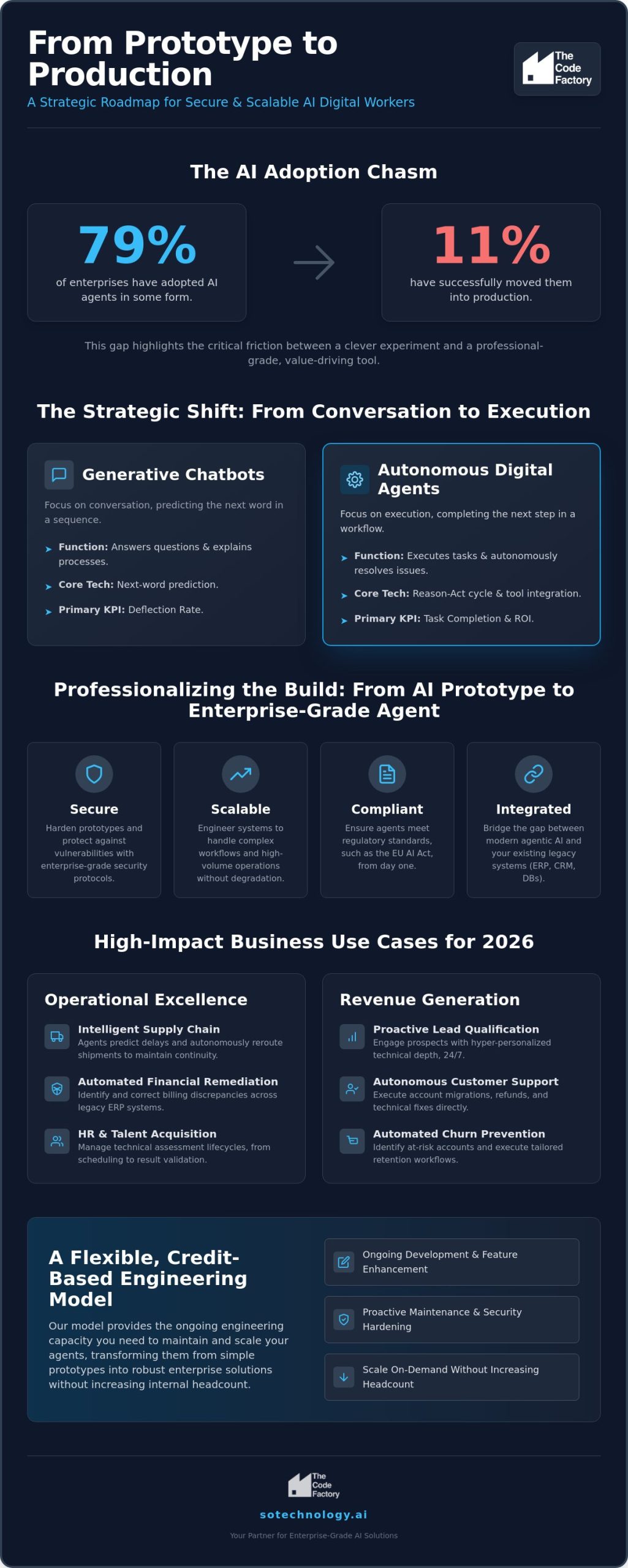
While 79% of enterprises have adopted AI agents in some form, only 11% have successfully moved them into production. This striking gap reveals the hidden friction between a clever experiment and a professional-grade tool. You’ve likely experimented with generative AI already; however, moving toward high-impact business use cases for digital agents requires more than just a prompt. It demands a rigorous focus on security, scalability, and the ability to bridge the gap with your existing legacy systems. You’re right to be skeptical of hallucinations and concerned about the engineering overhead required to keep these autonomous workflows running smoothly.
This guide provides a strategic roadmap for 2026, showing you how to execute complex workflows that drive measurable value without ballooning your headcount. We identify the most effective business use cases for digital agents, from automated software remediation to autonomous customer operations. You’ll learn how a flexible, credit-based engineering model provides the continuous support you need to scale your initial builds. We also examine how to manage technical debt so your agents remain secure and compliant as new regulations, such as the EU AI Act, take effect this August.
Key Takeaways
- Learn the critical distinction between generative chatbots and autonomous digital agents to transition your AI strategy from simple conversation to goal-oriented execution.
- Explore high-impact business use cases for digital agents that drive measurable enterprise value by automating complex workflows across supply chains and legacy financial systems.
- Discover the remediation steps necessary to harden AI-assisted prototypes into secure, scalable, and compliant professional products that meet 2026 regulatory standards.
- Understand how to bridge the gap between modern agentic AI and your existing legacy systems to ensure seamless, long-term technical integration and performance.
- See how a flexible, credit-based service model provides the ongoing engineering capacity you need to maintain and scale your agents without increasing internal headcount.
Beyond Chatbots: Defining the Strategic Shift to Digital Agents
The industry is moving away from basic conversational interfaces. While generative AI focuses on predicting the next word in a sequence, agentic AI focuses on completing the next step in a workflow. This distinction is central to identifying high-impact business use cases for digital agents. In 2026, the global market for these autonomous systems is estimated at $10.9 billion, reflecting a massive shift toward “Agentic Execution.” Organizations no longer want a bot that explains a process; they want a digital worker that executes it. Leveraging AI consulting services is often the first step to pinpointing which legacy workflows are ready for this transition.
The Anatomy of an Autonomous Digital Worker
An Intelligent agent operates through a continuous Reason-Act cycle. It doesn’t just process text; it interacts with software. By using tool-calling and API integrations, these agents can access your CRM, query a legacy database, or update an ERP system. This ability to bridge the gap between modern AI and established infrastructure is what makes a build truly professional. Secure and scalable agents don’t just “chat.” They reason through multi-step logic to achieve a specific goal. This allows them to handle business use cases for digital agents that were previously impossible with traditional automation.
From Conversation to Conversion: The ROI of Autonomy
Success is no longer measured by deflection rates alone. Instead, the primary KPI has shifted to Task Completion. Research shows that AI agents reaching production deliver an average ROI of 171%. By reducing the “human-in-the-loop” requirement for standard business processes, companies can scale operations without a corresponding increase in headcount. Our Digital Agent as a Service (DAaaS) model supports this growth through a flexible, credit-based system. This ensures your agents remain high-performing and secure as they evolve from simple prototypes into robust enterprise solutions.
High-Impact Business Use Cases for Digital Agents in 2026
Identifying the right business use cases for digital agents is about moving from generic automation to strategic execution. While many organizations struggle with data quality, losing an average of $15 million annually, digital agents act as the connective tissue between modern AI and legacy systems. They don’t just surface information; they resolve the underlying issues. If you are ready to identify which high-ROI workflows to prioritize, book an initiative discovery meeting with our team.
Operational Excellence: Internal Process Automation
Digital agents serve as Strategic Translators within your organization, pulling data from siloed legacy databases to complete complex tasks. Business process automation with AI evolves into a self-correcting ecosystem when agents gain the autonomy to not only identify bottlenecks but proactively resolve them. This transition is essential for companies looking to professionalize their initial AI builds into robust enterprise tools.
- Intelligent Supply Chain Orchestration: Agents predict potential delays by analyzing real-time logistics data and autonomously reroute shipments to maintain continuity.
- Automated Financial Remediation: Agents identify billing discrepancies across legacy ERP systems and execute corrections, ensuring financial data remains secure and scalable.
- HR and Talent Acquisition: Agents manage the technical assessment lifecycle, from scheduling to result validation, freeing teams for high-value engagement.
Revenue Generation: Sales and Customer Experience
The most effective business use cases for digital agents in revenue roles focus on proactive value. Lead qualification agents now engage prospects across time zones with hyper-personalized technical depth, moving beyond basic FAQs. For existing customers, agents provide dynamic support by executing account migrations and refunds directly within your core infrastructure. This level of autonomy is particularly powerful for churn prevention. By identifying at-risk accounts through usage patterns, agents can execute automated retention workflows that offer tailored incentives before a customer decides to leave.
Professionalising the Build: From AI Prototype to Enterprise-Grade Agent
Many developers fall into the “Prototype Trap.” It’s easy to build a functional demo in minutes, but scaling it for real-world business use cases for digital agents is where most projects stall. The gap between a functional script and a production-ready asset is often defined by technical debt and security vulnerabilities. We help bridge this gap by applying a comprehensive AI strategy for growth, ensuring your initial build is secure, scalable, and compliant from day one. This process moves your project beyond a simple experiment into a robust enterprise tool.
Remediation is the key to long-term success. AI-generated code frequently lacks the nuance required for high-stakes business use cases for digital agents, particularly when those agents must interact with legacy systems. We focus on hardening this code and making it resilient enough to handle complex logic without compromising your core infrastructure. Working with a dedicated generative AI implementation partner ensures that your digital workers can navigate established systems while utilizing the latest agentic capabilities.
The Credit-Based Model for Continuous AI Remediation
Software is never static. Our Digital Agent as a Service (DAaaS) model utilizes a flexible, credit-based system to provide ongoing engineering capacity. This isn’t a one-off transaction; it’s a partnership that facilitates future development. You can use monthly credits to address technical debt, perform security hardening, or evolve your agent’s features as your needs change. This model provides the professional support required to maintain a secure and scalable environment without the overhead of a massive internal headcount.
Security and Scalability: The Non-Negotiables
Production readiness requires more than just a successful test run. It demands rigorous authentication reviews and vulnerability remediation for every agentic access point. We implement automated testing and CI/CD pipelines specifically tailored for AI agents to ensure consistent performance. This proactive approach is vital for compliance. As major regulations like the EU AI Act come into full force on August 2, 2026, your digital agents must be technically sound and fully governed to protect your enterprise and your customers.
Scaling Your Agentic Strategy for 2026 and Beyond
The transition from simple chatbots to autonomous digital workers is no longer a future concept. It’s a present necessity for enterprise growth. Successfully implementing business use cases for digital agents requires a deliberate shift from experimental prototypes to professional-grade software. This means prioritizing security hardening and scalability while ensuring your new tools integrate seamlessly with established legacy systems. You’ve already taken the first step by exploring AI; now it’s time to ensure those builds are production-ready.
Our team specializes in this transition, providing the proactive remediation and technical debt management needed to turn AI-assisted builds into reliable enterprise assets. With our flexible credit-based model, you gain access to the engineering capacity required for continuous development and long-term support. It’s time to move beyond the prototype trap and build agents that deliver actual, measurable value across your organization.
We are here to act as your strategic partner, helping you navigate technical complexities with clarity and confidence. Let’s build something secure, scalable, and truly transformative together.
Frequently Asked Questions
What is the difference between a digital agent and a traditional chatbot?
A digital agent is defined by its ability to execute tasks, whereas a traditional chatbot is primarily designed for conversation. While chatbots provide answers based on text prediction, agents use a reason-act cycle to interact with software and APIs. This allows them to handle complex business use cases for digital agents that require autonomous decision-making and tool usage rather than just simple information retrieval.
How do I identify the best business use case for a digital agent in my organisation?
Focus on high-frequency, multi-step workflows that currently rely on manual intervention to bridge siloed data. The best business use cases for digital agents involve processes where an autonomous worker can access legacy systems to resolve discrepancies or orchestrate logistics. Look for tasks with measurable outcomes, such as automated billing remediation, where the agent’s ability to reason through logic provides a clear return on investment.
Are digital agents secure enough to access our internal legacy systems?
Digital agents can securely access internal legacy systems if they undergo professional remediation and rigorous security hardening. It’s essential to implement robust authentication reviews and secure access points to protect your core infrastructure. By professionalizing an initial AI prototype, you ensure that the agent operates within a secure and scalable framework that meets modern compliance standards while interacting with older databases.
How much does it cost to maintain a digital agent vs. hiring a developer?
Utilizing a credit-based service model provides a more flexible and cost-efficient alternative to hiring a dedicated developer for maintenance. This approach allows you to access specialized engineering capacity on demand to address technical debt and security updates. It ensures your digital agents remain production-ready and high-performing without the significant overhead and management requirements associated with expanding your permanent internal technical team.