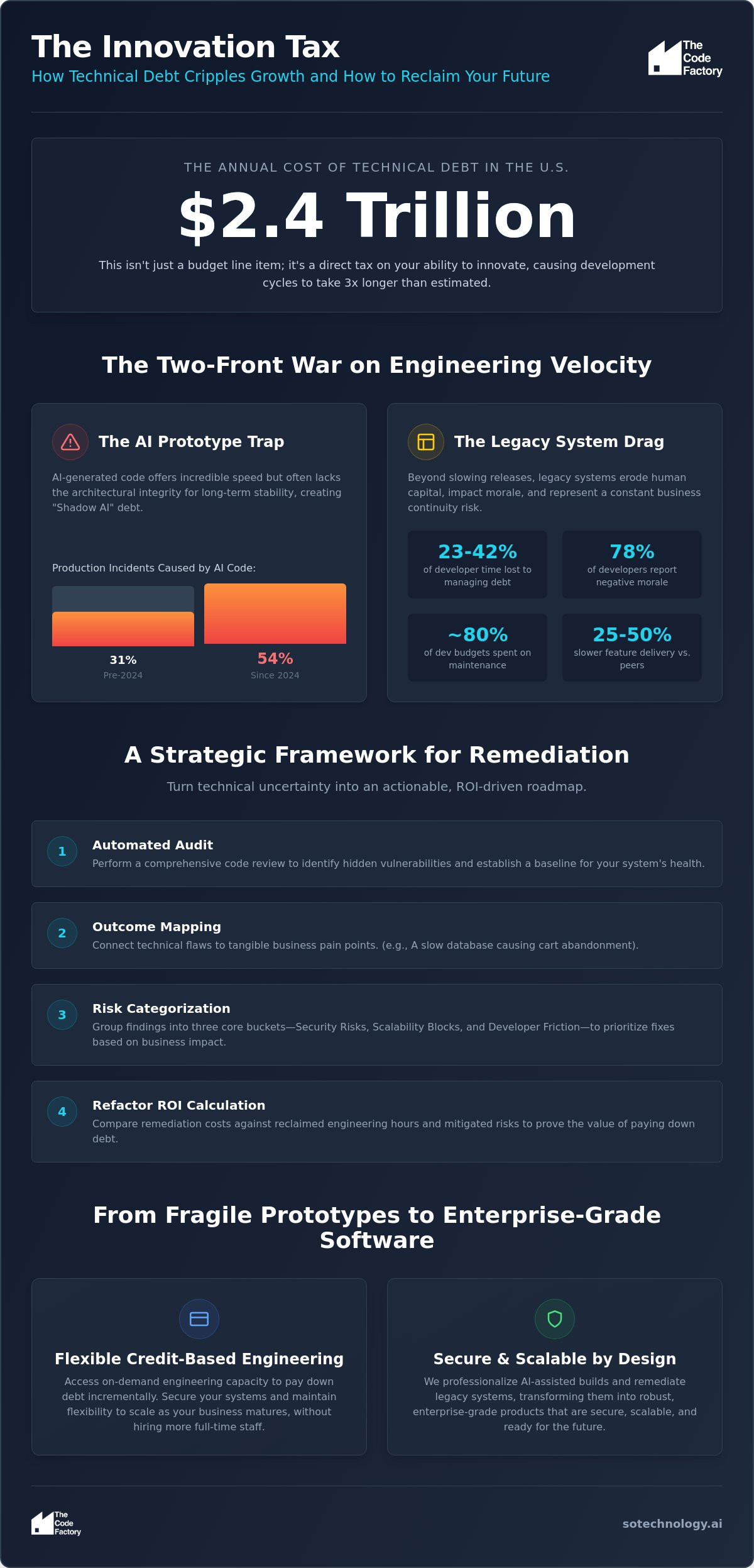
Did you know that technical debt costs US companies over $2.4 trillion annually? It’s a staggering figure that highlights how the hidden cost of technical debt isn’t just a line item on a balance sheet; it’s a direct tax on your ability to innovate. You’ve likely felt this friction when development cycles take three times longer than estimated or when AI-generated code introduces unexpected production incidents. It’s frustrating to watch your team struggle with legacy systems while unmanaged AI code adds another $58,000 in hidden costs per engineer every year.
We understand that you need to move from fragile prototypes to enterprise-grade software. This guide will show you how to quantify that innovation tax and provide a pragmatic framework to assess and remediate your systems for a scalable, AI-ready future. We’ll explore how to professionalize AI-generated code and use a flexible, credit-based model to secure your infrastructure without the need to hire more full-time staff. By the end, you’ll have a clear path to turn technical liabilities into strategic assets that drive long-term growth.
Key Takeaways
- Identify the specific ways the cost of technical debt functions as a compounding tax on your engineering velocity and long-term budget.
- Master a strategic assessment framework that maps code-level vulnerabilities to tangible business outcomes like system performance and deployment speed.
- Discover how to professionalize AI-assisted builds into robust, enterprise-grade products that are both secure and scalable for future growth.
- Leverage a credit-based engineering model to access flexible capacity for remediating legacy systems and securing modern AI code.
- Shift from reactive fixes to a proactive software remediation strategy that ensures your infrastructure is ready for the technical demands of 2026.
Quantifying the Innovation Tax: What Technical Debt Costs Your Business in 2026
Understanding what technical debt is through a lens of Strategic Translation reveals a simple truth: it’s the delta between a functional AI prototype and a professional, enterprise-grade product. While a prototype proves a concept, an enterprise solution requires rigorous security and scalability to survive in a production environment. Technical debt is a compounding interest on short-term technical shortcuts that eventually blocks all strategic movement.
The financial impact is measurable and severe. Research from vFunction indicates that many organizations now spend up to 80% of their development budgets on maintenance rather than innovation. This cost of technical debt functions as a heavy tax on your competitive edge. Instead of building new features that drive revenue, your team is stuck remediating old ones just to keep the lights on. High-debt organizations deliver features 25% to 50% slower than their peers, effectively stalling their market growth while competitors move ahead.
The AI Prototype Trap: Speed vs. Scalability
AI-generated code offers incredible speed, yet it often lacks the architectural integrity required for long-term stability. This creates a “Shadow AI” debt where unvetted tools are woven into core workflows without proper governance or oversight. Since 2024, the proportion of engineers reporting production incidents caused by AI-generated code has risen from 31% to 54%. Without a clear path to professionalize these builds, the initial speed gain quickly turns into a significant liability that compromises your system’s security.
The Hidden Costs of Legacy Systems
Legacy systems do more than just slow down your releases; they erode your human capital. Developers spend between 23% and 42% of their work week managing technical debt, which directly impacts their output and morale. In fact, 78% of developers report negative morale when forced to work on messy legacy infrastructure. This friction leads to higher attrition and makes it harder to hire elite talent who want to work with modern, secure technologies. Beyond staffing, these systems represent a constant business continuity risk that leaves you vulnerable to modern security threats.
To address these challenges effectively, we utilize a credit-based model that provides flexible engineering capacity. This “currency” allows you to pay down debt incrementally, securing your systems while maintaining the flexibility to scale as your business matures.
How to Conduct a Strategic Technical Debt Assessment
Calculating the true cost of technical debt requires moving beyond surface-level metrics. It’s not enough to know your code is “messy”; you must understand how that mess impacts your bottom line. The staggering costs of technical debt seen in large scale organizations prove that unmanaged systems eventually collapse under their own weight. A strategic assessment turns technical uncertainty into a clear, actionable roadmap for remediation.
- Step 1: Automated Audit. Perform a comprehensive code review using tools like The Code Registry. This identifies hidden vulnerabilities and provides a baseline for your system’s health.
- Step 2: Outcome Mapping. Connect technical flaws to business pain. For example, a legacy database might slow your checkout process by 4 seconds, directly causing cart abandonment.
- Step 3: Categorization. Group your findings into three buckets: Security Risks, Scalability Blocks, and Developer Friction. This helps you prioritize fixes based on business risk rather than technical preference.
- Step 4: Refactor ROI. Calculate the return by comparing the remediation cost against reclaimed engineering hours. If a $10,000 refactor saves 20 developer hours per month, the investment pays for itself in less than a year.
Leveraging Professional Code Review Services
Internal teams often struggle with bias when evaluating their own work. Our professional code review services provide the necessary objectivity to identify deep architectural debt that automated tools might miss. This is particularly vital for AI Readiness Assessments. Before you deploy Digital Agents, your underlying infrastructure must be secure and scalable to handle the increased load and complexity AI introduces.
Quantifying the “Debt Tax” for Stakeholders
To gain executive buy-in, you must translate technical issues into the language of growth. Use this simple formula: Growth Sacrifice = (Engineering Hours Lost to Debt x Average Hourly Rate) + (Estimated Revenue Lost to System Friction). Presenting this figure clarifies why debt remediation is a prerequisite for your AI in digital transformation roadmap. If you’re ready to see where your systems stand, you can schedule an AI initiative discovery meeting to begin your assessment.
Remediation Strategies: Paying Down Debt with Flexible Engineering
Software remediation is often viewed as a reactive fix, yet successful leaders treat it as a proactive business strategy. While the initial speed of an AI build is enticing, the long-term cost of technical debt becomes unsustainable without a clear path toward professionalization. By prioritizing your efforts through a “Security and Scalability” framework, you can systematically transform fragile prototypes into robust, enterprise-ready solutions.
Flexible engineering capacity serves as the strategic bridge between your current technical mess and your desired business impact. Most internal teams are fully committed to maintenance, leaving little room for critical refactoring. Accessing external expertise allows you to stabilize your core infrastructure without disrupting your primary development roadmap or delaying essential feature releases.
The Credit-Based Model for Incremental Paydown
The Code Factory utilizes a credit-based system that functions as “engineering currency.” This model provides the flexibility to pay down debt incrementally rather than all at once. It’s a pragmatic approach that allows you to:
- Access specialist expertise like Fractional CTOs or Security Experts exactly when needed.
- Avoid the overhead and long-term commitment of permanent headcount bloat.
- Scale your remediation efforts up or down based on your current budget and project requirements.
- Ensure ongoing support for both legacy systems and modern AI-generated code.
Professionalising AI-Built Software
Turning an AI prototype into a professional-grade product requires a shift in focus from “it works” to “it’s secure and scalable.” This involves rigorous code reviews and architectural hardening to ensure your tech stack is truly ready for 2026 automation. Leveraging AI consulting services can help you navigate this transition, ensuring that your AI builds are not just innovative, but built to last in a professional enterprise environment. For organizations seeking ongoing stability after remediation, enterprise website support services provide the strategic engineering capacity needed to harden legacy systems and maintain production-ready platforms at scale.
Securing Your Infrastructure for the AI-Driven Future
Transitioning from a high-speed prototype to a professional-grade product requires more than just a quick fix; it demands a strategic commitment to architectural integrity. By understanding the true cost of technical debt, you can move beyond endless maintenance cycles and begin reinvesting in the actual growth of your business. We’ve seen how automated identification through our partnership with The Code Registry provides the clarity needed to start this journey with confidence.
Our credit-based model offers a flexible way to access the engineering currency required for proactive remediation without the burden of hiring new full-time staff. This approach allows you to bridge the gap between legacy systems and modern AI agents while ensuring your code remains secure and scalable. Having a steady guide helps strip away the stress of technical uncertainty so you can focus on what matters most: your long-term success.
Take the first step toward a robust enterprise solution today. Book an AI Discovery Workshop to assess your technical health and AI readiness and turn your technical liabilities into a strategic advantage. You’ve built the vision; now let’s make it enterprise-ready.
Frequently Asked Questions
What is the first sign that my business has too much technical debt?
The most immediate sign is a noticeable drop in engineering velocity where simple updates take significantly longer than estimated. When your team spends over 40% of their week managing legacy systems rather than building new features, the cost of technical debt has already begun to stifle your growth. You’ll also see frequent production outages or security vulnerabilities appearing in previously stable modules, indicating that your underlying architecture can no longer support modern demands.
How does technical debt impact our ability to use AI and Digital Agents?
Technical debt acts as a barrier to entry for advanced automation because AI models and Digital Agents require a stable, well-structured foundation to function effectively. If your underlying architecture is fragmented, your AI projects are more likely to join the 95% of enterprise AI initiatives that fail due to data unreadiness or architectural instability. Remediation is a prerequisite for creating secure, scalable AI tools that actually deliver business value rather than adding to your technical burden.
Can we use a credit-based model to fix legacy systems and build new features simultaneously?
Yes, our credit-based model provides the flexible engineering currency needed to handle remediation and new development in parallel. Instead of choosing between fixing the past or building the future, you can allocate credits to access specialist expertise for securing legacy systems while your core team focuses on innovation. This approach ensures ongoing support and professional oversight for your tech stack without the need for permanent headcount increases or long-term hiring cycles.
Is AI-generated code inherently more debt-heavy than human-written code?
AI-generated code isn’t inherently flawed, but it often leads to comprehension debt where engineers struggle to maintain or extend code they didn’t personally author. Since 2024, production incidents linked to AI-assisted builds have risen to 54%, highlighting the critical need for professionalization. While AI tools provide incredible speed for initial prototypes, those builds must be paired with rigorous code reviews to ensure the resulting software is secure, scalable, and enterprise-ready.