An AI-generated prototype can get your product to market in record time, but the code that powers your MVP often lacks the structural integrity required for long-term growth. You’ve likely felt that nagging uncertainty about what’s actually under the hood of your AI-built application. It’s a common pressure. You want to scale fast, yet you worry about hidden technical debt and the complex landscape of 2026 data privacy laws like the Indiana Consumer Data Protection Act.
By leveraging professional secure code review services, you can transform these rapid prototypes into a secure and scalable foundation that satisfies both rigorous engineering standards and cautious investors. Our approach bridges the gap between initial AI creation and professional-grade engineering through a flexible, credit-based system designed for modern development cycles. You’ll learn how to transition your project into a production-ready application using our comprehensive 2026 security audit checklist. This roadmap covers everything from API security to dependency visibility, ensuring your software is robust and perfectly positioned for future development.
Key Takeaways
- Bridge the AI visibility gap by identifying hidden architectural flaws in your generated code before they become costly technical debt.
- Leverage professional secure code review services to audit your software supply chain and verify the integrity of every third-party dependency.
- Learn the specific 2026 audit criteria needed to transform an initial AI prototype into a Secure and Scalable application.
- Transition from a passive security report to an active remediation plan using a modern, flexible credit-based system.
- Build a robust foundation for future development that provides the transparency and confidence required by investors and stakeholders.
Why Application Security Audit Services are Non-Negotiable in 2026
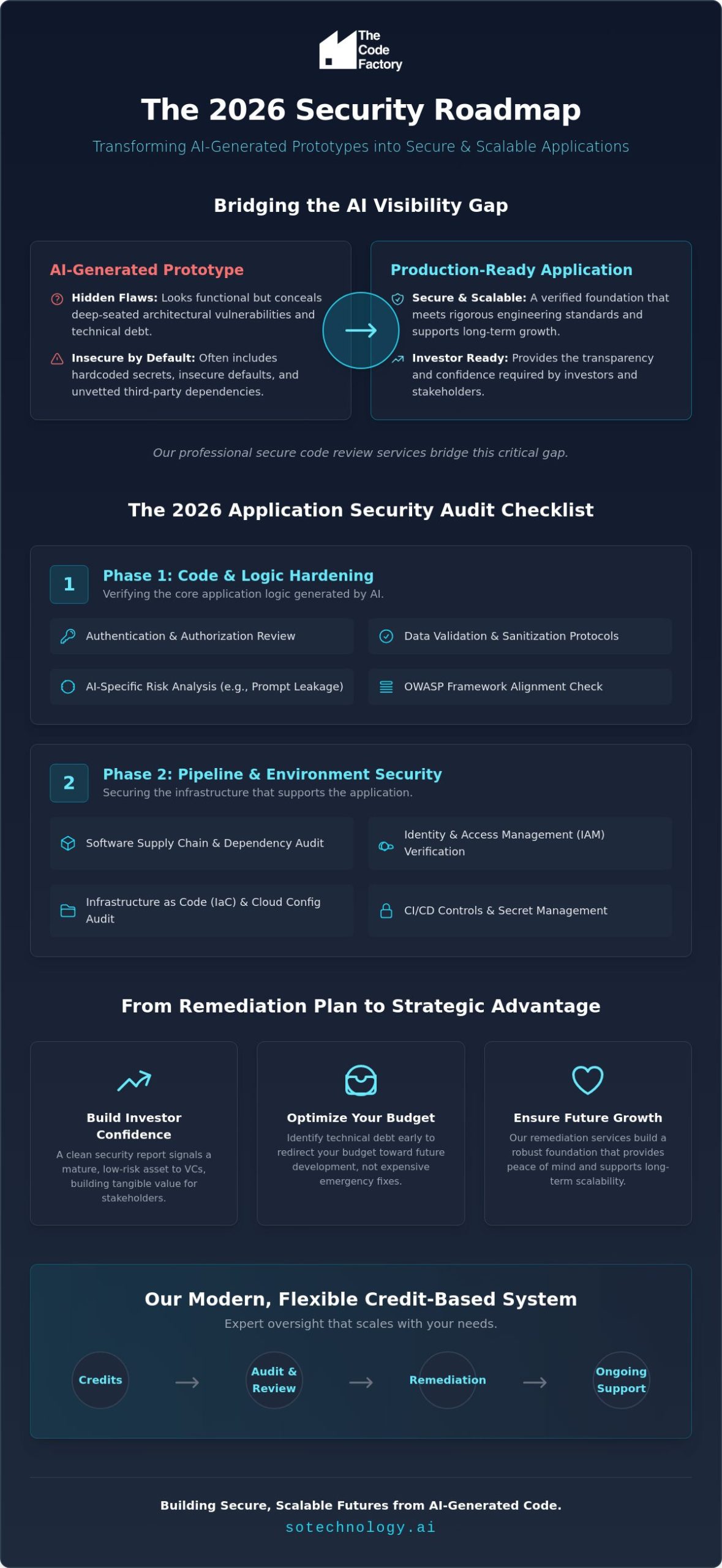
Modern application security audits have evolved into a comprehensive strategic review of code, logic, and infrastructure. While automated tools provide a baseline, they often miss the nuanced context that only expert-led secure code review services can provide. This distinction is critical in 2026. The “AI visibility gap” makes it easier than ever to ship code that looks perfect but contains deep-seated architectural vulnerabilities. We see a shift from one-time static scans toward continuous security hardening. This ensures that as your codebase evolves, its integrity remains intact.
The Risk of AI-Generated Foundations
AI-generated code is exceptional at solving immediate logic puzzles, but it often operates without a global understanding of security best practices. Just because your application functions doesn’t mean it’s enterprise-ready. Many AI-built prototypes suffer from insecure defaults or hardcoded secrets that remain invisible during basic testing. A formal code review process acts as a necessary filter. It ensures that your initial generation is refined into a Secure and Scalable product before you commit to large-scale deployment. This level of production-readiness is what separates a weekend project from a viable business application.
Strategic Benefits for Stakeholders
A high-quality security audit does more than protect data; it builds tangible value for stakeholders. For venture capital and private equity firms, a clean security report is a signal of a mature, low-risk asset. By identifying technical debt early in the lifecycle, you can redirect your budget toward future development rather than expensive emergency fixes. Our model uses a flexible credit-based system to provide this expert oversight. This allows you to scale your security efforts alongside your growth without the overhead of a full-time in-house team. It transforms security from a roadblock into a strategic advantage that gives investors and partners absolute peace of mind.
The 2026 Application Security Audit Checklist: From Prototype to Production
Moving from a rapid AI prototype to a robust enterprise application requires a structured approach to verify every layer of your software stack. While AI assistants accelerate the build phase, they often lack the foresight to configure complex security perimeters. A professional audit serves as the bridge between a functional demo and a professional-grade solution. Our secure code review services focus on identifying where AI-generated logic might deviate from engineering standards, ensuring your application is Secure, Scalable, and ready for future development.
Phase 1: Code and Logic Hardening
AI models are excellent at generating functional logic but often struggle with context-specific security nuances. This phase involves a deep dive into custom logic, specifically focusing on authentication and authorization mechanisms. We scrutinize data validation and sanitization protocols to prevent common injection attacks. For 2026, we pay special attention to prompt leakage risks and insecure patterns inherent in AI-generated blocks. Following a recognized framework like the OWASP secure code review checklist ensures no standard vulnerability is overlooked, while our expert team interprets how these risks affect your specific business logic.
Phase 2: Pipeline and Environment Security
Security extends far beyond the source code. We perform a rigorous inventory and dependency analysis to audit your software supply chain, identifying risks in open-source components that AI might have suggested. This phase also covers:
- Identity and Access Management (IAM): Verifying permission levels and authentication flows to ensure strict access control.
- Infrastructure as Code (IaC): Auditing cloud configurations to ensure they are resilient and ready for global growth.
- CI/CD Controls: Assessing secret management and pipeline security to prevent unauthorized code injections.
Validating your logging and alerting systems ensures you’re prepared for the realities of a live production environment. Our secure code review services operate on a flexible credit-based system, allowing you to address these technical requirements at a pace that matches your roadmap. If you’re ready to harden your application for the next stage of growth, you might consider a discovery meeting to map out your specific audit priorities.
Implementing Remediation: Turning Audit Findings into Action
Most automated tools or traditional consulting firms deliver a static PDF of vulnerabilities and leave the heavy lifting to your internal team. This gap between discovery and resolution is where many AI-driven projects stall. Our approach transforms that report into a dynamic remediation roadmap. By utilizing professional secure code review services, you gain more than just visibility; you gain the engineering capacity to resolve issues. The Code Registry identifies the architectural risks, while The Code Factory provides the talent to execute the necessary fixes.
Effective remediation requires a clear hierarchy of action. We prioritize critical security holes that threaten immediate data integrity while simultaneously planning for long-term scalability. This dual focus ensures your application isn’t just patched, but structurally sound. Adopting proven code review strategies allows us to integrate security hardening directly into your ongoing development lifecycle. It’s about moving from a reactive “fix-it” mindset to a proactive engineering culture.
The Credit-Based Model for Flexible Support
Your Roadmap to a Production-Ready Application
Achieving a Secure and Scalable foundation follows a logical, three-step progression:
- Step 1: Conduct an initial audit and AI readiness assessment to establish your baseline.
- Step 2: Engage in strategic consultation to prioritize your remediation backlog based on business impact.
- Step 3: Leverage your credits for ongoing maintenance and future development, ensuring your code remains robust as you grow. Pairing this with comprehensive enterprise website support services ensures your digital infrastructure remains hardened and professionally managed at every stage.
Ready to turn your AI-built foundation into a high-quality, long-term solution? Book an AI Discovery Workshop to Secure Your Roadmap and start your journey toward engineering excellence.
Secure Your Software Assets for the Next Phase of Growth
Transitioning from an AI-generated prototype to a production-ready application is a critical milestone in your development journey. As we’ve explored, a robust 2026 audit goes beyond simple bug hunting; it establishes a Secure and Scalable framework that supports long-term expansion. By addressing technical debt early and verifying your software supply chain, you transform a rapid experiment into a high-quality software asset.
Our partnership with The Code Registry allows for precise automated risk detection, while our flexible credit-based model provides the immediate engineering capacity to implement remediation. Utilizing professional secure code review services ensures your application meets enterprise-grade standards, giving you and your stakeholders absolute confidence. This strategic foresight prepares your project for seamless global scaling and future development. Sustaining that momentum over time requires the kind of ongoing strategic oversight that enterprise website support services are specifically designed to provide, bridging the gap between initial remediation and long-term platform resilience. We’re here to act as your expert guide, stripping away the stress of technical uncertainty so you can focus on innovation.
Ready to harden your codebase and protect your investment? Book an AI Discovery Workshop to Secure Your Roadmap today. Let’s turn your vision into a resilient, market-ready reality.
Frequently Asked Questions
What is the difference between a vulnerability scan and a professional code review?
A vulnerability scan identifies known signatures through automation, while professional secure code review services provide a deep manual analysis of your application’s logic. Scans are excellent for catching common bugs, but they often miss complex architectural flaws or broken access controls. Our expert-led reviews bridge this gap. We ensure your AI-built prototype moves beyond basic functionality into a Secure and production-ready environment that satisfies both users and investors.
How long does a typical application security audit take for an AI-built product?
A comprehensive security audit for an AI-generated product generally spans one to three weeks. This timeframe accounts for a rigorous inventory of dependencies and a manual deep dive into custom logic blocks. It’s a methodical process. By the end of this period, you’ll have a clear, actionable roadmap for future development that addresses immediate risks and long-term growth objectives. This ensures your foundation is robust before you attempt to scale.
Why is AI-generated code considered a security risk in 2026?
AI-generated code presents a risk because it often lacks the context of 2026 security standards and can introduce insecure defaults. While AI is fast, it’s prone to suggesting vulnerable libraries or outdated protocols that create hidden technical debt. Professional intervention is necessary. We help you transform rapid prototypes into Secure, high-quality solutions that are robust enough to handle enterprise-level traffic and satisfy increasingly complex data privacy regulations.
Can your credit-based model be used for both security fixes and new feature development?
Yes, our credit-based system allows you to apply engineering credits toward both critical security fixes and the creation of new features. This approach provides a flexible bridge between initial project generation and ongoing expansion. Whether you’re remediating findings from our secure code review services or building a Scalable new module, the process remains seamless. It’s an efficient way to manage engineering capacity without the friction of traditional contracts.