
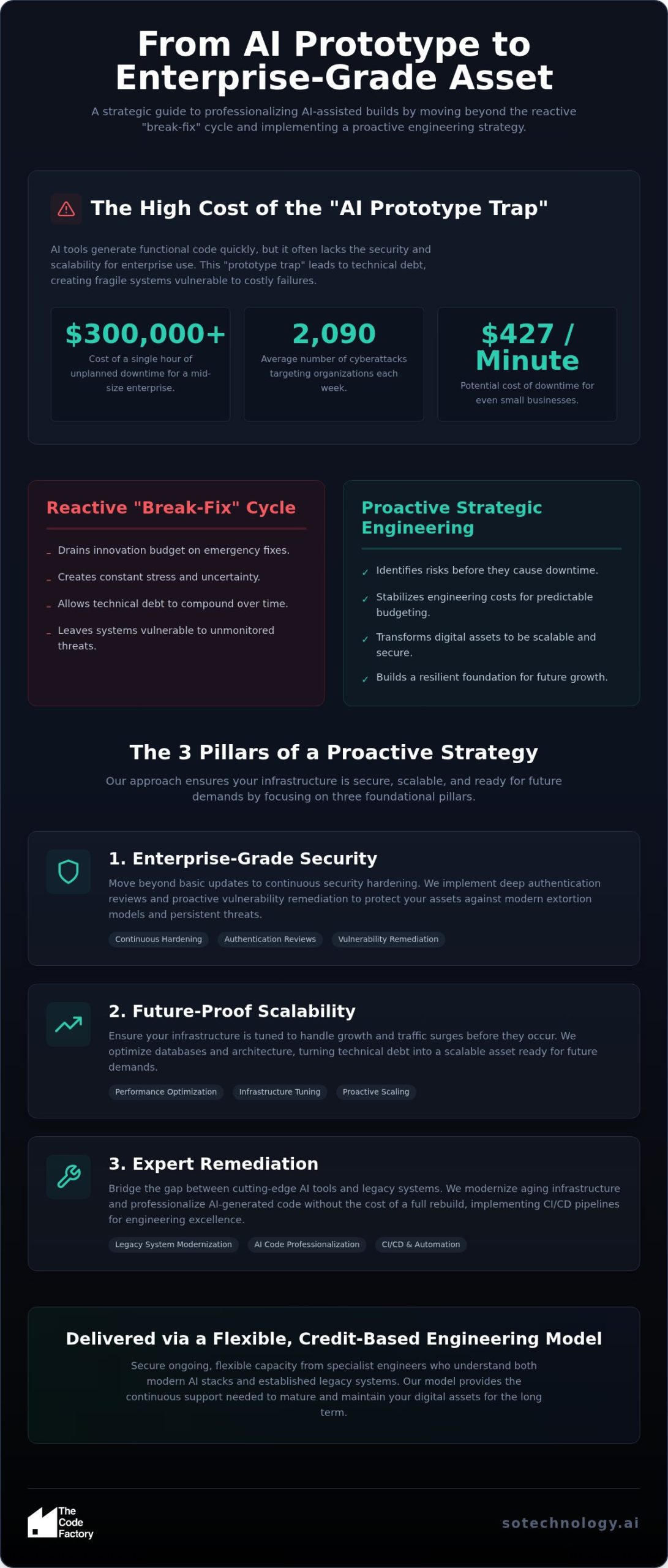
Did you know that in 2026, a single hour of unplanned downtime costs the average mid-size enterprise over $300,000? For many leaders, this isn’t just a technical glitch; it’s the inevitable result of technical debt from rapid, AI-assisted builds that weren’t hardened for production. Implementing a proactive website maintenance strategy is no longer a luxury for the cautious. It’s a fundamental shift from reactive firefighting to strategic engineering that ensures your systems are enterprise-ready and resilient against modern threats.
You’ve likely felt the stress of managing fragile legacy infrastructure or the uncertainty of an AI prototype that’s growing faster than its foundation can support. It’s exhausting to watch your team’s momentum stall because they’re busy patching vulnerabilities in unmonitored code. We’re here to change that narrative. This guide provides the roadmap to transition your digital assets from “working” to “scalable.” You’ll learn how to stabilize your engineering costs, secure your code against the 2,090 weekly cyberattacks reported this year, and transform your existing software into a robust, professional-grade solution that’s built to last.
Key Takeaways
- Discover how to move beyond the expensive “break-fix” cycle by implementing systematic engineering oversight that identifies risks before they disrupt your business.
- Learn to professionalize AI-assisted builds by identifying the “AI Prototype Trap” and hardening unmonitored code for enterprise-grade security.
- Implement a proactive website maintenance strategy that turns technical debt into a scalable digital asset, ensuring your infrastructure is ready for future growth.
- Bridge the gap between cutting-edge AI tools and legacy systems through expert software remediation that strengthens your existing foundations.
- Leverage a credit-based engineering model to secure flexible, ongoing capacity from specialists who understand both modern and established tech stacks.
Beyond the “Break-Fix” Cycle: Why Proactive Maintenance is a Strategic Asset
Many organizations view maintenance as a repair bill, but a true proactive website maintenance strategy is actually a form of engineering currency. It represents a shift from waiting for a system crash to performing systematic engineering oversight that catches a memory leak or a security flaw before it impacts your users. While the “break-fix” cycle feels productive because you’re solving immediate problems, it’s actually a drain on your long-term innovation and budget.
The ROI of Prevention vs. Reactive Remediation
Reactive fixes are a gamble with your bottom line. For small businesses, downtime can cost up to $427 per minute, a figure that dwarfs the cost of scheduled security hardening. Investing in a proactive website maintenance strategy ensures that your budget is spent on growth rather than emergency recovery. This oversight protects the core value of your software assets, which is particularly vital for VC or PE-backed firms. By maintaining a clean technical balance sheet, you ensure your asset remains attractive for future investment or acquisition.
Securing the 2026 Tech Stack
With an average of 2,090 weekly cyberattacks occurring this year, a “set it and forget it” mentality is a massive security liability. Your tech stack is a living organism that requires constant vigilance to remain secure. Security hardening is not a one-time event; it is a continuous discipline of refinement that evolves alongside the threat landscape. By treating security as a standard engineering requirement rather than an afterthought, you build a resilient foundation that can withstand the modern extortion models currently dominating the digital space.
The 3 Pillars of a Proactive Strategy: Security, Scalability, and Remediation
A robust proactive website maintenance strategy rests on three foundational pillars that transform your digital assets from simple tools into high-performing enterprise solutions. While traditional maintenance focuses on keeping the site online, our approach ensures that your infrastructure is secure, scalable, and ready for the demands of 2026. This isn’t just about survival; it’s about building a platform that supports continuous growth without the fear of structural failure.
Security hardening moves far beyond basic plugin updates. It involves deep authentication reviews and proactive vulnerability remediation to protect against the pay-or-leak extortion models currently rising in frequency. Simultaneously, scalability and performance optimization ensure your databases and infrastructure are tuned to handle traffic surges before they occur. Finally, software remediation allows you to modernize legacy systems and AI-generated code without the extreme cost of a total rebuild. By implementing CI/CD pipelines and release automation, we bring engineering excellence to every deployment, ensuring your site is always production-ready.
Professional Code Reviews and Assessments
Regular audits are the only way to identify technical debt before it halts your feature development. These reviews provide a clear roadmap for your engineering team, highlighting where unmonitored AI code or aging infrastructure might create future bottlenecks. Utilizing professional code review services allows you to see exactly where your system needs hardening to reach true enterprise standards. If you’re unsure where your current build stands, discussing your current tech stack with a specialist can help clarify your priorities.
Optimizing User Experience (UX) and Accessibility
Maintenance is a powerful tool for continuous UX improvement. It allows you to refine user journeys based on real-world data, ensuring your site remains intuitive and efficient. Accessibility is no longer optional; it’s a legal mandate. With WCAG 2.1 Level AA compliance deadlines approaching in 2027 and 2028 for many public entities, proactive UI enhancements are essential. We help you stay ahead of these regulations, ensuring your digital presence is inclusive, compliant, and optimized for every visitor.
Implementing Your Strategy with a Credit-Based Capacity Model
Implementing this model follows a methodical, three-step progression designed for maximum impact:
- Step 1: Baseline Assessment. We conduct an AI Readiness or Technical Debt Assessment to identify hidden vulnerabilities in your legacy systems or AI-assisted builds.
- Step 2: Priority Allocation. Credits are directed toward high-priority security hardening and performance bottlenecks to stabilize your foundation.
- Step 3: Rolling Roadmap. We establish a roadmap where unused capacity carries forward, ensuring your investment facilitates future development rather than disappearing at the end of the month.
This model is further strengthened by fractional CTO support. Having an expert guide your proactive website maintenance strategy ensures that every credit spent aligns with your broader business goals. It provides the high-level foresight needed to turn a fragile prototype into a scalable enterprise asset.
Flexible Capacity vs. Traditional Hiring
Increasing permanent headcount is a slow, expensive process that often creates fixed overhead. Our credit model provides immediate access to a diverse team of specialists, making it significantly more cost-effective than hiring. You get the specific expertise you need, exactly when you need it. This flexibility allows your team to maintain momentum on new features while we handle the deep technical remediation required to keep your systems secure.
Partnering for Long-Term Growth
We act as your Strategic Translator, turning complex technical debt into a clear, actionable path for growth. By bridging the gap between cutting-edge AI tools and established infrastructure, we ensure your digital transformation is both bold and grounded. We invite you to professionalise your AI-driven roadmap and transform your initial builds into robust, enterprise-ready solutions built for the scale of 2026.
Turning Technical Potential into Enterprise Reality
Scaling a digital asset in 2026 requires more than just keeping the lights on; it demands a shift toward strategic engineering. By adopting a proactive website maintenance strategy, you transition from the unpredictable costs of emergency fixes to a model of steady, calculated growth. This approach ensures your AI-generated builds and legacy systems remain secure and scalable, protecting your investment from the compounding risks of technical debt.
Our team acts as your partner in this transformation, offering specialist expertise in AI prototype professionalization. We provide an outcome-focused engineering currency that works collaboratively with your in-house teams to harden your infrastructure. Whether you are remediating older systems or maturing a new AI build, we provide the flexible capacity to ensure your software remains a robust, enterprise-ready asset that is built to last.
Your journey from a fragile prototype to a robust enterprise solution is a strategic evolution. We are here to provide the steady hand and technical proficiency needed to make that transition seamless and successful.
Frequently Asked Questions
What is the difference between reactive and proactive website maintenance?
Reactive maintenance waits for a system failure or security breach before acting, while proactive maintenance uses systematic engineering oversight to identify and resolve risks before they impact your users. This forward-looking approach shifts your focus from stressful firefighting to strategic engineering control. By hardening your environment against vulnerabilities and performance bottlenecks early, you ensure your platform remains stable and ready for enterprise-grade demands.
How does a credit-based model work for ongoing website support?
A credit-based model functions as “engineering currency,” providing you with flexible access to a team of specialists without the overhead of permanent hiring. You purchase monthly credits that can be allocated to high-priority tasks like security hardening, remediation, or new feature development. This system allows unused capacity to carry forward, ensuring your investment directly supports long-term growth and continuous technical improvement rather than disappearing at month’s end.
Why do AI-generated websites need professional maintenance and remediation?
AI-generated code is excellent for rapid prototyping, but it often lacks the structural integrity and security protocols required for a professional-grade product. These initial builds typically require professional remediation to address unmonitored code and architectural weaknesses that AI might overlook. Professional hardening ensures that your AI-assisted project is not just functional but also secure, scalable, and fully prepared for a rigorous enterprise environment.
Can proactive maintenance help reduce technical debt in legacy systems?
Implementing a proactive website maintenance strategy is one of the most effective ways to manage and reduce technical debt in legacy systems. By conducting regular audits and targeted remediation, you prevent debt from compounding and causing system-wide failures. This methodical approach allows you to modernize older infrastructure incrementally, ensuring it remains compatible with modern tools and secure against contemporary threats without requiring a total rebuild.
How often should a professional code review be conducted?
We recommend conducting a comprehensive code review at least quarterly for stable platforms, or monthly for systems undergoing active development. A baseline assessment should always be the first step to identify existing technical debt or AI-generated vulnerabilities. Regular reviews ensure your code remains clean and efficient, preventing small issues from evolving into expensive, large-scale remediation projects that could halt your feature development roadmap.
What are the risks of ignoring website maintenance for an enterprise?
For an enterprise, the risks of ignoring maintenance include catastrophic financial losses and long-term reputational damage. With unplanned downtime costing mid-size enterprises over $300,000 per hour in 2026, the cost of silence is simply too high. Beyond financial impact, unmonitored systems are vulnerable to the 2,090 weekly cyberattacks reported this year, which can lead to record-breaking data breach costs and significant legal liabilities.