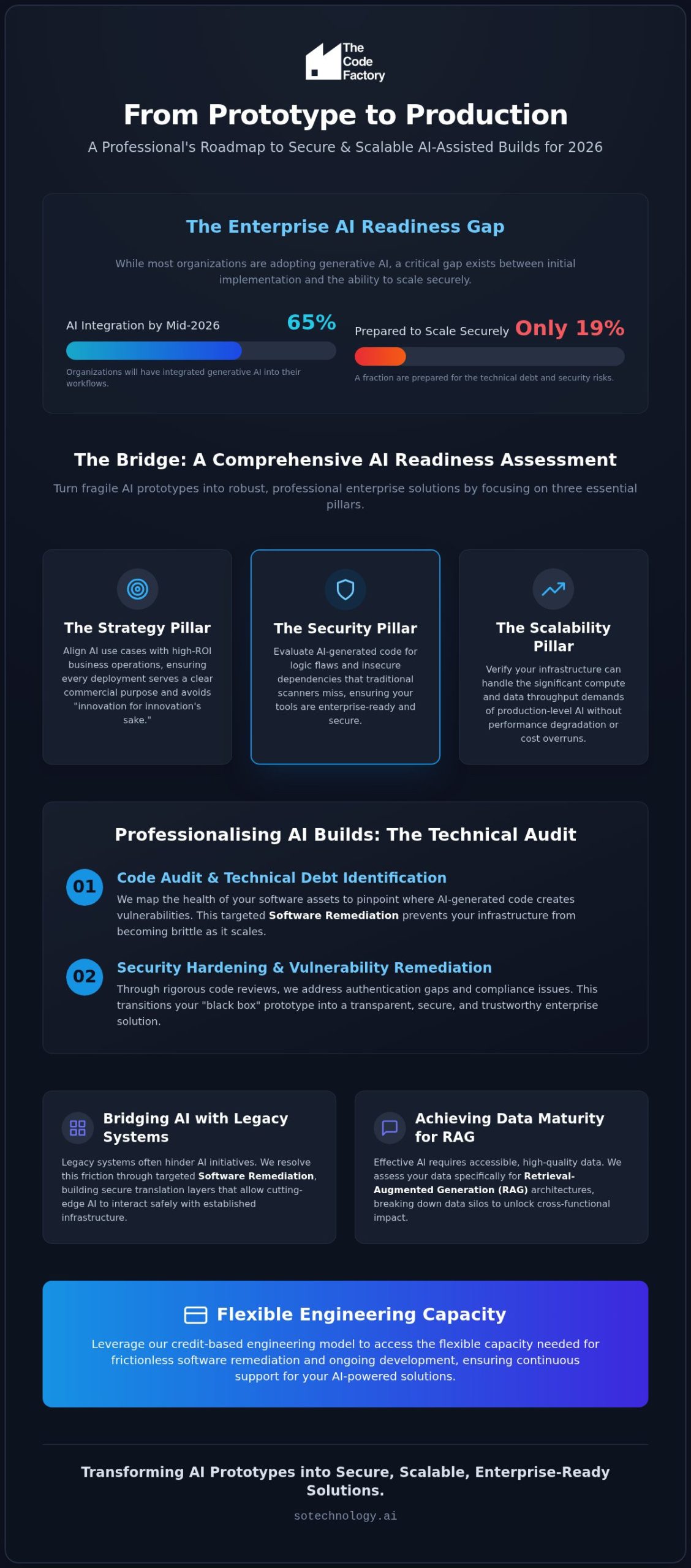
While 65% of organizations have integrated generative AI into their workflows by mid-2026, only 19% are actually prepared to scale those tools securely. You’ve likely felt this tension yourself. You’ve experimented with AI code generation and seen the immediate potential, yet you’re now facing the reality of technical debt, security vulnerabilities, and legacy systems that refuse to integrate. A comprehensive AI readiness assessment is no longer just a checkbox for compliance; it’s the strategic foundation for turning a fragile prototype into a robust, professional enterprise solution.
We understand that the transition from a “working” AI build to a professional-grade product is often where the most significant friction occurs. This guide provides a clear technical framework to help you move from experimentation to a secure, scalable reality. We’ll outline how to identify critical gaps in your current architecture, address the security risks inherent in AI-built tools, and introduce a flexible way to access engineering capacity for necessary remediation. By the end of this briefing, you’ll have a professionalised roadmap to navigate the 2026 landscape with total confidence.
Key Takeaways
- Align AI use cases with high-ROI business operations to ensure your roadmap prioritises strategic value over technical novelty.
- Conduct a deep-dive technical AI readiness assessment to pinpoint security vulnerabilities and technical debt hidden within AI-generated modules.
- Transition from fragile prototypes to enterprise-ready solutions by identifying exactly where professional engineering intervention is required.
- Leverage a credit-based engineering model to access the flexible capacity needed for frictionless software remediation and ongoing development.
- Bridge the gap between cutting-edge AI tools and legacy systems to create a unified, scalable infrastructure prepared for the demands of 2026.
The Strategic and Technical Pillars of an AI Readiness Assessment
While AI experimentation offers a low barrier to entry, it often produces code that lacks enterprise-grade durability. An AI readiness assessment acts as the bridge between these initial prototypes and a secure, scalable reality. In 2026, this process is the definitive measure of an organisation’s ability to deploy AI that is secure, scalable, and value-driven. Moving toward a professional roadmap requires a focus on three essential pillars.
- The Strategy Pillar: This involves aligning AI use cases with high-ROI business operations. By focusing on tangible outcomes, you avoid “innovation for innovation’s sake” and ensure every deployment serves a clear commercial purpose.
- The Security Pillar: AI-generated code often introduces vulnerabilities that traditional scanners miss. We evaluate code for logic flaws and insecure dependencies inherent in LLM-assisted builds to ensure your tools are enterprise-ready.
- The Scalability Pillar: Production-level AI agents demand significant compute and data throughput. We verify that your infrastructure can handle these loads without performance degradation or cost overruns.
This technical rigour aligns with evolving global standards, including the AI Readiness Assessment Methodology currently being refined by international safety institutes. By following a structured approach, you ensure your AI initiatives are both technically sound and compliant with emerging regulations like the EU AI Act.
Bridging the Gap: AI Tools vs. Legacy Systems
Legacy systems often present a complex integration challenge, yet they remain the core of many enterprise operations. These systems are frequently the silent killer of AI initiatives because they weren’t built for the high-velocity data demands of modern agents. We resolve this friction through targeted Software Remediation, building secure translation layers that allow cutting-edge AI capabilities to interact safely with your established infrastructure.
Data Maturity: Beyond Simple Storage
Effective AI requires more than just data storage; it requires data accessibility and governance. We assess your data quality specifically for RAG (Retrieval-Augmented Generation) architectures, where precision is non-negotiable. Data silos are a primary target during our audit. If your AI can’t access information across departments, it can’t deliver the cross-functional impact your business needs to stay competitive.
The Technical Audit: Professionalising AI-Assisted Builds
Initial AI prototypes are excellent for proving a concept, but they rarely meet the rigour required for production environments. Moving from a functional demo to an enterprise-ready solution requires a deep-dive technical audit. This process involves more than just checking if the code runs; it requires professional engineering intervention to ensure long-term stability and performance. Understanding How to Conduct an AI Readiness Assessment effectively means looking beneath the surface of AI-generated modules to find where logic might fail under real-world stress.
Our approach goes beyond surface-level checks. We conduct production readiness reviews that stress-test AI agents before they ever interact with live customers. This ensures your agents stay within operational boundaries and don’t hallucinate during critical user interactions. We also establish CI/CD pipelines specifically designed for the unique lifecycle of AI models, ensuring that future iterations are deployed with the same security and precision as the initial build.
Step 1: Code Registry Audit and Technical Debt Identification
We utilise automated tools through our partnership with The Code Registry to map the technical health of your software assets. This allows us to identify exactly where AI has taken shortcuts that could lead to system failure. Technical debt is the “interest” paid on sub-optimal AI code generation. By identifying these issues early, we can plan for targeted Software Remediation that prevents your infrastructure from becoming brittle as it scales.
Step 2: Security Hardening and Vulnerability Remediation
Security is often an afterthought in rapid AI experimentation, yet it’s the most critical factor for enterprise adoption. Our audit includes thorough Code Reviews to address authentication gaps and compliance issues in AI-integrated applications. We help you transition from a “black box” prototype to a transparent, secure enterprise solution. You can learn more about web development for AI integration to see how we harden these systems against modern threats.
If you’re ready to move beyond the prototype phase, we can help you audit your current AI build for production readiness.
From Assessment to Action: Implementing the AI Roadmap with Credits
The primary hurdle for many organisations isn’t the lack of a plan; it’s the friction of execution. Traditional project-based fees often fail the agility requirements of AI transformation, leaving valuable reports to collect dust while technical debt grows. We’ve replaced this rigid structure with a credit-based engineering model. This approach treats engineering capacity as a flexible currency, allowing you to move from an AI readiness assessment directly into remediation without the delay of new contracts or scope negotiations.
An assessment typically consumes between 500 and 2,000 credits, providing a clear baseline for your technical health. Once the audit is complete, these same credits become the engine for your roadmap. You can prioritise tasks based on immediate business impact, whether that means securing a legacy integration, fixing a critical bug in an AI-built module, or accessing fractional CTO support to guide your next phase of growth. This model ensures that your engineering capacity scales as your AI maturity grows.
The AI Discovery Workshop as a Catalyst
Transformation begins with a shared vision. Our AI Discovery Workshop serves as the strategic entry point, moving you from a technical audit to a collaborative execution plan. This session ensures that every engineering hour is spent on high-ROI activities. For those looking to build a long-term vision, we offer comprehensive AI consulting services that align your technical roadmap with broader enterprise goals.
Ongoing Support and Future-Proofing
Securing Your Competitive Edge for 2026
Moving from a functional AI prototype to a professional enterprise solution is a journey of refinement. You’ve seen how identifying technical debt and hardening security layers turns fragile code into a scalable asset. By bridging the gap between legacy systems and modern agents, you ensure your infrastructure doesn’t just survive the AI revolution but leads it. This transition requires a structural commitment to quality that moves beyond simple experimentation.
An AI readiness assessment provides the clarity you need to move forward with confidence. Our credit-based model allows you to access specialist engineering expertise without the burden of permanent headcount increases. With assessments typically consuming 500 to 2,000 credits, you gain a transparent, actionable roadmap designed for immediate results and long-term stability. It’s a pragmatic way to professionalise your builds while maintaining the agility your business demands.
The transition to production-level AI doesn’t have to be a source of technical uncertainty. With the right framework and a flexible engineering partner, you’re ready to build a secure, scalable future that delivers genuine business value. We’re here to help you turn that vision into a professional reality.
Frequently Asked Questions
How long does a typical AI readiness assessment take?
A deep manual audit typically takes between one and two weeks to complete. While automated 45-minute self-assessments exist, they don’t provide the code-level scrutiny required for enterprise deployment. Our process involves a thorough review of your architecture and security protocols to ensure your roadmap is grounded in technical reality rather than just strategic theory.
What is the difference between a strategic AI roadmap and a technical readiness assessment?
A strategic roadmap outlines your long-term vision and business goals, while a technical AI readiness assessment evaluates your actual ability to execute that vision. One identifies the destination; the other checks if your engine, data, and security are strong enough to get you there. We bridge this gap by auditing your existing code and infrastructure for production-grade durability.
Can an assessment help with code that was entirely generated by AI tools?
Yes, evaluating AI-generated code is a primary focus of our service. These builds often lack the architectural rigour and security standards required for professional products. We identify logic flaws and insecure dependencies within these modules, providing a clear path to transform a basic prototype into a secure and scalable enterprise solution that your team can confidently maintain.
How much does an AI readiness assessment cost in terms of credits?
A comprehensive AI readiness assessment typically consumes between 500 and 2,000 credits. This allocation covers the initial deep-dive audit and the identification of technical debt through our partnership with The Code Registry. It’s a transparent way to establish your baseline before using remaining credits for targeted remediation or new feature development.
Do we need an assessment if we are already using digital agents?
Yes, because many early digital agent deployments are built as “black box” solutions that are difficult to scale or secure. An assessment verifies that your agents are operating within safe parameters and that their underlying integration with your data is robust. It’s about moving from a tool that “just works” to one that is enterprise-ready and fully supported.
What happens if the assessment identifies significant technical debt in our legacy systems?
We address identified debt through targeted software remediation using your existing credit pool. Legacy systems are often the biggest blockers to AI integration; we focus on building secure translation layers to bridge the gap. This approach allows your modern AI agents to interact with older infrastructure without compromising system stability or security, ensuring a smooth path toward full digital transformation.