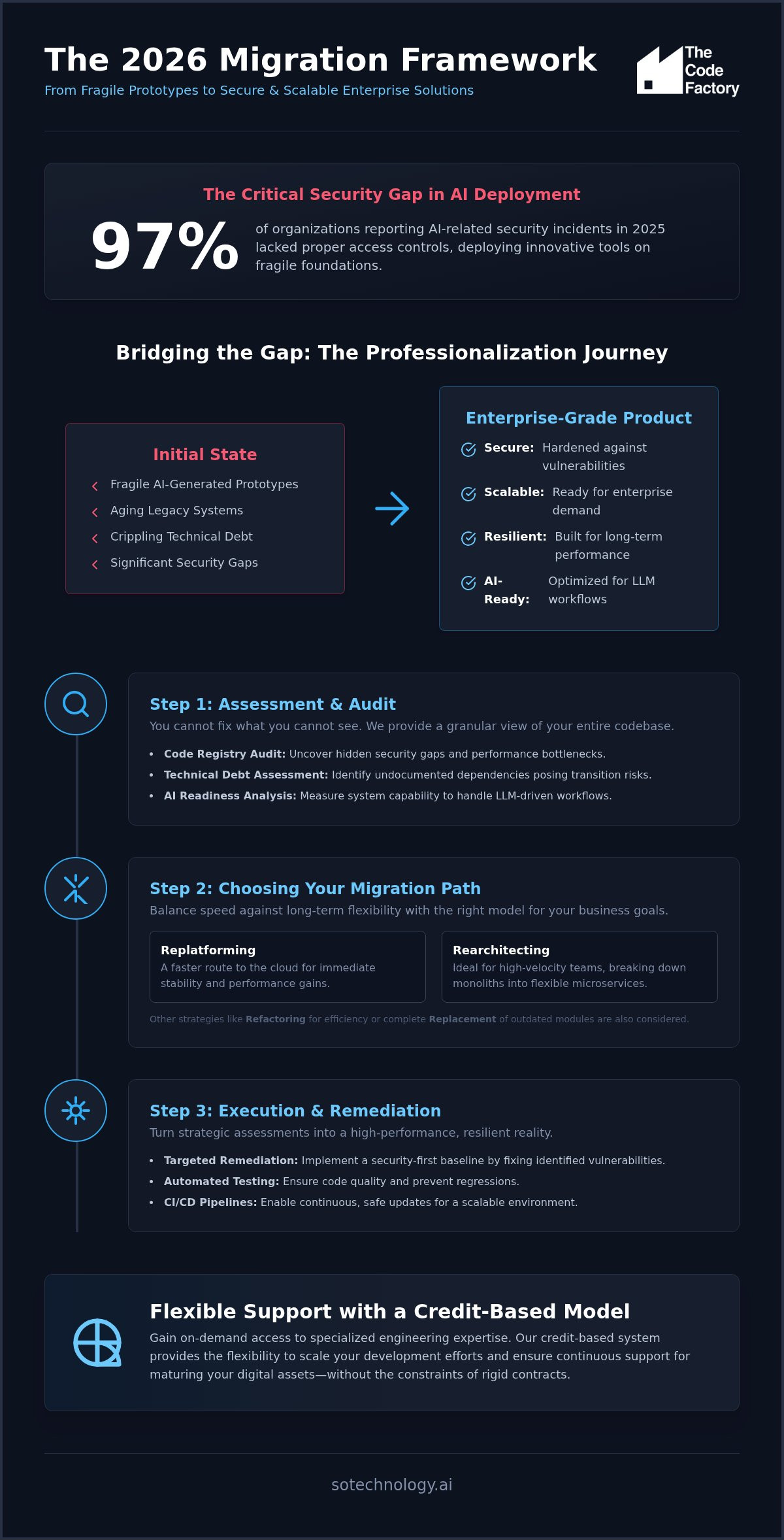
97% of organizations that reported an AI-related security incident in 2025 lacked proper access controls, highlighting the danger of deploying innovative tools on fragile foundations. You likely understand the frustration of building a cutting-edge prototype only to find it cannot survive in a production environment due to crippling technical debt or security gaps. Transitioning these projects into professional-grade products requires a legacy system migration strategy that prioritizes long-term resilience over temporary fixes.
We agree that the shift from an initial AI build to an enterprise solution is a complex leap, but it is one that can be managed with strategic, flexible control. This guide will show you how to transform aging infrastructure into systems that are both Secure and Scalable, ensuring they are ready for the demands of 2026. We will preview a framework for assessing risk and introduce a credit-based engineering model designed to provide the continuous support necessary for maturing your digital assets.
Key Takeaways
- Modernize your approach by shifting from static, one-off transfers to a continuous remediation process that ensures your infrastructure is ready for AI deployment.
- Develop a robust legacy system migration strategy by conducting a comprehensive technical debt assessment to align your migration path with actual business value.
- Turn fragile AI-generated prototypes into secure, scalable enterprise software through targeted security hardening and professional-grade engineering support.
- Utilize a flexible, credit-based model to access specialized engineering expertise, allowing you to scale your development efforts without the constraints of rigid contracts.
- Integrate Digital Agents to automate complex legacy workflows, creating a seamless bridge between your existing infrastructure and modern digital solutions.
Defining a Legacy System Migration Strategy in the AI Era
A Legacy system represents more than just aging code; it’s a structural barrier to agility. In the current landscape, a legacy system migration strategy must evolve beyond the traditional “lift and shift” mentality. By 2026, the focus has moved toward AI-enabled remediation, a process that doesn’t just relocate infrastructure but actively repairs and modernizes it during the transition. This approach ensures that your foundation is Secure, Scalable, and ready for deep integration with modern enterprise tools.
The Hidden Cost of Technical Debt
Unaddressed technical debt functions as a silent financial anchor, dragging down even the most ambitious growth plans. When organizations rely on fragmented, older codebases, they often fall into the trap of “shadow IT,” where teams implement unauthorized workarounds to maintain speed. These shortcuts frequently rely on outdated authentication protocols that create significant exposure. A strategic migration identifies these vulnerabilities early, replacing them with governed, high-performance alternatives that protect the business while lowering long-term maintenance overhead.
Bridging the Gap: AI Prototypes vs. Enterprise Products
Many organizations now face the challenge of professionalizing AI-assisted builds that were rushed into production without a robust architecture. While these tools allow for rapid experimentation, they often lack the structural integrity required for 2026 enterprise standards. Transitioning these projects into something truly Scalable requires a focus on Software Remediation. This process bridges the gap between a fragile prototype and a resilient product, setting the stage for broader AI in digital transformation by ensuring every component is optimized for performance and security.
The 2026 Migration Framework: Assessing Risk and Choosing Your Path
Success in modernization is determined long before the first server is moved. A structured legacy system migration strategy begins with a clear-eyed evaluation of your current technical landscape. By identifying which components are assets and which are liabilities, you can allocate resources effectively and avoid the “lift and shift” traps mentioned previously. This framework focuses on a four-step progression designed to maximize ROI while minimizing operational disruption.
Assessment: The Code Registry and Technical Audits
You cannot fix what you cannot see. Utilizing a Code Registry Audit provides a granular view of your codebase, highlighting security gaps and performance bottlenecks that standard automated scanners often miss. This level of scrutiny is essential because many critical legacy systems contain layers of undocumented dependencies that pose significant risks during a transition. AI Readiness, in this context, is the specific measure of a system’s ability to ingest and process LLM-driven workflows without breaking core functionality.
Choosing the Right Migration Model
Selecting the correct path requires balancing speed against long-term flexibility. While Replatforming offers a faster route to the cloud for immediate stability, Rearchitecting into microservices is often the preferred choice for global teams that require high-velocity feature deployment. Leveraging AI consulting services provides the strategic foresight needed to select the right “R,” whether that involves Refactoring for efficiency or a complete Replacement of outdated modules. To refine your specific roadmap, you may find it helpful to book an AI Initiative Discovery Meeting.
Once the path is chosen, execution focuses on establishing a security-first baseline through targeted Remediation of identified vulnerabilities. This is followed by the implementation of automated testing and CI/CD pipelines. These tools ensure that your new environment remains Scalable and resilient, allowing for continuous updates without the fear of regression. Our credit-based model supports this evolution, providing the specialized engineering capacity required to turn these strategic assessments into a high-performance reality.
Executing Migration with Professional-Grade Security and Scalability
Moving from a strategic roadmap to active implementation requires a high degree of technical precision. In 2026, the execution phase of a legacy system migration strategy isn’t just about moving data; it’s about refining the logic that drives your business. By leveraging frameworks like Human-AI Collaboration in Modernization, engineering teams can accelerate the refactoring process while maintaining the strict oversight required for enterprise-grade software. This collaborative approach ensures that the resulting system is not only Secure but also inherently Scalable, allowing it to grow alongside your organization.
Digital Agents play a pivotal role during this transition by automating the bridge between old and new environments. These agents can handle complex data mappings and routine legacy workflows, preventing the operational downtime that often plagues large-scale migrations. This automation allows your internal team to remain focused on high-level goals while the “heavy lifting” of the transition happens in the background, maintaining business continuity throughout the project lifecycle.
For organizations that want to leverage this newfound time to boost their market presence, you can check out Just Go Sell to provide your team with expert sales training and coaching.
The Credit-Based Model: Engineering Currency for Transformation
Traditional, rigid service contracts often fail to account for the unexpected complexities discovered during a migration. Our credit-based model provides a more agile alternative, functioning as a form of “Engineering Currency” that adapts to your changing needs. You receive a monthly allocation of credits that can be applied to any priority, whether that involves urgent Software Remediation or long-term infrastructure hardening. If a specific phase of the migration finishes early, unused credits roll over, ensuring your investment is always working toward your next development milestone.
Security Hardening and Performance Optimization
True modernization is only complete when the new stack is fully optimized for the 2026 threat landscape. This involves deep technical tasks such as reviewing authentication protocols, optimizing database indexing, and hardening cloud infrastructure against evolving vulnerabilities. The end goal is to achieve a professional standard of web development for AI integration. By treating this migration as an ongoing partnership rather than a one-off transaction, you ensure that your systems remain resilient, high-performing, and ready to support future innovation.
Building a Scalable Foundation for 2026 and Beyond
Transitioning from a prototype to a professional-grade product requires moving past the initial speed of AI generation toward a focus on long-term stability. A successful legacy system migration strategy in 2026 demands a partner who can bridge the gap between cutting-edge innovation and hardened infrastructure. By refining your code to be Secure and Scalable, you ensure that your digital assets are ready for the rigorous demands of an enterprise environment.
Our credit-based engineering model provides the outcome-focused flexibility required for this journey. Whether you are addressing deep technical debt through Remediation or scaling your global delivery capacity, our specialist expertise ensures your transition is methodical and purposeful. We don’t just deliver a project; we provide the “Engineering Currency” needed for continuous growth and future-proof development.
Modernization is a journey of improvement and clarity. To ensure your leadership team is aligned during this transition, you can discover On-Purpose Solutions to help unlock the power of purpose while we strip away technical uncertainty and build a resilient foundation for your success.
Frequently Asked Questions
What is the most effective legacy system migration strategy in 2026?
The most effective approach is a phased, remediation-focused framework that prioritizes security hardening and AI readiness over a simple “lift and shift.” By breaking the transition into manageable stages, you reduce operational risk and avoid the pitfalls of a “big bang” overhaul. This ensures your legacy system migration strategy remains flexible enough to adopt modern CI/CD pipelines while maintaining the stability of your core business logic.
How do I assess the AI readiness of my existing software infrastructure?
You assess AI readiness by evaluating your system’s data architecture, API maturity, and ability to process LLM-driven workflows. An AI Discovery Workshop is the ideal starting point to identify whether your monolithic databases can handle high-frequency data ingestion or if they require microservices refactoring. We focus on specific technical bottlenecks, such as outdated authentication protocols, that might prevent seamless integration with modern Digital Agents.
What are the risks of ignoring technical debt in legacy systems?
Ignoring technical debt leads to crippling maintenance costs that can consume up to 75% of your IT budget, leaving no room for innovation. Beyond the financial impact, unaddressed debt creates severe security vulnerabilities and makes your infrastructure incompatible with modern, Scalable tools. This stagnation often results in non-compliance with strict 2026 regulations like DORA or NIST CSF 2.0, exposing your organization to significant legal risks and data compromises.
How does a credit-based engineering model help with software remediation?
A credit-based model provides the flexible engineering capacity needed to address the unpredictable challenges found in older codebases. Instead of being locked into rigid contracts, you use “Engineering Currency” to tackle specific Remediation tasks like database optimization or infrastructure hardening as they are discovered. This system allows you to scale your development team up or down based on project needs, ensuring you always have expert support for professionalizing your tech stack.