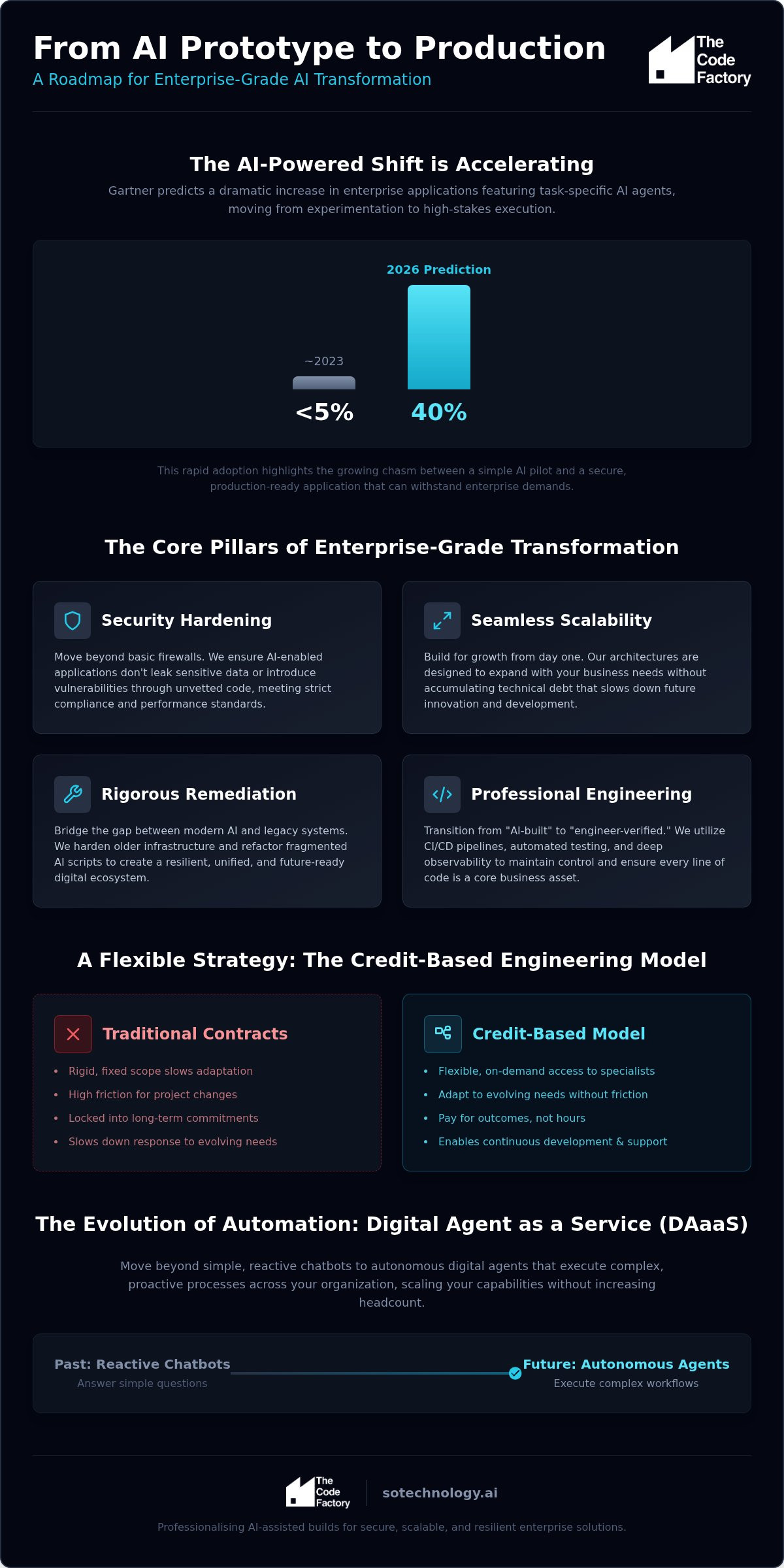
Gartner predicts that by the end of 2026, 40% of all enterprise applications will feature task-specific AI agents, a massive jump from less than 5% just a year ago. This surge signals that AI-powered digital transformation has moved past the era of “wait and see” into a phase of rapid, high-stakes execution. You likely recognize that while generating an initial prototype with AI is faster than ever, the distance between a working pilot and a secure, production-ready application often feels like a growing chasm. It’s common to feel the pressure of security vulnerabilities in AI-generated code or the frustration of rigid consulting contracts that don’t adapt to your evolving needs.
In this guide, you’ll discover how to move beyond basic AI prototypes to build secure, scalable, and enterprise-grade digital assets using a flexible engineering model. We’ll outline a roadmap for professionalising your AI builds and explain how on-demand specialists can bridge the gap between legacy systems and modern innovation. By the end, you’ll have a clear strategy for creating a software architecture that’s built to last, providing the stability and support your business requires to thrive in a sophisticated digital economy.
Key Takeaways
- Transition from experimental pilots to professionalised engineering by understanding how AI-powered digital transformation in 2026 evolves into an AI-native strategy.
- Implement enterprise-grade security hardening and scalable software architectures to ensure your AI-assisted builds are ready for production.
- Discover the efficiency of a credit-based engineering model that provides flexible, on-demand access to technical specialists without the friction of rigid contracts.
- Master the process of remediation to bridge the gap between AI-generated code and established legacy systems for a more resilient digital infrastructure.
What is AI-Powered Digital Transformation in 2026?
While many organisations treat Digital transformation as a completed milestone, the reality in 2026 is far more dynamic. True AI-powered digital transformation represents a strategic evolution from a digital-first mindset to an AI-native operation. This shift requires professionalised engineering that prioritises long-term stability over quick fixes. Without this focus, businesses often fall into the trap of high technical debt, contributing to the estimated 70% failure rate seen in complex transformation initiatives globally.
Success today requires a “Strategic Translator” to navigate the space between AI hype and production-grade reality. This role bridges the gap between technical complexity and business value, ensuring that every tool serves a clear commercial purpose. It’s no longer enough to experiment with basic pilots. Your AI in digital transformation roadmap must prioritise security and scalable architecture from day one to avoid the hidden costs of extensive remediation later.
From AI Prototypes to Production-Grade Assets
The rise of “Shadow AI” poses a significant threat, as unvetted code and insecure prompts find their way into the enterprise environment. Moving from a fragile prototype to a robust, professional asset requires a methodical approach. An AI Discovery Workshop provides a low-risk starting point for this transition. These sessions help you identify high-impact use cases while ensuring every build is secure, scalable, and fully aligned with your broader organisational goals.
Modernising Legacy Systems for the AI Era
The Core Pillars of Enterprise-Grade AI Transformation
Enterprise-grade AI isn’t just about the model you choose; it’s about the engineering rigour surrounding it. To achieve a successful AI-powered digital transformation, organisations must move beyond the “prompt and pray” approach. This requires a foundation built on four non-negotiable pillars: security hardening, seamless scalability, engineering excellence, and rigorous remediation.
Security hardening involves more than just firewalls. It’s about ensuring AI-enabled applications don’t leak sensitive data or introduce vulnerabilities through unvetted code. Scalability, meanwhile, ensures your software expands without accumulating technical debt that slows down future growth. We treat engineering excellence as a standard, utilising CI/CD pipelines, automated testing, and deep observability to maintain control over complex AI ecosystems. Finally, remediation allows us to take legacy systems or fragmented AI scripts and turn them into professional, enterprise-ready assets.
Professionalising AI-Generated Code
AI tools are excellent for rapid prototyping, but they often lack the architectural integrity required for enterprise scale. Without professional code reviews, these builds can become a liability. By integrating web development for AI integration into your existing tech stack, you ensure that every line of code meets strict security compliance and performance standards. This transition from “AI-built” to “engineer-verified” is what separates a gimmick from a core business asset.
Digital Agent as a Service (DAaaS)
The next evolution of automation involves moving from simple, reactive chatbots to autonomous digital agents. These agents don’t just answer questions; they execute complex processes across your organisation. Managing these as “Digital Agent as a Service” (DAaaS) provides a strategic advantage, allowing you to scale your workforce’s capabilities without the overhead of permanent headcount. This shift is a critical component of a mature AI-powered digital transformation, ensuring your automation is both proactive and profitable. If you’re ready to move beyond basic pilots, you might want to discuss your AI roadmap with a specialist to see how DAaaS fits into your long-term strategy.
A Flexible Strategy: The Credit-Based Engineering Model
Traditional project-based billing often creates unnecessary friction in a rapidly changing technical landscape. It locks you into a rigid scope that might become obsolete before the project even concludes. In contrast, a credit-based engineering model acts as a versatile currency, allowing for a more fluid AI-powered digital transformation. This approach enables you to pivot resources as your technical needs shift, ensuring your budget is always directed toward the highest-value outcomes.
By moving away from static contracts, you gain immediate access to a global pool of specialists without the overhead of permanent headcount. Whether you require deep remediation for legacy systems, secure web development, or high-level fractional CTO guidance, you use credits to pull in the exact expertise required for the task at hand. This model facilitates continuous transformation, moving beyond one-off projects to provide the ongoing support necessary for maturing AI-driven assets.
Outcomes Over Hours: Aligning Incentives
The core advantage of this model is its focus on tangible software improvements and security milestones rather than just billable hours. It aligns incentives by ensuring that every credit spent translates into measurable progress for your digital infrastructure. The flexibility of rolling over credits means you don’t have to rush through low-priority tasks just because a budget cycle is ending. Instead, you can bank your engineering capacity for major feature releases or critical security hardening phases.
Starting Your Transformation Roadmap
Every organisation is at a different stage of maturity. Whether you are a Start-Up aiming for rapid scalability, a Growth-stage company refining its architecture, or an Enterprise managing complex legacy systems, identifying the right credit tier is the first step toward professionalisation. To begin, you can book an AI Discovery Workshop to kickstart your transformation. This session allows us to build a technical remediation plan that takes your initial AI prototypes and turns them into robust, production-ready assets that drive long-term business value.
Securing Your Competitive Edge in an AI-Native Future
Transitioning from a fragile AI pilot to a production-ready application requires more than just rapid code generation; it demands a foundation of rigorous engineering and security hardening. By addressing legacy debt through systematic remediation and adopting a flexible engineering currency, you can maintain the pace of innovation without the friction of traditional, rigid contracts. This shift ensures your digital assets are not only functional but also resilient and ready for the demands of a sophisticated market.
Successful AI-powered digital transformation is a continuous journey of refinement rather than a one-off project. Our model provides you with specialists in legacy security and outcome-focused solutions like Digital Agent as a Service, giving you the strategic control needed to scale with confidence. We’re committed to bridging the gap between technical complexity and business value, ensuring your infrastructure remains a robust driver of growth.
We’re here to help you replace technical uncertainty with strategic clarity. Let’s work together to turn your initial AI builds into a secure, scalable, and enterprise-grade reality.
Frequently Asked Questions
What is the difference between an AI prototype and an enterprise-ready solution?
An AI prototype serves as a functional proof of concept, whereas an enterprise-ready solution is a secure, scalable asset verified by professional engineering. Most prototypes lack the architectural integrity needed for production environments. Transitioning to a professional-grade product involves rigorous code reviews and remediation to ensure the software can handle real-world traffic without introducing vulnerabilities or accumulating technical debt that hinders growth.
How does a credit-based model differ from traditional digital transformation consulting?
A credit-based model offers a flexible engineering currency that prioritises outcomes over rigid project scopes or billable hours. Traditional consulting often locks you into fixed day rates and narrow contracts that don’t adapt to fast-moving AI needs. By using credits, you gain on-demand access to specialists for tasks ranging from fractional CTO support to high-level remediation, allowing for a continuous approach to AI-powered digital transformation.
What are the biggest security risks in AI-powered digital transformation?
The primary security risks include the use of unvetted AI-generated code and the emergence of “Shadow AI” within the enterprise. These vulnerabilities can lead to data leakage or insecure endpoints if the code isn’t properly hardened. Professional AI-powered digital transformation mitigates these risks by implementing automated testing, deep observability, and strict security compliance protocols to ensure every digital asset remains protected against evolving threats.
Can legacy systems be integrated with modern AI digital agents?
Yes, legacy systems can be integrated with modern AI digital agents through targeted remediation services. We specialise in hardening older infrastructure to create a secure bridge between established data and cutting-edge automation tools. This process involves cleaning up technical debt and ensuring that legacy architectures are scalable enough to support the autonomous decision-making processes required by advanced digital agents, turning old infrastructure into a modern business driver.