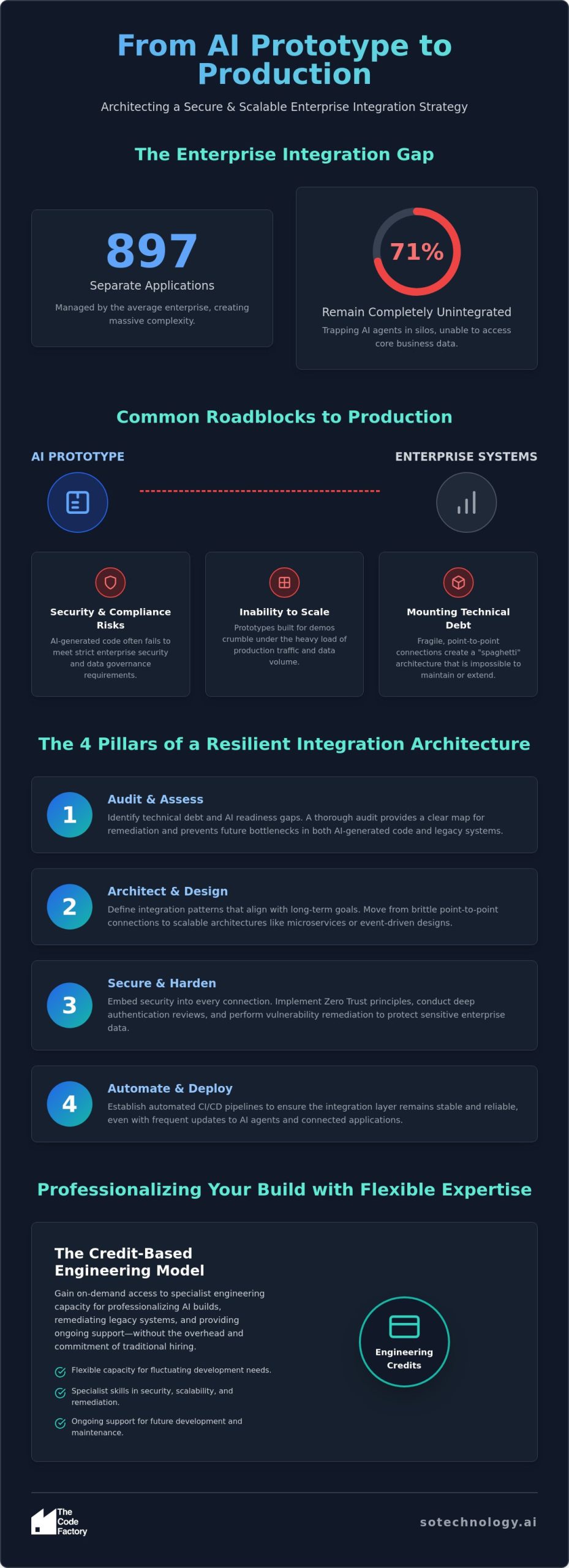
The average enterprise now manages 897 separate applications, yet a staggering 71% of them remain completely unintegrated. This fragmentation isn’t just an IT headache; it’s a structural barrier that prevents AI-generated prototypes from ever reaching production. Without a cohesive enterprise application integration strategy, your latest digital agents are likely trapped in silos, unable to communicate with the core business data they need to function. You’ve built the future, but it’s currently held back by the brittle, point-to-point connections of the past.
It’s frustrating to watch a promising AI pilot stall because it can’t scale or meet the security requirements of your legacy infrastructure. We understand that bridging the gap between cutting-edge code and established systems feels like a constant battle against technical debt. This guide will show you how to architect a secure, scalable integration framework that professionalises your AI builds and hardens your existing ecosystem. We’ll explore how to move beyond fragile quick fixes toward a remediation-first approach that ensures every part of your 2026 digital landscape is ready for enterprise-grade performance.
Key Takeaways
- Understand why a robust enterprise application integration strategy is the essential foundation for moving AI agents from isolated prototypes into production-ready business assets.
- Learn how to identify and resolve technical debt within your legacy systems and AI-generated code by leveraging specialist audits and remediation services.
- Discover the architectural patterns, from microservices to event-driven designs, that keep your digital ecosystem secure and scalable under heavy load.
- Explore how a credit-based engineering model provides the flexible capacity needed to professionalise AI builds without the overhead of traditional hiring.
The Evolution of Enterprise Application Integration Strategy in 2026
Historically, Enterprise Application Integration was a back-office necessity for syncing CRMs and ERPs. By 2026, it’s evolved into a survival-critical framework. We define a modern enterprise application integration strategy as the strategic blueprint that synchronises data and workflows across an increasingly fragmented technology stack. While old methods focused on basic data movement, today’s strategy acts as the nervous system for your entire digital ecosystem.
The landscape has shifted dramatically. Integration is no longer just an IT task; it’s the primary bottleneck for AI adoption and business agility. Many organisations find their AI prototypes hitting a wall because they can’t access core business data securely. Moving away from brittle, point-to-point “spaghetti” connections toward loosely coupled architectures is essential. A proactive enterprise application integration strategy prevents the chaotic disintegration that occurs when shadow AI tools proliferate without a central plan. It turns a mess of disconnected apps into a professional, cohesive platform.
Why Integration is the Foundation for AI Success
AI can’t generate value in a vacuum. By integrating AI with legacy systems, you unlock deep repositories of trapped enterprise data that give your models necessary context. We use AI Discovery Workshops to pinpoint exactly where these integrations provide the highest ROI. This ensures your AI builds aren’t just flashy demos but are secure, scalable, and fully functional tools that drive growth.
The Cost of Disconnection: Technical Debt and Silos
Application sprawl is expensive. With the average enterprise juggling nearly 900 apps, the operational drag of unintegrated systems is immense. This creates silos where data becomes inaccessible and innovation stalls. Our role as a Strategic Translator is to align your complex technical architecture with clear business outcomes. We help you remediate the technical debt of AI-assisted prototypes, turning them into professional-grade products that bridge the gap between cutting-edge tools and established legacy infrastructure.
Core Pillars of a Scalable and Secure Integration Architecture
Architecting a resilient enterprise application integration strategy requires moving past reactive fixes toward a structured, four-step methodology. We begin by auditing technical debt and AI readiness. Tools like The Code Registry are invaluable here, providing a clear map of where AI-generated prototypes might lack the necessary structure for production. Once we understand the baseline, we define the integration pattern that best fits your goals. Whether it’s a centralised Hub-and-Spoke model or a more agile Event-Driven Architecture, the choice must align with your long-term business objectives. Security isn’t an afterthought. Execution relies on hardening every touchpoint to prevent data leakage between disparate systems. Finally, establishing automated CI/CD pipelines ensures that your integration layer remains stable even as you push frequent updates to your AI agents. If you’re unsure where your current architecture stands, we can help you map out a path during an AI initiative discovery meeting.
Security and Scalability: Non-Negotiables for 2026
In a world of increasing data regulation and sophisticated threats, basic API connectivity isn’t enough. We conduct deep authentication reviews and vulnerability remediation to ensure every connection is “Secure” by design. Aligning your enterprise application integration strategy with the Zero Trust Maturity Model provides a robust framework for protecting sensitive enterprise data. This security layer must coexist with a scalable web application architecture that can handle global traffic loads without performance degradation.
Remediation: Bridging Legacy Systems and Modern APIs
Legacy systems often lack the modern interfaces required for seamless AI integration. Software remediation is the essential bridge here, modernising older codebases so they become “integration-ready.” We perform thorough architecture reviews to identify performance bottlenecks that might hinder real-time data flow. This proactive approach turns technical debt into a strategic asset, ensuring your established infrastructure supports, rather than stifles, your latest AI innovations. It’s about making your entire ecosystem professional, reliable, and ready for future growth.
Executing the Strategy: Professionalising AI Builds and Legacy Remediation
Transitioning from a successful AI pilot to a production-ready asset requires more than just code; it requires a disciplined enterprise application integration strategy. Most AI-assisted builds are designed for speed, often leaving security and scalability as secondary concerns. To professionalise these builds, we focus on a rigorous remediation process that hardens code and ensures it plays well with your established infrastructure. Success isn’t just about connectivity. It’s measured by how effectively these systems reduce operational risk and boost team productivity across the board.
As academic research on enterprise application integration in enterprise architecture highlights, EAI is a fundamental component of a stable corporate framework. It acts as the bridge that allows modern, AI-driven tools to coexist with legacy systems without creating a maintenance nightmare. By treating integration as a core architectural pillar, you ensure that new innovations strengthen your digital ecosystem rather than creating fresh silos of technical debt.
From Prototype to Production: A Remediation Roadmap
AI-built applications often lack the “Secure” and “Scalable” markers required by enterprise IT departments. We conduct production readiness reviews to identify these gaps, focusing on security hardening and performance optimisations. By incorporating the specialized testing and DevOps capabilities of Test Triangle, we ensure that every application meets the highest enterprise standards. We don’t view a digital agent as a standalone tool. Instead, we position Digital Agent as a Service (DAaaS) as a managed, fully integrated outcome. This shift from a “one-off build” to an integrated service ensures that your AI assets remain reliable and relevant as your business grows. Understanding the full scope of AI-driven web development is essential for closing the production gap between a functional prototype and a truly enterprise-ready product.
Flexible Capacity for Continuous Improvement
The “headcount hurdle” often stops integration projects before they start. Hiring a full-time team for a modernisation project is slow and expensive. Our credit-based model provides a flexible alternative, giving you access to fractional CTO support and specialist engineering capacity exactly when you need it. These monthly credit allocations allow for continuous improvement, moving your team from reactive bug fixing to proactive platform modernisation. It’s about having the right expertise at the right time to keep your enterprise application integration strategy moving forward without the overhead of traditional hiring models.
Future-Proofing Your Integrated Digital Ecosystem
Transitioning from a loose collection of AI prototypes to a professional-grade platform requires a deliberate enterprise application integration strategy. By auditing technical debt and hardening security at every touchpoint, you transform fragmented applications into a cohesive, scalable engine for growth. Bridging the gap between legacy systems and modern APIs isn’t just about connectivity; it’s about building a resilient foundation that supports continuous innovation without the drag of technical debt.
Our flexible credit-based model gives you immediate access to a team of specialists who can execute these complex integrations without the overhead of traditional hiring. Through our AI readiness assessments, we help you identify and remediate security risks before they impact your growth. This approach ensures your 2026 digital landscape is not only functional but truly enterprise-ready. It’s time to move past the prototype stage and build something that lasts.
Ready to turn your technical challenges into a strategic advantage? Book an AI Discovery Workshop to align your integration strategy with your growth goals. We’re here to help you architect a future that’s secure, scalable, and fully integrated.
Frequently Asked Questions
What is the difference between EAI and iPaaS in 2026?
EAI is the strategic architectural framework, while iPaaS is the cloud-based delivery platform used to execute it. In 2026, most organisations use iPaaS as the engine to run their enterprise application integration strategy, but EAI remains the essential discipline that governs data flow and security. While iPaaS provides the tools, EAI provides the blueprint for how those tools connect your hybrid cloud and on-premise systems.
How does an integration strategy reduce technical debt?
A proactive strategy reduces technical debt by replacing fragile, point-to-point connections with standardised, reusable patterns. This prevents the “spaghetti code” that typically breaks during system updates or high traffic periods. By using remediation services to professionalise AI-generated prototypes, you ensure that your integration layer is built on clean, maintainable code rather than a series of emergency patches.
Can I integrate AI-generated applications with my existing legacy systems?
You can integrate AI-built tools with established infrastructure by using remediation services to build modern, secure interfaces. We specialise in bridging this gap, ensuring that cutting-edge AI prototypes can safely access data trapped in older legacy systems. This process transforms isolated experiments into professional-grade products that function as a core part of your digital ecosystem rather than separate silos.
What are the most common risks of a poorly executed integration strategy?
The most significant risks include security vulnerabilities, data silos, and total system failure under peak traffic loads. Without a clear enterprise application integration strategy, organisations often suffer from “chaotic disintegration,” where apps exist but cannot communicate effectively. This leads to inaccurate data reporting and prevents your AI models from accessing the real-time information they need to provide value, ultimately stalling your digital transformation.