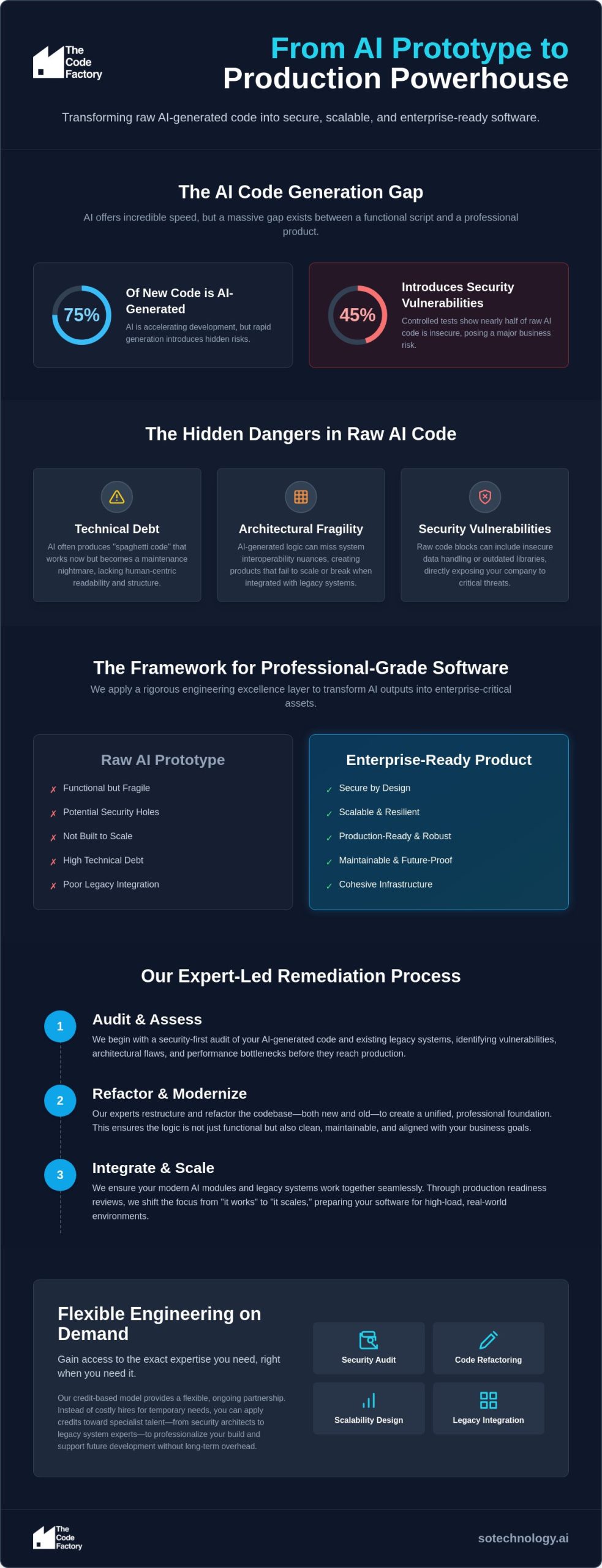
Did you know that 45% of AI-generated code introduces a security vulnerability during controlled testing? While Google reports that 75% of new code is now AI-generated, there is a massive gap between a functional script and a professional product. You’ve likely experienced the speed of AI Code Generation, but that speed often comes with the quiet anxiety of hidden bugs or architectural debt that won’t hold up under heavy user loads.
It’s frustrating to feel like you’re building on a foundation of sand, especially when your internal team is already stretched thin. We understand that you need more than just a working prototype; you need software that is secure, scalable, and ready for the enterprise. This guide will show you how to transform raw AI outputs into professional-grade software using an expert-led remediation framework. We’ll explore how a flexible, credit-based engineering model provides the continuous support you need to professionalize your build and bridge the gap between cutting-edge AI and your existing legacy systems.
Key Takeaways
- Identify why functional prototypes often lack the architectural integrity required for enterprise use and how to bridge that gap.
- Discover the essential criteria for professional-grade software, focusing on making your build secure and scalable for long-term growth.
- Learn how expert remediation services can align modern AI Code Generation with your existing legacy systems for a cohesive infrastructure.
- Understand the benefits of a credit-based engineering model for accessing specialist talent exactly when your project needs it.
- Gain a strategic path to transform AI-assisted builds into robust, maintainable products that deliver consistent business value.
The AI Code Generation Gap: Why Your Prototype Isn’t Production-Ready
By July 2026, the landscape of AI-assisted software development has transitioned from simple syntax suggestions to the generation of entire functional modules. This speed is undeniably impressive, but it often leads developers into the “Prototype Trap.” You might have a build that runs perfectly in a sandbox, yet it lacks the architectural integrity required for enterprise environments. This gap exists because AI focuses on immediate logic rather than the long-term health of your software ecosystem.
To move forward, you need a “Strategic Translator.” This role acts as a vital bridge between raw AI outputs and the stable, high-performance software your business demands. We treat software remediation as a necessary phase in the modern development lifecycle. It’s the disciplined step where raw AI Code Generation is audited, refined, and professionalized before it ever touches a production server.
Understanding the Risks of Raw AI Output
Rapid generation creates significant technical debt. AI can produce “spaghetti code” that works today but becomes a maintenance nightmare tomorrow because it lacks human-centric readability. Without expert oversight, these systems suffer from architectural fragility. An AI model might miss the nuances of system interoperability, creating a product that fails to scale or breaks when integrated with your existing infrastructure.
The Security Imperative for AI-Built Systems
Security is the most critical hurdle for AI-assisted builds. With 45% of AI-generated code introducing vulnerabilities in controlled tests, a hands-off approach is a major business risk. Raw AI blocks often include insecure data handling or references to outdated libraries that expose your company to threats. Professional ai consulting services must include a security-first audit to catch these flaws early. We focus on ensuring your AI Code Generation is secure and scalable, turning a vulnerable prototype into a robust enterprise solution.
Professionalising AI Builds: A Framework for Secure and Scalable Code
Professional-grade software isn’t defined by a lack of errors alone. It’s defined by security, scalability, and long-term maintainability. While AI Code Generation offers a significant head start, the resulting output often lacks these enterprise-critical attributes. We bridge this gap by applying a rigorous engineering excellence layer to every module, ensuring your build is ready for the demands of a live environment.
Legacy systems and AI-written code might seem worlds apart, but they share a common need for specialized remediation expertise. Legacy code is often brittle due to age; AI code is often brittle due to a lack of context. Human-led code reviews are the only reliable way to validate that these disparate pieces work together without compromising your security posture. Research from Georgetown University on the Cybersecurity Risks of AI-Generated Code highlights that automated tools can unintentionally replicate known vulnerabilities. SoTechnology acts as your expert partner, providing the steady hand needed to turn these risks into reliable assets.
Remediation: Fixing the Foundation
Refactoring is about more than just cleaning up syntax. It involves restructuring logic to ensure it aligns with your broader ai in digital transformation strategy. By modernizing both your AI-generated blocks and your existing legacy systems, we create a unified, professional codebase that’s easy to manage. If you’re unsure about the integrity of your current build, you can schedule a discovery meeting to assess your architecture.
Designing for Scalability
A prototype that works for one user rarely works for ten thousand. Moving to cloud-native, high-load environments requires a deep understanding of infrastructure that AI Code Generation simply hasn’t mastered yet. We perform production readiness reviews to ensure your software is robust enough for the real world, shifting the focus from “it works” to “it scales.”
Flexible Engineering Capacity: The Credit-Based Model for AI Evolution
Owning software built through AI requires a new kind of partnership. Traditional hiring is too slow for the pace of modern builds. One-off projects often leave you stranded when the technology shifts. We solve this through an “Engineering Currency” model. This credit-based system gives you on-demand access to specialists. You get the expertise needed to mature your product without the burden of a permanent headcount.
The reality of AI Code Generation is that it creates a continuous need for professional oversight. By utilizing our Digital Agent as a Service (DAaaS), you ensure your AI-enabled tools remain functional as underlying models and APIs evolve. This proactive approach prevents the cybersecurity risks of AI code generation from becoming active threats to your business. It’s about maintaining strategic control, not just firefighting bugs.
How the Credit System Works for AI Projects
Our process starts with an AI Discovery Workshop to map your technical needs. From there, you move into a recurring Growth or Enterprise credit allocation. This flexibility is vital for long-term success. One month, you might use your credits for deep security hardening. The next, you could pivot to rapid feature development or integrating legacy systems. It’s a dynamic resource that scales alongside your business ambition.
Why Outcomes Matter More Than Hours
We don’t sell day rates. We sell capacity and measurable improvements. This philosophy de-risks the long-term ownership of your software. Instead of paying for a developer’s time, you’re investing in a secure and scalable product. This model ensures that remediation isn’t a one-time fix. It becomes a continuous part of your software’s evolution. You focus on growth while we handle the technical excellence required to keep your AI builds professional and robust.
Transforming AI Potential into Enterprise Performance
The speed of AI Code Generation is a powerful catalyst for innovation, but it’s only the beginning of the journey. To move from a functional prototype to a market-ready product, you must bridge the gap between raw output and professional-grade software. We’ve explored how a dedicated remediation framework turns architectural fragility into a robust, scalable foundation. By integrating these modern modules with your existing legacy systems, you create a cohesive ecosystem that is built to last.
Managing this evolution doesn’t require a bloated internal team. Our outcome-focused credit model offers you flexible engineering capacity without the traditional overhead of hiring. Whether you need deep security hardening or proactive feature development, you have on-demand access to experts who understand both legacy remediation and modern AI builds. It’s time to strip away the stress of technical uncertainty and take strategic control of your software roadmap. Book an AI Discovery Workshop to professionalise your build and start your transition to a secure, scalable future today.
Frequently Asked Questions
Is AI-generated code secure enough for enterprise use?
Raw AI output is rarely secure enough for enterprise use without expert intervention. Research shows that 45% of AI-generated code blocks introduce vulnerabilities during controlled testing. We solve this by treating AI Code Generation as a starting point, applying a rigorous security-first audit to eliminate risks like insecure data handling or outdated library references before the software reaches your production servers.
What is the difference between a prototype and professional-grade software?
The primary difference lies in architectural integrity and resilience. A prototype is a functional proof of concept that often lacks the depth needed for a live environment. Professional-grade software is built to be secure and scalable, meaning it’s designed to handle heavy user loads and integrate smoothly with your existing legacy systems without failing or creating long-term maintenance nightmares.
How does a credit-based engineering model differ from traditional hiring?
Traditional hiring involves long-term commitments and fixed roles, whereas our credit-based model offers on-demand access to specialized engineering talent. This “Engineering Currency” allows you to scale your team’s capacity up or down as needed. It’s a more pragmatic way to handle the evolving needs of AI projects, allowing you to focus on high-impact outcomes rather than managing permanent headcount.
Can you help remediate legacy systems as well as new AI builds?
Absolutely. Our expertise covers the full spectrum of software remediation, from modern AI Code Generation to established legacy systems. We act as a Strategic Translator, ensuring that your cutting-edge AI modules communicate effectively with older infrastructure. This holistic approach creates a unified, professional codebase that supports your long-term digital transformation goals and ensures system interoperability.
What happens if my AI-generated code has significant technical debt?
Technical debt is a common byproduct of rapid AI generation, but it’s manageable with a systematic remediation framework. We focus on refactoring the “spaghetti code” that AI often produces, turning it into clean, maintainable software. By addressing these issues early, we ensure your build remains robust and capable of supporting future feature development without the risk of architectural collapse or performance degradation.
Do I need an AI Discovery Workshop before starting a remediation project?
We highly recommend starting with an AI Discovery Workshop to establish a clear strategic roadmap. This session allows us to identify hidden vulnerabilities and architectural fragility in your current build. It ensures that your recurring credit allocation is used effectively, targeting the highest-value improvements first to turn your initial prototype into a secure, enterprise-ready solution that delivers consistent business value.