With 83% of companies now ranking AI as a top priority in their business plans, the race to innovate has moved from simple experimentation to a high-stakes push for production. You’ve likely already witnessed the speed of ai in digital transformation by using models like GPT-5.4 or Claude Opus 4.7 to build initial versions of your projects. It’s a powerful way to start, but as we approach the August 2026 implementation of high-risk obligations under the EU AI Act, the gap between a functional prototype and a secure, enterprise-ready solution has never been more critical to close.
We understand that while AI can generate code, it often leaves behind technical debt and security vulnerabilities that stall long-term growth. You need a way to refine those foundations into something truly robust. In this article, you’ll discover how to professionalise your 2026 roadmap by turning initial AI creations into a scalable architecture ready for future development. We’ll preview a strategic path to success, illustrating how a flexible credit-based system provides the expert engineering support required to ensure your software is secure, stable, and prepared for the next stage of your journey.
Key Takeaways
- Learn how to redefine business value by positioning intelligent automation as a core pillar of your strategic roadmap.
- Discover a five-step framework to successfully integrate ai in digital transformation by refining AI-generated prototypes into production-ready software.
- Understand how to ensure your code is secure and scalable, creating a robust foundation for future development and growth.
- Explore how a flexible credit-based system provides on-demand access to specialist engineering expertise without increasing permanent headcount.
- Master the transition from initial AI generation to a professional lifecycle of ongoing maintenance and expansion.
Understanding the Role of AI in Modern Digital Transformation
AI is no longer an optional add-on; it’s the fundamental engine driving modern business value. While traditional digital transformation often focused on moving paper processes to the cloud, the current era is defined by intelligent automation that reshapes how organisations operate. Integrating ai in digital transformation means moving beyond surface-level tools to build systems that think, learn, and scale. We act as a Strategic Translator in this process, helping you convert complex technical capabilities into clear business outcomes that drive growth.
By 2026, the industry has reached a critical turning point. The focus has shifted from “can we do this with AI?” to “how do we make this AI enterprise-ready?”. Setting a long-term vision requires more than just generating code; it demands high-level AI consulting services to ensure your strategy aligns with both market demands and upcoming regulations like the EU AI Act. We bridge the gap between your initial AI experiments and a professional-grade engineering standard.
Beyond Automation: AI as a Core Business Architect
True transformation occurs when AI influences your core software architecture and security protocols. It isn’t just about automating a single task; it’s about designing a system where AI serves as the architect. Our AI Discovery Workshops help you identify high-ROI use cases where ai in digital transformation provides the most impact. This proactive approach ensures your foundation is ready for future development from the very first line of code, preventing the fragmentation that often plagues unrefined AI projects.
The 2026 Shift: From Exploration to Enterprise-Ready Integration
The experimental phase of AI is over. Today’s market demands Secure and Scalable systems that can handle real-world workloads. Many businesses have used LLMs to generate functional prototypes, but these often carry hidden technical debt and security gaps. Staying in the exploration phase too long invites unnecessary risk. We provide a flexible credit-based system that allows you to access professional engineering expertise exactly when you need it. This ensures your AI-built foundations are refined into high-quality, long-term solutions without the overhead of increasing permanent headcount.
Bridging the Gap: Transforming AI-Generated Prototypes into Scalable Software
Many businesses today begin their journey by using Large Language Models to generate initial codebases. It’s an efficient way to validate a concept, but these prototypes often lack the structural integrity required for a production environment. To truly realise the role of AI in digital transformation, you must move beyond the “it works” phase and enter the “it scales” phase. This transition requires a disciplined approach to professionalising your software to ensure it remains robust as your user base grows.
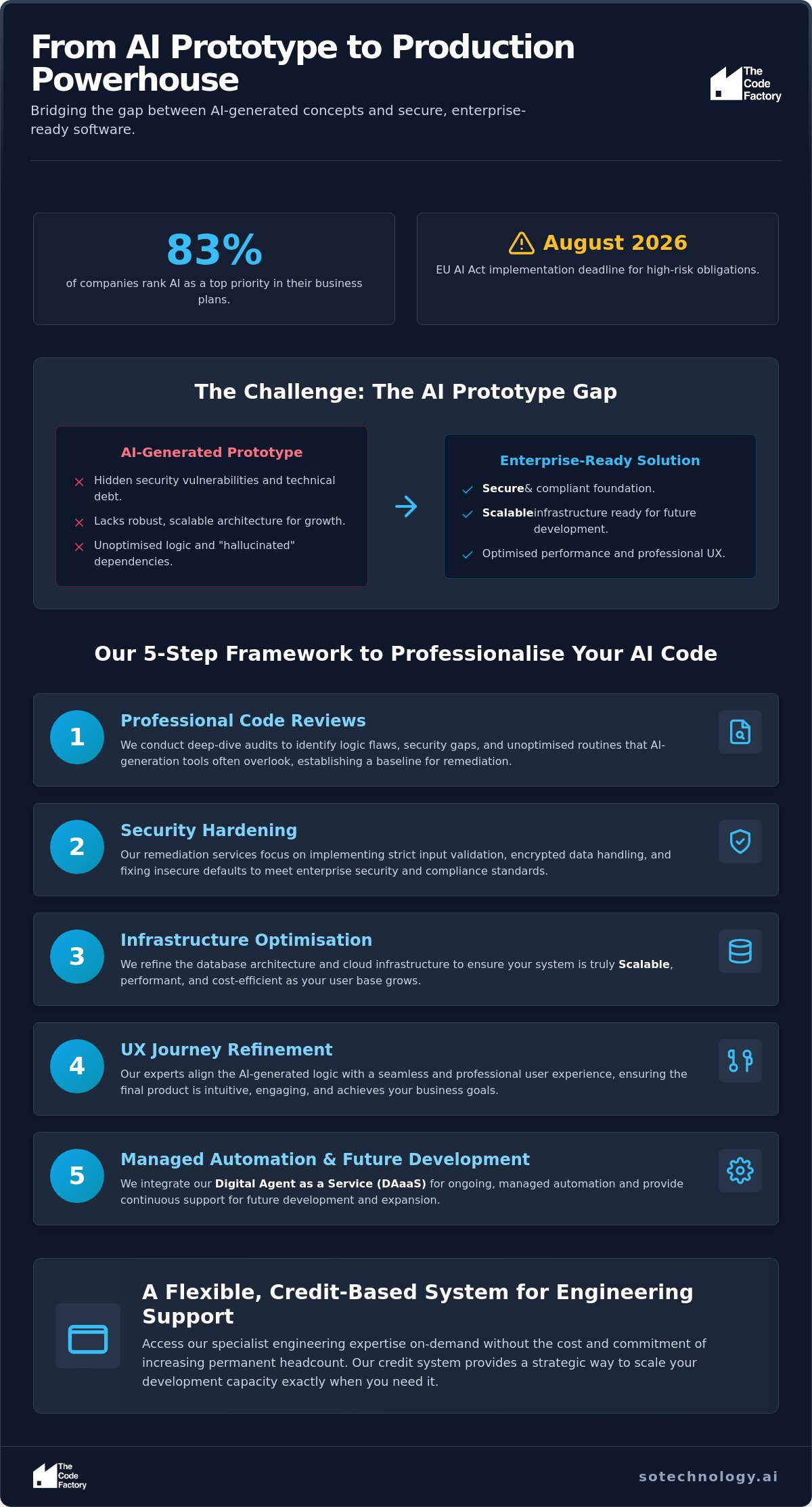
We’ve developed a five-step framework to help you bridge this gap and prepare your foundations for future development:
- Professional Code Reviews: Deep-dive audits to identify logic flaws and unoptimised routines AI often overlooks.
- Security Hardening: Implementation of strict input validation and encrypted data handling to meet enterprise standards.
- Infrastructure Optimisation: Refining database architecture to ensure your system is Scalable and efficient.
- UX Journey Refinement: Aligning AI-generated logic with a seamless, professional user experience.
- Managed Automation: Integrating Digital Agent as a Service (DAaaS) to provide ongoing, managed automation that evolves with your business.
Utilizing DAaaS ensures your project doesn’t remain a static prototype but becomes a dynamic asset capable of handling complex workflows. If you’re ready to see how these steps apply to your specific project, you can book a discovery meeting with our team to discuss your roadmap.
Ensuring Security and Scalability in AI-Built Foundations
AI-generated code frequently contains “hallucinated” dependencies or insecure defaults that create significant risks. Security hardening involves implementing robust authentication layers and patching vulnerabilities that initial AI tools might skip. Technical debt in the context of AI code generation represents the accumulated cost of unoptimised logic and security gaps left behind by rapid, automated prototyping. By addressing these issues early, you ensure your architecture is Secure and your infrastructure is optimised for long-term growth.
The Production Readiness Review: A Critical Transformation Milestone
A successful transition in ai in digital transformation culminates in a Production Readiness Review. This isn’t just a final check; it’s a strategic audit that covers everything from security protocols to how your software handles peak traffic. We use a flexible credit-based system to provide the exact engineering capacity you need for these reviews. This model allows you to access specialist expertise to transform a fragile prototype into a high-quality, long-term solution that empowers your business to grow with confidence.
Implementing AI-Driven Change with Strategic Engineering Capacity
Scaling your initiatives often hits a wall when internal teams lack the specific expertise to professionalise initial prototypes. While 77% of companies are currently exploring or using AI, many struggle to move beyond the experimental phase due to the rigidity of traditional hiring. Realising the full potential of ai in digital transformation requires a more agile approach to engineering capacity. We provide this through a flexible credit-based system, acting as a unit of engineering currency that lets you access specialist skills exactly when your project demands them.
This model eliminates the overhead of increasing permanent headcount while ensuring your software remains Secure and Scalable. Unlike traditional day-rate consulting, which often prioritises hours worked over results, our approach focuses on tangible outcomes. By using recurring service subscriptions, you ensure that your AI tools receive the ongoing Support & Maintenance necessary for long-term success. It’s about moving from a one-off build to a continuous lifecycle of improvement and expansion.
The Credit-Based Model: Flexible Support for Future Development
The beauty of a credit-based system lies in its versatility. You can allocate credits across various needs, from urgent bug fixes to the roll-out of new features for future development. If your priorities shift mid-month, your engineering capacity shifts with you. Our model includes a roll-over policy that ensures your investment is never wasted, providing a predictable yet adaptable way to scale your digital infrastructure as your business evolves. It’s a modern solution for a fast-moving field.
Why Outcome-Focused Partnerships Outperform Traditional Outsourcing
True transformation isn’t a commodity you can buy by the hour; it’s a collaborative journey toward better business performance. We position ourselves as a partner invested in your success, offering fractional CTO-level guidance through our Discovery & Strategy services. This ensures that every technical decision aligns with your high-level commercial goals. By focusing on Digital Agent as a Service (DAaaS) and managed automation, we help you build a resilient enterprise that doesn’t just use AI, but thrives because of it.
Professionalising Your AI Roadmap for 2026 and Beyond
The transition from an AI-generated prototype to a production-ready system is a defining moment for any modern business. We’ve explored how professionalising your foundations ensures your software is Secure, Scalable, and ready for future development. By moving beyond the initial generation phase, you eliminate technical debt and position your organisation to meet the rigorous standards of the 2026 landscape.
Integrating ai in digital transformation isn’t just a technical upgrade; it’s a strategic commitment to quality and longevity. Our outcome-focused credit-based delivery model provides the flexible engineering capacity needed to refine your vision into an enterprise-grade reality. As a global partner for digital solutions, we’re here to bridge the technical gap so you can focus on driving measurable business value.
Book an AI Discovery Workshop to start your transformation journey and secure your software’s future today. Your journey from initial AI creation to high-quality engineering is a path we’re ready to walk with you. Let’s build something robust together.
Frequently Asked Questions
What is the role of AI in digital transformation for 2026?
In 2026, the role of ai in digital transformation focuses on moving beyond simple task automation to creating autonomous systems that influence core software architecture. It involves operationalising AI to drive measurable value while adhering to high-risk obligations under the EU AI Act. This strategic shift ensures that intelligent automation acts as a foundational layer of the enterprise rather than just a standalone tool.
How do I manage technical debt in code generated by AI?
Managing technical debt starts with professional code reviews to identify unoptimised logic and security vulnerabilities inherent in rapid AI generation. You should prioritise refining these foundations to ensure they’re secure and scalable before adding new features. Using a structured support system allows for ongoing maintenance, ensuring that initial code generation doesn’t become a long-term liability for future development.
What are the benefits of a credit-based engineering model for AI projects?
A credit-based engineering model provides a flexible unit of currency that allows you to access specialist expertise without the overhead of permanent hiring. It enables you to scale your engineering capacity up or down based on the specific needs of your project lifecycle. This modern approach ensures you have the right support for everything from discovery workshops to production-readiness audits exactly when you need it.
Can AI-built prototypes be used for enterprise-level production?
AI-built prototypes can serve as the foundation for enterprise production, provided they undergo rigorous security hardening and architectural refinement. While AI is excellent for initial creation, enterprise standards require code that’s robust, secure, and scalable. Professional intervention bridges this gap, transforming a functional prototype into a high-quality solution that can support ongoing growth and complex ai in digital transformation initiatives.