Your AI-generated prototype isn’t a finished product; it’s a high-speed invitation to technical debt. While AI tools allow you to manifest an idea in hours, the resulting code often lacks the structural integrity required for a truly scalable web application architecture. You’ve likely noticed that while the initial build feels like magic, maintaining it often feels like navigating a minefield of unexpected downtime and hidden security vulnerabilities.
We recognize the frustration of watching a promising tool hit its ceiling just as your user base begins to grow. This article provides a clear roadmap to transform those fragile foundations into a secure, robust system ready for the demands of 2026. You’ll learn how to bridge the gap between initial AI creation and professional engineering standards, ensuring your platform is prepared for long-term future development. We’ll also explore how our flexible credit-based system provides the expert engineering capacity you need to stabilize and expand your vision with confidence.
Key Takeaways
- Identify the “AI Prototype Trap” and learn how to recognize the specific technical debt that currently limits your application’s growth.
- Determine the most effective scalable web application architecture for your business by comparing the streamlined modular monolith with high-performance microservices.
- Establish a Secure and resilient production environment through professional technical debt assessments and expert-led code reviews.
- Build a foundation for seamless future development by implementing engineering best practices, including automated testing and robust CI/CD pipelines.
- Utilize a flexible, credit-based system to access high-level engineering capacity exactly when your project moves from initial generation to enterprise-grade expansion.
Defining Scalability: Moving Beyond AI-Generated Prototypes
Scalability isn’t just a technical metric; it is your digital infrastructure’s ability to handle increased load without compromising performance or security. AI tools have made it incredibly easy to launch a proof of concept, yet these tools often lack the strategic foresight required for a robust scalable web application architecture. For many organizations, partnering with PurpleCow Digital Marketing ensures that strategic website design and development are integrated into the project’s vision from the very beginning. The reality is that a prototype built in an afternoon isn’t designed to support thousands of concurrent users or complex data interactions.
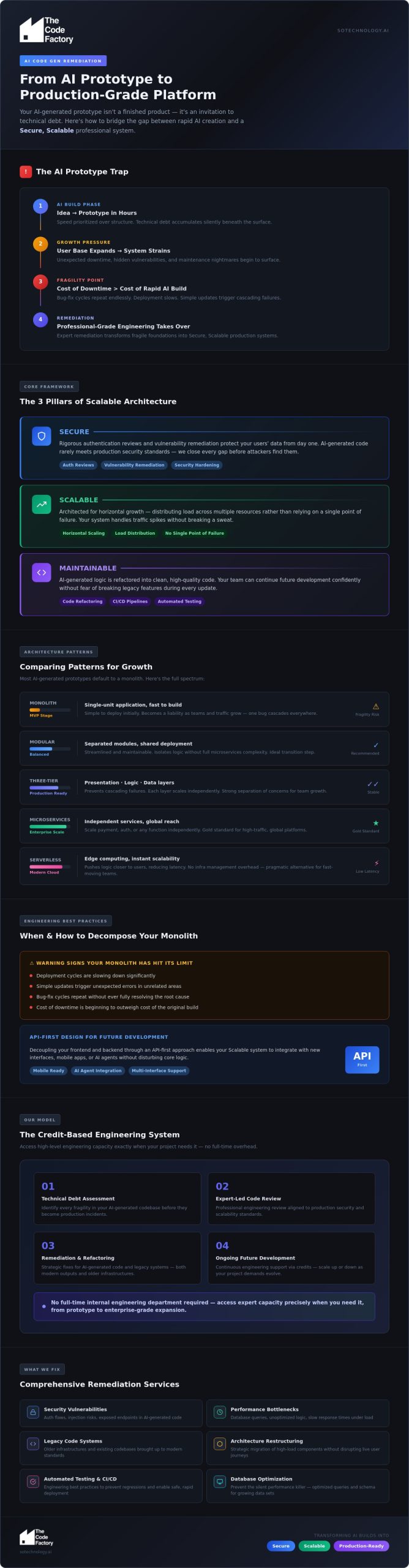
Many founders fall into the “AI Prototype Trap.” This occurs when initial generation tools prioritize speed over structure, creating technical debt that hinders future development. You eventually reach a “Fragility Point” where the cost of downtime and repetitive bug fixes exceeds the initial savings of rapid AI coding. Bridging this gap requires a transition to professional-grade engineering. By implementing a multitier architecture, you can separate your logic, data, and presentation layers to ensure stability and long-term growth.
The Three Pillars of Scalable Web Application Architecture
To ensure your application is production-ready, we focus on three essential areas that turn a fragile script into a resilient platform:
- Secure: We perform rigorous authentication reviews and vulnerability remediation to ensure your users’ data is protected from day one.
- Scalable: We architect for horizontal growth, allowing your system to handle traffic spikes by distributing the load across multiple resources rather than relying on a single point of failure.
- Maintainable: We refactor AI-generated logic into high-quality code. This ensures that your team can continue future development without the fear of breaking legacy features.
Our credit-based system provides you with flexible access to this expert engineering capacity. It allows you to transform your AI-built foundations into a Secure, high-quality solution that is ready for the market’s demands without the overhead of a full-time internal engineering department.
Comparing Architectural Patterns for Growth
The path to a scalable web application architecture isn’t a one-size-fits-all journey. Most AI-generated prototypes default to a monolithic structure because it’s the fastest way to manifest an idea. While a monolithic build offers simplicity during the MVP phase, it quickly becomes a liability as your user base expands. To ensure stability, many organizations transition toward a three-tier architecture. This separates your presentation, logic, and data layers, preventing a single bug from cascading through your entire system.
For organizations aiming for global reach, microservices represent the gold standard. By breaking your application into independent services, you can scale specific functions like payment processing or user authentication without over-provisioning the rest of your environment. If managing complex infrastructure feels like a distraction from your core mission, serverless and edge computing offer a pragmatic alternative. These modern cloud capabilities provide instant scalability and push logic closer to your users, significantly reducing latency. However, your choice of data structure remains the silent killer of performance. Even the most advanced architecture will fail if your database isn’t optimized to handle the weight of your growing data sets.
When to Decompose Your Monolith
You’ll know your AI-built monolith has reached its limit when deployment cycles slow down or simple updates trigger unexpected errors. The transition doesn’t require a total rewrite. We focus on strategic technology implementation, identifying and migrating high-load components into independent services. This incremental approach ensures your user journey remains uninterrupted while we strengthen your foundation for future development.
API-First Design for Future Development
Decoupling your frontend and backend through an API-first approach is essential for scaling modern teams. This flexibility allows your Scalable system to integrate with new interfaces, mobile apps, or even AI agents without disturbing the core logic. Our flexible credit-based system allows you to access this level of engineering expertise exactly when you need it. If you’re ready to evaluate your current setup, you can book a discovery meeting to map out your transition from prototype to production.
Ensuring Production-Readiness: Security and Flexible Engineering
Launching a prototype is a significant milestone, but securing that prototype for a production environment is a distinct challenge. AI-generated code often follows “happy path” logic; it works perfectly when everything goes right but can fail unpredictably under stress or malicious attack. A scalable web application architecture requires more than just a cloud subscription. It demands a rigorous Technical Debt Assessment to identify where AI-built logic might compromise your system. This assessment serves as your baseline for stability, ensuring your foundation is Secure before you invite thousands of users to interact with your data.
True engineering excellence involves moving beyond manual fixes to automated, resilient systems. Implementing CI/CD pipelines and automated testing ensures that every new feature added during future development doesn’t break existing functionality. While AI can write code quickly, expert human Code Reviews remain essential to validate its logic against complex real-world edge cases. For those looking for a deeper dive into these structural patterns, this comprehensive guide to web application scalability provides academic depth on load balancing and caching strategies that support high-traffic environments.
Security Hardening for Global Scaling
Scaling globally means meeting diverse compliance standards and defending against sophisticated threats. We move your project from “it works” to “it is secure” through deep authentication reviews and proactive vulnerability remediation. We don’t wait for a breach to happen. Instead, we identify potential failure points early to maintain your business continuity and protect your reputation as you grow. For instance, if your infrastructure relies on WordPress, you can learn more about Digital Junction and their specialized care plans designed to ensure long-term stability.
Flexible Engineering with The Code Factory
Most technical guides focus on infrastructure tools like AWS or Azure, but they ignore the human capacity needed to manage them effectively. This is where The Code Factory changes the equation. Our credit-based system allows you to access high-level engineering specialists without the overhead of full-time hiring. You get outcome-focused capacity for architecture optimization, giving you a Scalable team that expands exactly when your project does. This model ensures you have the ongoing support required to maintain your competitive edge as you transition from a generator-built app to a professional-grade platform. A critical part of this transition is developing a cohesive enterprise application integration strategy that connects your AI-built components with your existing business systems, preventing the data silos that stall even the most promising digital initiatives. If your existing codebase is holding back your AI initiatives, our guide to integrating AI with legacy systems outlines a clear modernisation roadmap to help you move forward with confidence.
Strengthening Your Foundation for Sustainable Growth
Transitioning from an AI-generated proof of concept to a scalable web application architecture is the most critical phase of your project’s lifecycle. While AI provides the initial spark, professional engineering ensures that your platform remains resilient under the pressure of real-world traffic. We’ve explored how identifying technical debt early and choosing the right architectural patterns can turn a fragile build into a Secure, enterprise-ready solution.
Our team provides the specialist expertise required for technical debt remediation and the delivery of enterprise-ready AI solutions. We bridge the gap between initial generation and professional-grade standards through rigorous Code Reviews. By utilizing our flexible credit-based engineering capacity, you can access elite technical talent exactly when your project demands it. This modern approach keeps your future development agile, efficient, and ready for global expansion.
Don’t let technical debt stall your momentum. Secure your future development with a professional Code Review from SoTechnology and build with the confidence that your infrastructure is ready for whatever comes next. Your vision has the potential to grow, and we’re here to ensure your technology can grow with it.
Frequently Asked Questions
What is the difference between vertical and horizontal scaling?
Vertical scaling involves increasing the capacity of a single server, such as upgrading its CPU or RAM, while horizontal scaling expands your system by adding more machines to the network. Vertical scaling has a physical ceiling and creates a single point of failure. Horizontal scaling is the foundation of a scalable web application architecture because it allows for virtually unlimited growth and improved redundancy by distributing the load across multiple instances.
How do I know if my AI-generated code is ready for production?
Your AI-generated code is ready for production when it has passed a professional code review that validates its security, performance, and maintainability. Most AI tools generate “happy path” logic that works under ideal conditions but lacks the robust error handling required for real-world stress. You must conduct a technical debt assessment to ensure the foundation is Secure and capable of supporting future development without constant emergency patches.
Can I scale my web application without a massive in-house dev team?
You can absolutely scale your application without the overhead of a large in-house team by utilizing flexible engineering partnerships. Our credit-based system allows you to access specialist expertise on demand, providing the high-level capacity needed for architecture optimization without long-term hiring commitments. This model bridges the gap between initial AI creation and professional engineering standards, allowing you to focus on your core business strategy while we handle the technical expansion.
What are the most common security risks in scalable web architectures?
The most common security risks in a scalable web application architecture include broken authentication, insecure API endpoints, and sensitive data exposure. As systems become more distributed, the attack surface grows, making it easier for vulnerabilities to hide in the communication between services. Proactive security hardening and regular vulnerability remediation are essential to protect your users and ensure your platform remains resilient as it expands into new markets. Organizations that are also integrating AI with legacy systems must pay particular attention to these risks, as older codebases can introduce additional attack vectors when connected to modern AI-driven components.