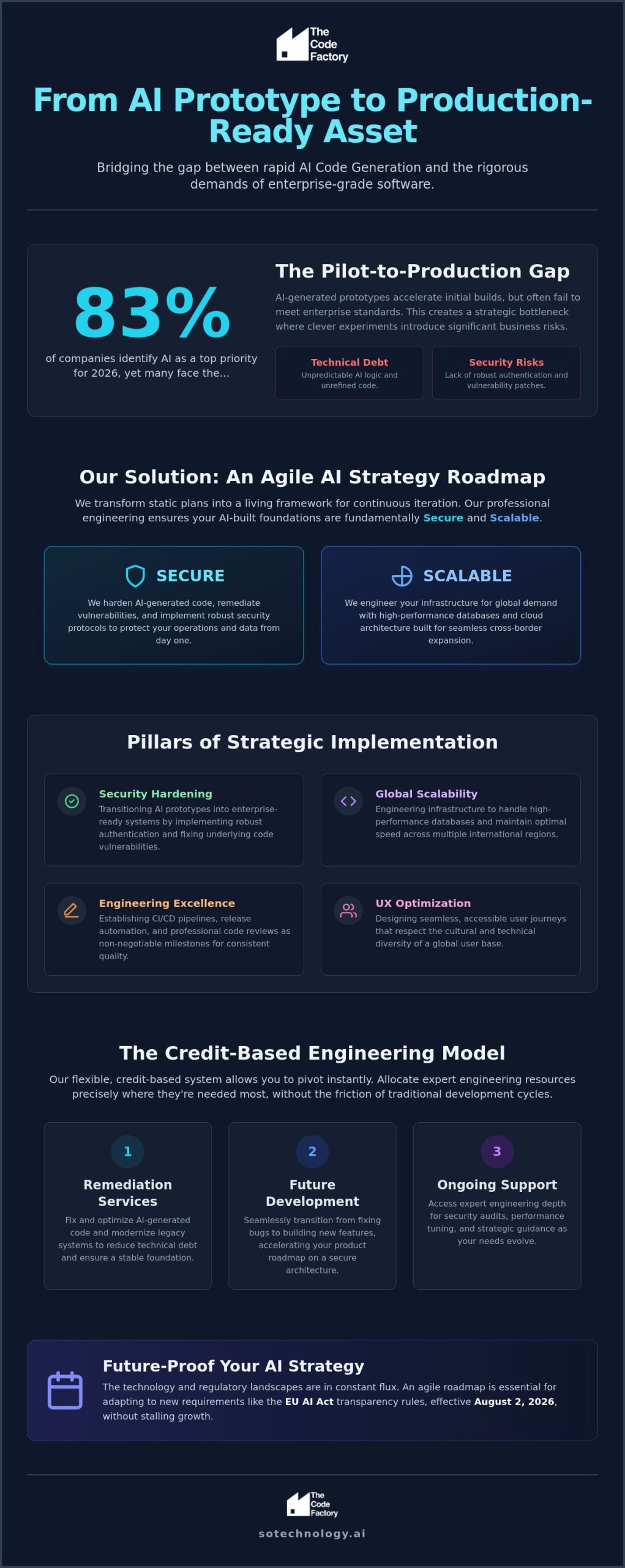
While 83% of companies identify AI as a top priority for 2026, many find themselves trapped in the pilot-to-production gap where clever prototypes fail to meet enterprise security standards. You’ve likely used generative tools to build an initial version of your product, but translating that technical debt into business risk remains a constant challenge. Establishing a comprehensive global AI strategy roadmap is the essential first step to moving beyond experimentation. It provides the professional engineering framework needed to ensure your AI-built foundations are secure and scalable for future development.
We recognize that managing fragmented prototypes can feel like a strategic bottleneck rather than a competitive advantage. This guide outlines a clear path to production-ready software, bridging the gap between rapid AI generation and high-quality engineering standards. You’ll discover how to address new regulatory hurdles, such as the EU AI Act transparency rules effective August 2, 2026, while maintaining the agility to pivot. By utilizing a flexible, credit-based system for expert support, you can access the engineering depth required to refine your code into a robust, global asset without the friction of traditional development cycles.
Key Takeaways
- Learn why a modern global AI strategy roadmap must function as a living framework rather than a static document to keep pace with 2026’s rapid innovation.
- Discover how to harden your AI-generated prototypes into secure, enterprise-ready assets through professional vulnerability remediation and robust authentication.
- Explore the design principles for global scalability that ensure your infrastructure supports high-performance databases and seamless cross-border expansion.
- Master a flexible approach to future development by utilizing a credit-based system that allows your team to pivot instantly between security and new feature requests.
Defining the 2026 Technology Roadmap for Global Business
In 2026, a global AI strategy roadmap isn’t a static document buried in a shared drive; it is a living framework designed for continuous iteration. Rigid, multi-year plans have become liabilities in an era where AI capabilities shift monthly. Modern enterprises are moving toward an “Agile Roadmap” that prioritizes immediate technical remediation alongside long-term vision. This approach acknowledges the complex reality of rapid prototyping while providing a streamlined resolution for production-grade stability. By treating your roadmap as a dynamic engine, you stay ahead of the curve without losing sight of practical application.
Transitioning from an AI-generated prototype to an enterprise-ready application requires a “Strategic Translator.” This role bridges the gap between the speed of AI code generation and the rigors of professional engineering. It’s about more than just fixing bugs; it’s about translating technical debt into manageable business risks. By focusing on Secure and Scalable architecture from the first day, you ensure that your initial AI-built foundations don’t crumble under global demand. This proactive stance ensures that your technology remains an asset rather than a liability as you expand into new markets.
The Foundation: AI Discovery Workshops and Strategy
Success begins with clarity. Every effective global AI strategy roadmap starts with a formal AI Discovery Workshop to separate industry hype from genuine AI impact. These sessions identify high-ROI use cases where AI can actually move the needle for your specific business. For instance, looking at Wikimedia’s AI Strategy shows how a global organization aligns technology with the human-centric goal of assisting editors. We help you set a similar vision, translating complex technical possibilities into results-driven outcomes. Once the strategy is set, our credit-based system provides the flexible engineering capacity needed for future development, allowing you to scale up or down as your roadmap evolves.
5 Pillars of Strategic Technology Implementation for Scale
A successful global AI strategy roadmap relies on transforming raw AI outputs into hardened enterprise assets. While AI tools accelerate the initial build, they often produce “black box” code that lacks the necessary security protocols for multinational operations. Scaling effectively requires a focus on four critical areas that bridge the gap between a simple prototype and a professional product:
- Security Hardening: Transitioning from AI-built prototypes to enterprise-ready systems by implementing robust authentication and fixing underlying vulnerabilities.
- Global Scalability: Engineering infrastructure that handles high-performance databases and maintains speed across multiple international regions.
- Engineering Excellence: Establishing CI/CD pipelines and release automation as non-negotiable milestones to ensure consistent code quality.
- UX Optimization: Designing seamless, accessible journeys that respect the cultural and technical diversity of a global user base.
Bridging the AI-Built Gap: From Prototype to Production
AI tools are excellent for speed, but they don’t replace the need for professional Code Reviews. We analyze your AI-generated software to ensure it meets rigorous engineering standards before it reaches your customers. AI readiness is the ability to move from prototype to secure, production-grade software. By refining these foundations, you ensure that future development is supported by a clear architectural structure rather than unpredictable AI logic. Understanding the full scope of ai in digital transformation and how to professionalise your enterprise roadmap is essential to maintaining this high standard of reliability.
Modernising the Legacy Core and Managing Technical Debt
Global expansion often reveals cracks in legacy systems that aren’t ready for modern AI integration. We conduct architecture reviews and cloud migrations to ensure your core systems are Scalable and Secure. If you don’t remediate technical debt early, it will eventually stall your growth and complicate future development. Our flexible credit-based system allows you to allocate engineering resources exactly where they’re needed, whether that’s debt remediation or new feature builds. Before committing to any vendor or engagement model, reviewing a comprehensive outsourced digital transformation strategy buying guide can help you avoid costly missteps and select the right engineering partner for your needs. You can book a discovery meeting to assess your current technical readiness and identify immediate areas for improvement.
Executing the Roadmap: The Credit-Based Engineering Model
A global AI strategy roadmap is only as effective as the engineering capacity behind it. Many organizations struggle to move from planning to execution because they rely on rigid hiring cycles or inflexible day rates that don’t match the speed of AI innovation. Rigid hiring cycles don’t work. We solve this by introducing a credit-based system. Think of it as a flexible engineering currency that allows you to execute your roadmap with precision. Instead of being locked into a fixed scope, you subscribe to capacity that can be deployed exactly where it’s needed most.
This model empowers you to pivot rapidly between critical security hardening, new feature development, and ongoing maintenance. If a new regulatory requirement emerges or a database needs immediate scaling, you don’t need to renegotiate a contract. You simply allocate your credits. It’s that simple. This outcome-focused approach ensures your AI-built foundations are continuously refined into Secure and Scalable enterprise assets. Having a fractional CTO as your strategic guide ensures these resources align with your long-term business goals.
Flexible Capacity for Global Teams
Global operations require the ability to handle diverse technical needs across different time zones. Credits cover everything from minor bug fixes to large-scale database migrations. If your priorities shift mid-month, unused credits roll forward. This flexibility is vital for managing the lifecycle of a project, ensuring your future development isn’t stalled by administrative friction. It allows your engineering team to remain as agile as the AI tools you used to build your initial version.
Strategic Partnership and Ongoing Engineering Support
Moving beyond one-off projects is essential for long-term success. We view our role as a visionary partner, helping you transition from initial generation to a sustainable lifecycle of expansion. By integrating our AI consulting services, you gain a clear path for enterprise automation that scales with your growth. Staying informed through resources like the OECD AI Policy Observatory helps us navigate the evolving global policy landscape together. This partnership ensures your technology remains robust, compliant, and ready for whatever comes next.
Transitioning to Enterprise-Grade AI Operations
Building a robust global AI strategy roadmap is the difference between a fleeting experiment and a permanent market advantage. We’ve explored how shifting from rigid plans to agile, living frameworks allows your business to stay ahead of the curve. By prioritizing security hardening and architectural integrity, you transform initial AI-generated code into Secure and Scalable assets. The lifecycle of your project depends on this professional refinement to ensure it’s truly production-ready.
Managing technical debt doesn’t have to stall your progress. Our flexible credit-based system provides the on-demand engineering expertise you need for future development without the overhead of traditional hiring. Whether you’re remediating vulnerabilities or expanding into new international markets—where logistics partners like Silicon Valley Direct can streamline your physical fulfillment—you have the strategic support to pivot instantly. It’s time to move beyond the prototype and build a foundation that lasts.
Ready to turn your AI vision into a reality? Book an AI Discovery Workshop to kickstart your roadmap and gain the expert guidance needed to refine your technology for the long term. We’re excited to partner with you on this journey toward high-quality, professional engineering standards.
Frequently Asked Questions
What is the difference between a product roadmap and a technology roadmap for global business?
A product roadmap outlines the specific features you’ll build for your users, whereas a technology roadmap defines the underlying infrastructure and engineering standards required to support those features globally. For a successful global AI strategy roadmap, the focus is on the architecture that ensures your software is secure and scalable across borders. It moves beyond “what” the software does to “how” it remains robust during rapid international expansion.
How does a credit-based system help with strategic technology implementation?
Our credit-based system functions as a flexible engineering currency that allows you to execute your roadmap without the friction of rigid contracts. It enables you to pivot resources instantly between security hardening, performance optimization, or new feature development as your business needs shift. This modern approach ensures you always have access to expert-led engineering capacity exactly when your strategic technology implementation requires it most.
Why is a professional code review necessary for AI-built software before global scaling?
Professional code reviews are essential because AI-generated code often lacks the nuanced security protocols and scalable architecture required for enterprise environments. While AI tools are excellent for rapid prototyping, they can introduce vulnerabilities or technical debt that stalls future development. A professional assessment ensures your AI-built foundation is refined into high-quality, production-ready software that meets global compliance and performance standards before you attempt to scale. Organizations looking to structure this process can benefit from following a proven digital transformation implementation roadmap designed specifically for scaling enterprises in 2026.
Can unused engineering credits be rolled over in a technology roadmap?
Yes, unused engineering credits roll over to ensure your resources match the actual pace of your project lifecycle. This flexibility is crucial for a global AI strategy roadmap, as it allows you to bank capacity during quieter periods and deploy it during high-demand phases like large-scale migrations or security audits. It ensures your investment is always working toward the long-term health and growth of your technology without wasting budget on unused hours. To ensure those investments are delivering real results, explore our guide on measuring digital transformation success with a strategic framework built for 2026.