The era of simply chatting with your software is ending, as the focus shifts from dialogue to actual execution. You’ve likely felt the frustration of a chatbot that understands your problem but lacks the power to solve it. This tension defines the debate of conversational AI vs digital agents in 2026. While many businesses have experimented with basic AI prototypes, the confusion over terminology and the fear of deploying unscalable code often stall progress before real value is realized. It’s understandable to feel cautious when your goal is to bridge the gap between a clever interface and a secure, enterprise-grade system.
This article clarifies that distinction, moving you beyond the hype of simple dialogue toward autonomous action. You’ll learn how to professionalize your AI strategy by transforming experimental builds into robust, scalable solutions that play well with your legacy systems. We provide a clear framework for distinguishing these capabilities and a roadmap for maximizing your ROI through strategic remediation and purposeful development. By the end, you’ll see why the future of automation isn’t just about how well your tools talk, but how much work they actually get done.
Key Takeaways
- Move from simple interaction to autonomous execution by understanding how agents plan their own steps to reach specific goals.
- Grasp the critical distinctions between conversational AI vs digital agents to ensure you’re investing in tools that actually do work rather than just talking about it.
- Professionalize your AI-assisted builds by focusing on secure and scalable architectures that move beyond experimental prototypes.
- Seamlessly integrate new automation with your established infrastructure through expert remediation of both AI-generated and legacy code.
- Use a structured discovery process to identify the right automation path, ensuring your AI strategy aligns with long-term growth.
Defining the Shift: From Dialogue to Digital Agency
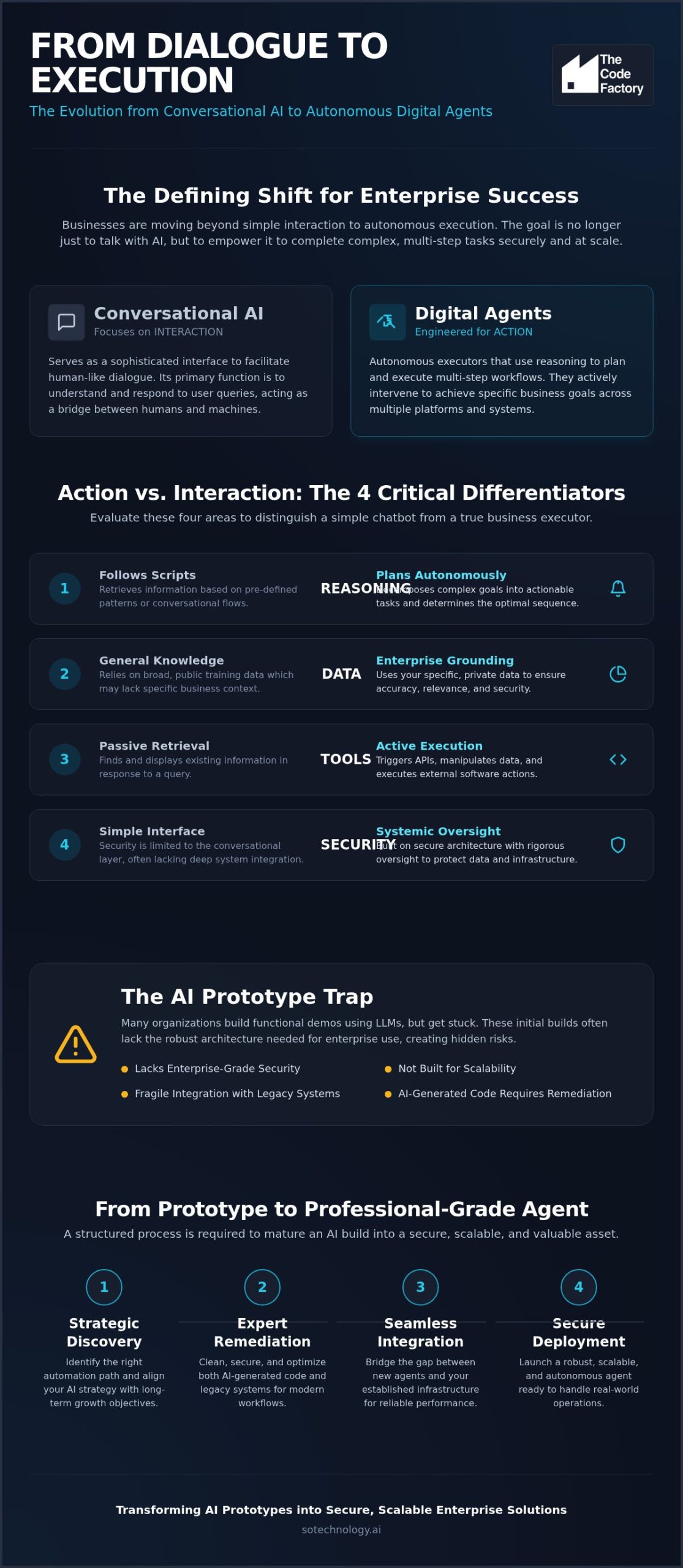
The distinction between conversational AI vs digital agents is becoming the defining factor for enterprise success in 2026. While conversational AI serves as a sophisticated interface focused on natural language processing, its primary goal is to facilitate human-like interaction. It acts as a bridge that helps humans communicate with machines more effectively. In contrast, digital agents are built to act. They are autonomous entities that use reasoning to execute multi-step workflows, moving beyond mere response to achieve specific business goals through direct intervention.
A Digital Agent is an autonomous executor of business strategy that orchestrates complex workflows rather than simply retrieving information.
The Evolution of the Interface
We’ve moved rapidly from the rigid, rule-based chatbots of the past to fluid, LLM-powered conversational interfaces. However, the real transformation lies in how intent recognition has matured into autonomous reasoning. By leveraging the principles of intelligent agents, modern systems no longer just identify what a user wants; they determine the best sequence of actions to deliver it. This shift represents a move from passive retrieval tools to active digital colleagues that can think through a problem before acting on it.
Why Businesses are Moving Beyond Chatbots
Reactive systems aren’t enough in a proactive market. A chatbot waits for a query, but a digital agent follows a directive through to completion across multiple platforms and legacy systems. Businesses are shifting their focus because they need to scale productivity by delegating entire tasks, not just managing information requests. This transition requires a move from fragile AI prototypes to secure, scalable software that can handle the weight of real-world operations. It’s about turning a conversation into a completed ticket, a processed order, or a resolved technical issue without constant human oversight.
Action vs. Interaction: The 4 Critical Differentiators
Understanding the distinction between conversational AI vs digital agents requires looking past the chat window. While one focuses on the quality of the conversation, the other focuses on the impact of the result. To build a system that moves the needle for your business, you need to evaluate four specific areas where agents diverge from simple chat interfaces.
- Reasoning and Autonomy: Chatbots follow a script or a retrieval pattern. Agents plan their own path to a goal.
- Data Grounding: Agents use enterprise-specific data rather than general training knowledge to ensure accuracy and relevance.
- Tool Use: Digital agents act as active participants by triggering APIs and executing external software actions.
- Security and Oversight: Moving from chat to action necessitates adherence to rigorous AI standards and frameworks to protect your data and infrastructure.
The Power of Agentic Reasoning
Agents don’t just respond; they decompose complex business goals into a series of actionable tasks. They evaluate the tools at their disposal and determine the most efficient sequence to reach an outcome. If a goal is too high-stakes for full autonomy, a “human-in-the-loop” model ensures your team stays in control of the final decision. This approach transforms AI from a query tool into a reliable collaborator. If you’re unsure where your current prototype sits on this spectrum, a brief discovery meeting can help clarify your path forward.
Integration with Legacy Systems
The most significant challenge for 2026 isn’t building the AI itself; it’s making it work with what you already have. Digital agents must bridge the gap between cutting-edge models and established legacy systems. This is where software remediation becomes vital. By cleaning and securing older codebases, we ensure your existing infrastructure can support modern agentic workflows. It’s about making your entire stack scalable and secure, turning fragile AI prototypes into robust enterprise solutions that actually deliver long-term value.
Professionalizing the Build: From Prototype to Scalable Agent
Many organizations find themselves caught in the “AI Prototype Trap.” It’s surprisingly easy to build a functional chat interface using modern LLMs, but these initial builds often lack the security and scalability required for enterprise use. When evaluating conversational AI vs digital agents, the risk isn’t just in the interaction; it’s in the underlying code. AI-generated code can be messy, fragile, and difficult to maintain. Transitioning these projects into professional-grade products requires a deliberate shift toward software remediation and robust architecture. Selecting the right enterprise AI agent framework is a critical first step in ensuring your architecture can withstand the demands of a production environment.
We specialize in turning these initial experiments into production-ready software. By applying expert remediation services, we bridge the gap between cutting-edge AI tools and established legacy systems. This process ensures your digital agents don’t just work in a vacuum but integrate seamlessly with your existing infrastructure. Achieving optimizing digital agent performance is an ongoing journey that demands continuous refinement and strategic foresight.
Our flexible, credit-based model supports this evolution. Rather than a one-off transaction, this system provides ongoing engineering capacity for future development and support. It allows you to scale your AI initiatives at your own pace, ensuring you have the technical proficiency available whenever you need to secure or expand your capabilities. This steady approach strips away the stress of technical uncertainty, giving you strategic control over your automation path.
Securing and Scaling Your AI Assets
Professional code reviews are essential for any AI-assisted build. We look for vulnerabilities that automated tools might miss, ensuring your sensitive company data remains protected. By implementing enterprise-grade security standards, we transform vulnerable prototypes into scalable assets that can grow with your business needs. It’s about moving from a proof-of-concept to a robust, secure enterprise solution.
Starting with an AI Discovery Workshop
Identifying where an agent outperforms a simple chatbot is the first step toward a high-ROI strategy. Our AI Discovery Workshops help you pinpoint high-impact use cases and build a concrete roadmap for AI in digital transformation. This structured approach ensures you choose the right path in the conversational AI vs digital agents landscape, focusing on autonomous execution rather than just dialogue.
Mastering the Shift to Autonomous Agency
The transition from reactive dialogue to proactive execution is the defining challenge for businesses in 2026. By focusing on agency rather than just interaction, you unlock a new level of operational efficiency that simple chatbots can’t match. Professionalizing your AI assets through rigorous code review and remediation ensures your builds are secure and scalable, protecting your enterprise from the fragility of unrefined prototypes.
Your path to a more efficient, automated future is within reach. Let’s work together to turn your initial AI experiments into robust, production-ready solutions that drive real results.
Frequently Asked Questions
Can a conversational AI chatbot be upgraded into a digital agent?
Yes, you can upgrade a chatbot, but it involves moving from simple intent recognition to autonomous reasoning. This process often requires remediation of the original AI-generated code to ensure it’s secure and capable of executing multi-step workflows. We focus on transitioning these initial dialogue-focused prototypes into active agents that can perform tasks within your existing business environment, effectively turning a talker into a doer.
What security risks are unique to autonomous digital agents?
Autonomous agents carry higher risks because they have the power to execute actions, not just provide information. This means you need a professional-grade security framework to prevent unauthorized API calls or data breaches. When choosing between conversational AI vs digital agents, you must prioritize a secure and scalable architecture that includes robust oversight and clear boundaries for autonomous behavior to protect your enterprise assets.
How do digital agents handle legacy systems and older software infrastructure?
Digital agents interact with legacy systems by serving as a sophisticated interface layer. We use software remediation to modernize older infrastructure, ensuring it can handle the requests and data flows required by modern AI tools. This allows you to leverage the power of new automation without needing to completely replace your established, reliable software foundations, bridging the gap between old and new.
Is Digital Agent as a Service (DAaaS) more cost-effective than hiring full-time developers?
Digital Agent as a Service (DAaaS) offers a more flexible alternative to traditional hiring through a credit-based engineering model. It provides access to specialized expertise for both development and ongoing support without the long-term overhead of a full-time team. This approach is particularly effective for businesses navigating the complex choice of conversational AI vs digital agents, as it allows for scalable growth based on actual project needs.