What if the AI prototype that saved you thousands in initial development ends up costing you millions in technical debt and security breaches? It’s a reality many leaders face as they realize that generating code is only the first step, and a misguided outsourced digital transformation strategy can quickly lead to wasted spend. With 70% of companies currently implementing transformation initiatives, the pressure to move fast is high, yet the risk of unrefined AI-generated code has never been greater. You likely agree that while AI tools offer a head start, the resulting infrastructure often lacks the security and scalability required for enterprise use. Navigating the 2026 regulatory environment, including the SECURE Data Act and new privacy laws in states like Kentucky and Rhode Island, requires a sophisticated, professional approach.
This guide will show you how to move beyond rigid, low-value contracts and professionalize your AI-driven projects with flexible engineering capacity. You’ll discover how to remediate technical debt in legacy systems and use a credit-based model to keep your technology hardened against modern threats. We will provide a clear roadmap to turn your initial prototypes into robust, enterprise-grade products that scale with your business while maintaining strategic control over your technical future.
Key Takeaways
- Learn how to shift from rigid project scopes to an outcome-based outsourced digital transformation strategy that prioritizes flexible engineering capacity.
- Discover the critical framework for professionalising AI-generated code by focusing on security hardening and scalability remediation.
- Identify why an AI Discovery Workshop is the essential first step to establishing a strategic roadmap and uncovering hidden technical debt.
- Explore the advantages of a credit-based engineering model as a flexible currency for ongoing support and future development.
- Understand how to bridge the gap between initial AI experimentation and robust, enterprise-grade products that meet 2026 regulatory standards.
What is an Outsourced Digital Transformation Strategy in 2026?
In 2026, Digital Transformation is no longer a one-time project but a continuous evolution of your business model. An effective outsourced digital transformation strategy involves the strategic acquisition of engineering capacity and expert guidance to professionalise your technical infrastructure. While traditional IT outsourcing often focused on cost-cutting and maintenance, modern strategies prioritise high-value outcomes and technical agility. This shift is essential because 2026 requires businesses to move beyond rigid, project-based contracts that can’t adapt to the rapid pace of AI development.
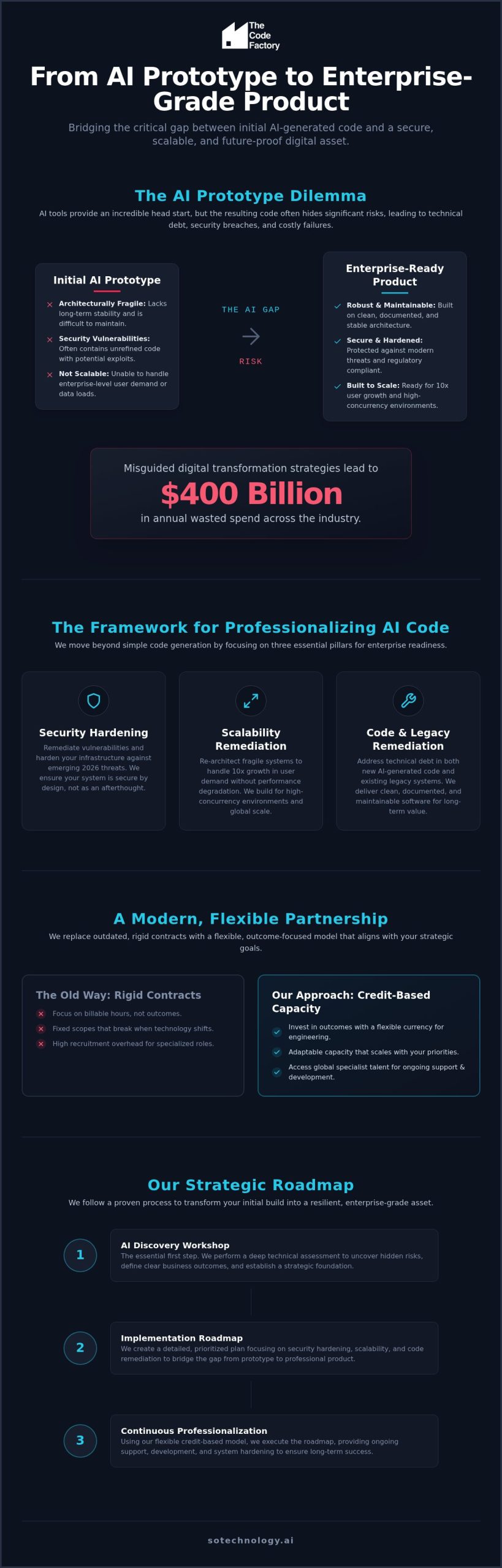
The AI Gap is the critical distance between an unrefined AI-generated prototype and a secure, scalable, enterprise-ready product. Bridging this gap requires more than just code generation; it demands sophisticated engineering that ensures your systems are hardened against modern threats and ready for global scale.
The Cost of Misguided Digital Transformation
Failed transformation efforts lead to nearly $400 billion in annual waste across the industry. This massive loss isn’t usually the result of poor technology, but rather a failure of strategy. Most organisations struggle with three primary roadblocks: internal skill gaps in emerging security standards, rigid roadmaps that break when technology shifts, and unaddressed technical debt from unrefined AI builds. Without a roadmap to professionalise these initial efforts, prototypes remain stuck in a fragile state, unable to support enterprise growth.
Why Organisations are Moving to Outsourced Models
Companies are increasingly avoiding the heavy recruitment overhead of permanent headcount for specialised roles. Instead, they seek access to global specialist talent that provides flexible capacity. They need Strategic Translators who can turn raw AI potential into tangible business value. These partners focus on measuring digital transformation success through long-term impact rather than just billable hours. By outsourcing, you gain the ability to scale your engineering team up or down based on current priorities, ensuring your budget is always aligned with your most critical outcomes.
The Framework for Evaluating an Outsourced Strategy Partner
Choosing an outsourced digital transformation strategy partner requires moving beyond standard procurement checklists. In 2026, the criteria have shifted from mere delivery to technical resilience. You need a partner built on three specific pillars: Security, Scalability, and Remediation. While many agencies can build new features, few possess the expertise to fix what’s already broken or unrefined. Successful firms use a robust framework for digital transformation to ensure every technical decision serves a specific business goal.
AI Readiness is no longer a luxury; it’s a fundamental requirement. A visionary partner understands how to integrate cutting-edge AI agents while simultaneously managing legacy systems. This dual capability ensures that new innovations don’t break established infrastructure. We advocate for a “Capacity vs. Hours” approach. Buying engineering capacity is superior to buying day rates because you’re investing in outcomes rather than just paying for someone’s time. This model provides the flexibility to pivot as your technology landscape evolves.
Security and Scalability: The Non-Negotiables
Security hardening and vulnerability remediation are essential components of modern web development. You shouldn’t just ask if a partner can build a platform; ask how they protect it against emerging 2026 threats. Evaluating a partner’s ability to scale involves looking at their architectural approach. A scalable system must handle a 10x growth in user demand without requiring a total rewrite. Your partner should provide proof of their ability to harden code and build for high-concurrency environments.
Professionalising AI-Generated Code
The rise of AI-built software has created an urgent need for enterprise-grade code reviews. Most AI-generated prototypes are functionally complete but architecturally fragile. A strategic partner bridges the gap between a raw prototype and a comprehensive digital transformation implementation roadmap. This transition ensures your code is clean, documented, and ready for long-term maintenance. If you’re ready to transition your AI build into a professional-grade product, you can schedule an AI initiative discovery meeting to assess your current technical standing.
Implementing a Flexible Strategy: Credits, Capacity, and ROI
Executing an outsourced digital transformation strategy in 2026 requires a departure from the rigid milestones of the past. Instead of locked scopes that become obsolete before deployment, we utilize a model built for the speed of modern innovation. This journey begins with an AI Discovery Workshop, a targeted session designed to audit your existing AI-generated builds and legacy systems. By identifying high-ROI use cases early, you ensure that every engineering hour is spent on initiatives that drive measurable growth and technical stability.
The core of this flexible approach is our credit-based engineering model. We treat credits as a versatile engineering currency that adapts to your changing business priorities. Whether you need an urgent security hardening patch or a deep-dive code review for a new AI agent, your credits provide the immediate capacity required. This system eliminates the friction of new contracts for every minor pivot, allowing your team to move with confidence without the burden of technical debt.
The AI Discovery Workshop: Your Strategic Starting Point
No transformation succeeds in a vacuum. Every engagement must begin with a workshop to map out your technical landscape and identify where AI in digital transformation can provide the most significant impact. We look beyond the hype to find practical applications that professionalise your existing prototypes. This step is crucial for uncovering hidden technical debt and ensuring your roadmap is both secure and scalable from day one, bridging the gap between a simple build and an enterprise product.
Achieving Long-Term Flexibility with Engineering Credits
We offer three distinct tiers, Start-Up, Growth, and Enterprise, to align with your specific organisational needs. Unlike traditional agencies where budget is lost to idle hours, our model ensures unused capacity rolls forward. This flexibility allows you to apply credits across various needs as they arise. You can focus on software remediation for legacy systems, security hardening to meet 2026 regulations, or implementing Digital Agent as a Service (DAaaS) for long-term automation ROI. By professionalising your roadmap with a global AI strategy roadmap, you turn technical uncertainty into a structured path for enterprise-grade success.
Professionalising Your Technical Future
A successful outsourced digital transformation strategy in 2026 is no longer a luxury; it’s a strategic necessity for businesses aiming to scale. You’ve discovered that true agility comes from a flexible credit-based model that replaces rigid day rates with outcome-driven engineering currency. By prioritising specialists who can remediate both AI-generated code and legacy systems, you ensure your products are secure, scalable, and ready for the demands of a global market.
The journey from a functional prototype to an enterprise-ready platform requires a methodical approach to security hardening and architectural refinement. Our model provides the ongoing support and technical proficiency needed to bridge that gap, allowing you to innovate with confidence. You can now move beyond the uncertainty of initial AI builds and focus on long-term growth and strategic foresight.
We look forward to helping you transform your technical challenges into a robust foundation for success.
Frequently Asked Questions
What is the difference between IT outsourcing and digital transformation outsourcing?
Digital transformation outsourcing focuses on the strategic acquisition of engineering capacity to evolve your business model rather than just maintaining current systems. While traditional IT outsourcing handles routine support and maintenance, an outsourced digital transformation strategy provides the expert guidance needed to professionalise AI-driven initiatives. It prioritises high-value outcomes like security hardening and scalability remediation, ensuring your technical infrastructure supports long-term growth.
How much does an outsourced digital transformation strategy cost in 2026?
Industry data for 2026 shows that mid-market digital transformation projects typically range from $150,000 to $1.5 million. Large enterprise overhauls can exceed $2 million with significant monthly recurring costs for ongoing support. These figures vary based on the complexity of your legacy systems and the depth of AI integration required. It’s essential to look beyond initial quotes and consider the value of reduced technical debt.
Can an outsourced partner work alongside my existing in-house developers?
A professional partner acts as a strategic translator to augment your existing in-house team rather than replacing it. This collaboration fills critical skill gaps in specialised areas like security hardening and scalability remediation without the recruitment overhead of permanent hiring. By working alongside your developers, an outsourced partner provides the flexible capacity needed to professionalise AI-generated code while your internal team remains focused on core priorities.
Why should I use a credit-based model instead of a fixed-price project?
A credit-based model provides a flexible engineering currency that adapts to the rapid pace of technical change. Unlike fixed-price contracts that lock you into rigid scopes, credits allow you to pivot resources toward your most urgent needs, such as remediation or new feature development. This ensures your budget is never wasted on idle hours, as unused capacity rolls forward to support your evolving outsourced digital transformation strategy.
What happens if we built our initial product using AI tools and now need to scale?
If your initial build used AI tools, the next step is a professional code review to identify vulnerabilities and architectural weaknesses. Most AI-generated prototypes require remediation to become secure and scalable enterprise-grade products. A strategic partner bridges this “AI Gap” by hardening the code and ensuring it can handle increased user demand while remaining compliant with 2026 data privacy regulations like the SECURE Data Act.
How do I measure the ROI of an outsourced transformation partner?
ROI is measured through tangible technical outcomes and business impact rather than billable hours. Key metrics include the reduction of technical debt, improved system uptime, and the speed at which you can deploy secure new features. By professionalising your roadmap, you also lower the long-term costs of maintenance and potential security breaches, turning your initial AI experimentation into a robust, scalable asset that drives sustainable revenue.